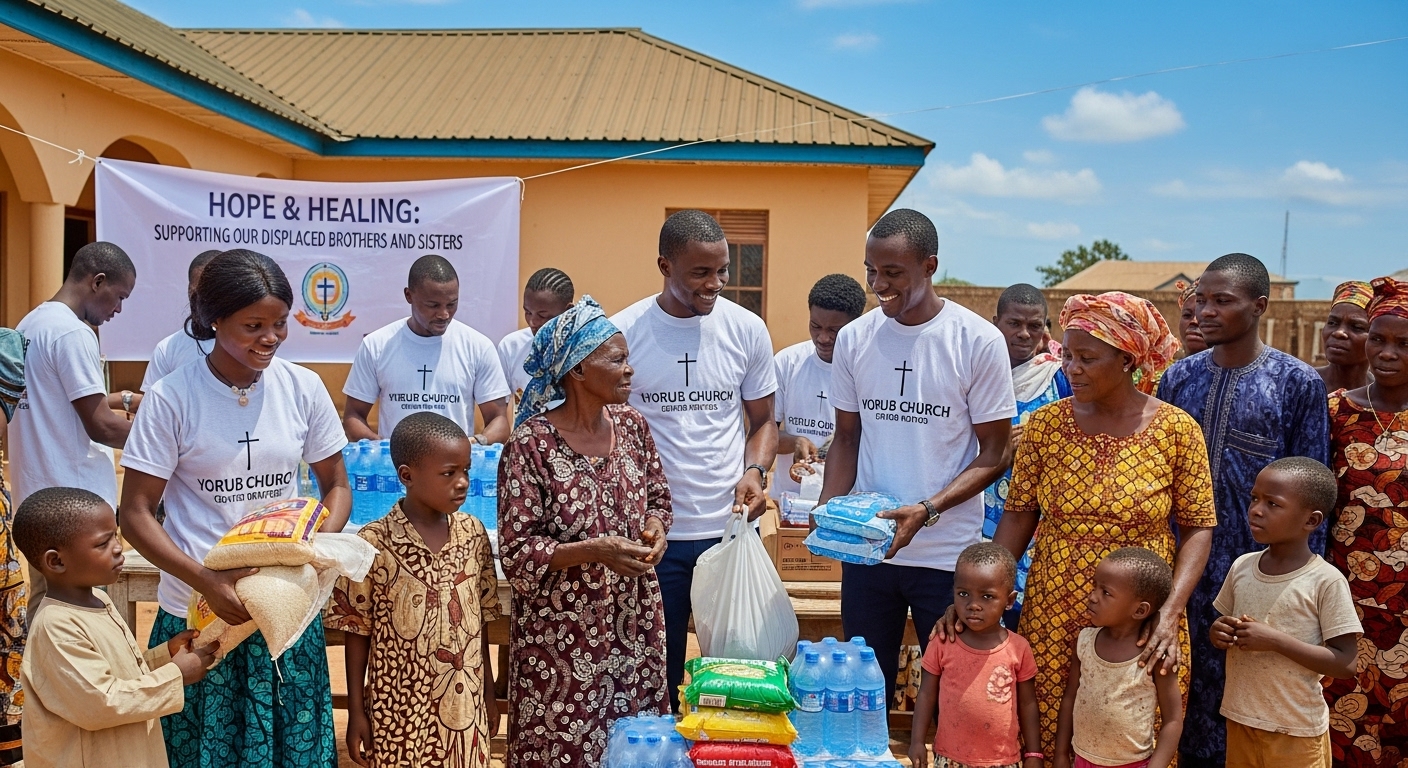
When 14-year-old Aisha arrived at the St. Francis Catholic Church relief camp in Maiduguri with nothing but the clothes on her back, she never imagined she’d leave two years later as a trained seamstress with her own small business. Her story is just one of millions that reveal a hidden revolution happening across Nigeria—where churches have become lifelines for the displaced, and surprisingly, young people are leading the charge.
The Silent Crisis That’s Reshaping Nigeria
Nigeria is facing one of Africa’s largest humanitarian crises. As of 2024, over 3.6 million Internally Displaced Persons (IDPs) have been forced from their homes due to Boko Haram insurgency in the Northeast, farmer-herder conflicts in the Middle Belt, banditry in the Northwest, and increasingly, devastating floods that have submerged entire communities.
But here’s what international headlines often miss: While government response struggles with bureaucracy and underfunding, Nigerian churches have quietly mobilized an unprecedented grassroots humanitarian network—and the most shocking part? Young Nigerians are driving this movement.
Why Churches Became the First Responders
When violence erupted in Plateau State in early 2024, forcing thousands to flee their villages, it wasn’t government trucks that arrived first. It was the Evangelical Church Winning All (ECWA) youth fellowship, armed with bags of rice, blankets, and smartphones coordinating relief efforts through WhatsApp groups.
The Trust Factor
Churches have become natural sanctuaries for IDPs for several compelling reasons:
Established Infrastructure: With over 89 million Christians in Nigeria, churches already have buildings, networks, and organizational structures in every corner of the country. When crisis strikes, these structures activate immediately.
Cultural Trust: In communities where traditional institutions have failed, churches maintain deep-rooted trust. A displaced Muslim family in Adamawa State told reporters they felt safer in a Christian church camp than in government facilities, citing better security and more consistent food supplies.
Apolitical Ground: Unlike government-run camps that can become politically contentious, church-operated shelters are seen as neutral ground focused solely on humanitarian needs.
The Youth Revolution in Nigerian Church Humanitarian Work
Here’s where the story takes an unexpected turn.
Young People Are Rewriting the Playbook
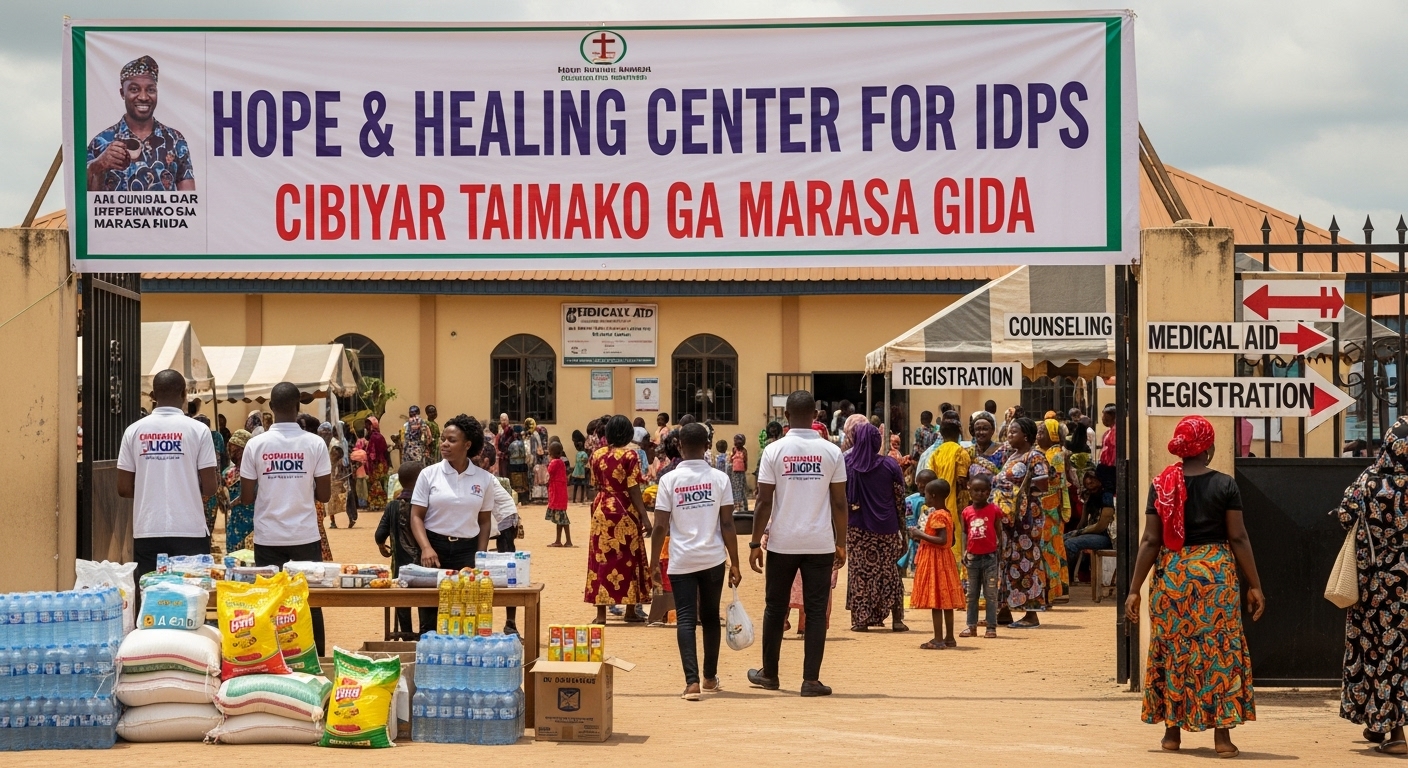
If you visit the Living Faith Church (Winners Chapel) IDP support center in Abuja, you’ll notice something striking: over 70% of the volunteers are under 35 years old. This isn’t coincidental—it’s a generational shift in how Nigerian churches approach humanitarian work.
Tech-Savvy Coordination: 28-year-old Chidinma Okafor runs a WhatsApp network of 5,000 youth volunteers across 12 states who respond to displacement crises within 48 hours. Using Google Forms and mobile money, her team has distributed over ₦45 million in aid since 2022.
“Our parents’ generation would hold committee meetings for weeks,” Chidinma explains. “We create a Telegram group, verify the need through video calls, and deploy resources the same day.”
Real Stories From the Field
The Maiduguri Model: At the Christ Embassy Church camp in Borno State, 23-year-old Samuel Yakubu established what he calls “Skills, Not Just Meals” program. Rather than just providing food, his youth team teaches IDPs marketable skills.
“We realized that giving people fish feeds them once, but these displaced persons might be here for years,” Samuel says. Since 2023, his program has trained over 800 IDPs in phone repairs, hair braiding, tailoring, and digital marketing.
The Plateau Peace Network: When sectarian violence displaced 15,000 people in Jos in early 2024, a coalition of youth groups from Catholic, Anglican, and Pentecostal churches created inter-faith trauma counseling centers. Led by 26-year-old Ruth Danjuma, a psychology graduate, the initiative paired young Christian and Muslim volunteers to provide counseling, deliberately building bridges while addressing trauma.
How Churches Are Actually Supporting IDPs: The Comprehensive Approach
1. Immediate Emergency Relief
When disaster strikes, church youth networks activate with surprising military precision:
- First 24 Hours: Youth evangelism groups often arrive before official aid organizations, distributing water, food packs, and blankets
- Mobile Kitchens: Churches like RCCG (Redeemed Christian Church of God) deploy youth-operated mobile kitchens that can serve 2,000 meals daily
- Medical First Response: Many church youth corps include medical students and young nurses who provide immediate health screening
The Catholic Diocese of Maiduguri, working with its youth wing, reportedly fed over 12,000 IDPs daily during the height of the Boko Haram crisis in 2023.
2. Shelter and Long-term Housing
Churches have converted seminaries, church halls, and even school buildings into IDP camps:
The Yola Model: The Lutheran Church of Christ in Nations (LCCN) in Adamawa State transformed its youth center into a model IDP camp housing 450 families. What makes it remarkable is that young architects and engineers volunteered to design dignified temporary housing with privacy partitions, solar lighting, and proper sanitation—a stark contrast to the overcrowded tents in many government camps.
3. Education for Displaced Children
Perhaps nowhere is youth involvement more impactful than in education:
Youth-Led Informal Schools: At the St. John’s Anglican Church camp in Abuja, university students created “The Hope School,” providing free education to 300 IDP children who would otherwise miss years of schooling.
24-year-old teacher Blessing Adewale explains: “These kids have witnessed horrors no child should see. We don’t just teach mathematics—we’re helping them recover their childhood.”
The schools use donated tablets, solar chargers, and downloaded educational apps to continue learning even without reliable electricity or internet.
4. Psychosocial Support and Trauma Counseling
Young Nigerian counselors and psychology students have pioneered culturally-sensitive trauma therapy:
Group Therapy Sessions: Youth volunteers at the Assemblies of God camp in Jos facilitate “Story Circles” where IDPs share experiences in their native languages, with trained young counselors guiding them through processing trauma.
Children’s Play Therapy: Youth volunteers have established play areas where displaced children can begin healing through structured play, art therapy, and drama—approaches rarely seen in traditional Nigerian aid programs.
5. Economic Empowerment and Skills Training
This is where church youth programs truly shine:
Microenterprise Development: The Deeper Life Bible Church youth department in Lagos runs “Marketplace Skills” program, teaching IDPs who’ve lost everything how to start small businesses. They provide initial capital through church youth fundraising and micro-grants.
Success story: 32-year-old Mohammed (a Muslim IDP) learned barbing skills at a Christian church vocational center in Yola. He now employs three other displaced persons in his shop.
Digital Skills Training: Young tech-savvy church members are teaching IDPs social media marketing, graphic design using free apps, and how to sell products online—skills that transcend displacement.
6. Agricultural Rehabilitation Programs
For IDPs from farming communities, young agricultural extension workers from churches help restart livelihoods:
The Christ Apostolic Church youth wing in Benue State donated seeds and farming implements to 200 displaced farming families and provided young volunteer agronomists to advise on cultivation in new locations.
7. Legal Aid and Documentation
Young Nigerian lawyers volunteering through church legal aid clinics help IDPs with:
- Replacing lost documents (birth certificates, IDs)
- Property rights protection
- Accessing government benefits
- Family reunification paperwork
The Youth in Politics Connection: Why This Matters
Here’s the revelation that connects everything: The humanitarian crisis is politicizing Nigerian youth like nothing before.
Young people working in church IDP programs are asking uncomfortable questions:
- “Why did the government fail to protect these communities?”
- “Where is the allocated humanitarian budget?”
- “How can we prevent future displacement?”
These questions are driving unprecedented youth political engagement.
From Humanitarian Work to Political Activism
Case Study: The #BringBackOurGirls movement that started in churches evolved into broader political activism. Many of its young leaders first became socially conscious through church humanitarian work with displaced families from Boko Haram areas.
Electoral Impact: In the 2023 elections, youth voter registration in displacement-affected states increased by 40%. Young church workers who witnessed government failures firsthand became polling agents, local council candidates, and political activists.
Twenty-nine-year-old Precious Chukwu, who started as a volunteer teacher in a church IDP school, now runs for local government office in Plateau State: “When you see children who can’t go to school because politicians diverted education funds, you realize voting is not enough—we must be in those offices.”
Challenges Nigerian Churches Face in Supporting IDPs
Despite remarkable efforts, church-led humanitarian work faces significant obstacles:
1. Funding Constraints
While international NGOs receive donor funding, most church IDP programs depend on:
- Sunday offerings
- Individual donations from church members
- Youth-organized fundraising events
The disparity means church camps often struggle with basic supplies while having stronger community integration than well-funded but bureaucratic NGO programs.
2. Security Risks
Young volunteers face real danger. In 2023, two youth church workers were kidnapped while delivering supplies to an IDP camp in Kaduna. The incident didn’t stop the program but highlighted the risks young Nigerians accept to serve displaced persons.
3. Burnout Among Young Volunteers
The enthusiasm of youth workers can mask serious burnout issues. Church leaders are learning to rotate volunteers and provide mental health support for those experiencing vicarious trauma.
4. Government Coordination
Some state governments view church humanitarian work with suspicion, creating bureaucratic obstacles. Progressive church youth leaders are learning to navigate these politics while maintaining independence.
5. Sustainability Questions
Can passion-driven youth volunteerism sustain long-term IDP needs? Churches are experimenting with hybrid models combining volunteers with trained, paid humanitarian workers.
Innovative Programs You Haven’t Heard About
The “Host Community Integration” Initiative
Young members of the Mountain of Fire and Miracles Ministries (MFM) in Abuja created a revolutionary program: instead of keeping IDPs isolated in camps, they connect displaced families with church members who host them in their homes.
The program includes conflict mediation training for youth volunteers, monthly check-ins, and financial support for host families. Over 200 families have been successfully integrated, with displaced children attending local schools alongside host children.
Digital Storytelling Project
Youth volunteers from multiple denominations created “Voices of the Displaced,” a YouTube channel and podcast where IDPs tell their stories in their own words. The project, managed entirely by volunteers under 30, has attracted over 500,000 views and helped raise awareness that led to increased donations.
The Mobile Clinic Revolution
Young medical professionals from Winners Chapel engineered solar-powered mobile clinics that travel to remote IDP settlements. The clinics provide primary healthcare, maternal services, and vaccination programs—filling gaps in government health services.
The Islamic-Christian Youth Collaboration
Perhaps the most hopeful development is interfaith youth cooperation:
In Kaduna, where religious tensions have historically run high, young Christians and Muslims jointly operate the “Kaduna Peace IDP Initiative.” Christian churches provide buildings and resources; Muslim youth organizations provide volunteers and cultural interpretation. Together, they serve IDPs regardless of religion.
“My grandmother would be shocked to see me, a Muslim, volunteering at a church,” laughs 25-year-old Abubakar Ibrahim. “But when you see suffering, religion becomes secondary. We’re all Nigerians trying to help other Nigerians.”
What This Movement Means for Nigeria’s Future
The convergence of church humanitarian work, youth volunteerism, and political awakening represents something unprecedented in Nigerian society:
A Generation Learning Practical Governance: These young people are essentially running mini-governments within IDP camps—managing resources, resolving disputes, providing services. They’re developing leadership skills that will shape Nigeria for decades.
Erosion of Apathy: The stereotype of disengaged Nigerian youth focused only on “japa” (emigrating) doesn’t match reality on the ground. Thousands are choosing to stay and serve their most vulnerable compatriots.
New Political Consciousness: Youth who witness government failures firsthand while providing superior church-based alternatives are unlikely to accept political excuses. They’re becoming a generation of informed, critical voters and potential leaders.
How You Can Support This Movement
For churches looking to start or enhance IDP support:
- Partner with youth groups – Don’t just assign youth to tasks; let them design and lead programs
- Invest in training – Send young volunteers for trauma counseling, project management, and humanitarian response training
- Create digital infrastructure – Help youth volunteers build apps, websites, and coordination systems
- Document and share – Success stories inspire replication across other churches
- Advocate together – Use your collective voice to demand better government IDP policies
For individuals:
- Donate to church humanitarian funds (often more efficient than large NGOs)
- Volunteer your skills (tech, medical, teaching, counseling)
- Mentor young church humanitarian workers
- Amplify IDP stories on social media
- Hold political leaders accountable for displacement prevention
The Questions We Must Ask
As we witness this remarkable youth-driven, church-based humanitarian movement, we must confront difficult questions:
Why are churches succeeding where government fails? Is it just resources, or is it accountability, innovation, and genuine compassion that make the difference?
What happens when these young volunteers become older? Will they maintain their idealism, or will Nigeria’s notorious system wear them down?
Can this movement scale? With displacement numbers potentially increasing due to climate change, can passion-driven church programs expand proportionally?
Will this translate to political change? Or will the same systemic issues that created the displacement crisis absorb and neutralize this youth energy?
Conclusion: A New Nigerian Story Being Written
When historians look back at this era of Nigerian crisis, they might write about terrorism statistics, displacement numbers, and government responses. But if you look closer—at the church hall in Maiduguri where young volunteers teach coding to displaced teenagers, at the mobile clinic staffed by twenty-something medical students in Borno, at the interfaith youth teams mediating conflicts in Plateau State—you’ll see a different story.
You’ll see a generation refusing to accept that “this is just how Nigeria is.” You’ll see young people channeling faith into action, empathy into expertise, and outrage into organization. You’ll see churches becoming what they claim to be: sanctuaries, not just for worship, but for the most vulnerable.
Aisha, the displaced teenager from the beginning of this story? She’s now 16 and runs a small tailoring business from the church vocational center. But more than that, she volunteers to teach newcomers—displaced persons who arrive traumatized and hopeless—the skills she learned. She’s part of a chain reaction of empowerment, started by young church volunteers who refused to let crisis be the final word.
This is how churches are supporting IDPs in Nigeria. This is how young people are reshaping both religion and politics in the process. And this is how a nation learns that sometimes its salvation comes not from politicians in Abuja, but from twenty-somethings armed with smartphones, faith, and an unshakeable belief that they can build something better.
The question isn’t whether Nigerian youth are impacting churches and humanitarian work—they’re revolutionizing it. The real question is: are we paying attention?
What’s your experience with church humanitarian work or youth activism in Nigeria? Have you witnessed similar innovations in your community? Share your stories in the comments below. And if this article moved you, share it—the more Nigerians know about these quiet heroes, the more we can support and replicate their life-saving work.
#NigerianChurches #IDPSupport #YouthActivism #NigerianYouth #HumanitarianWork #ChurchInAction #DisplacedPersons #NigeriaNews #FaithInAction #YouthLeadership