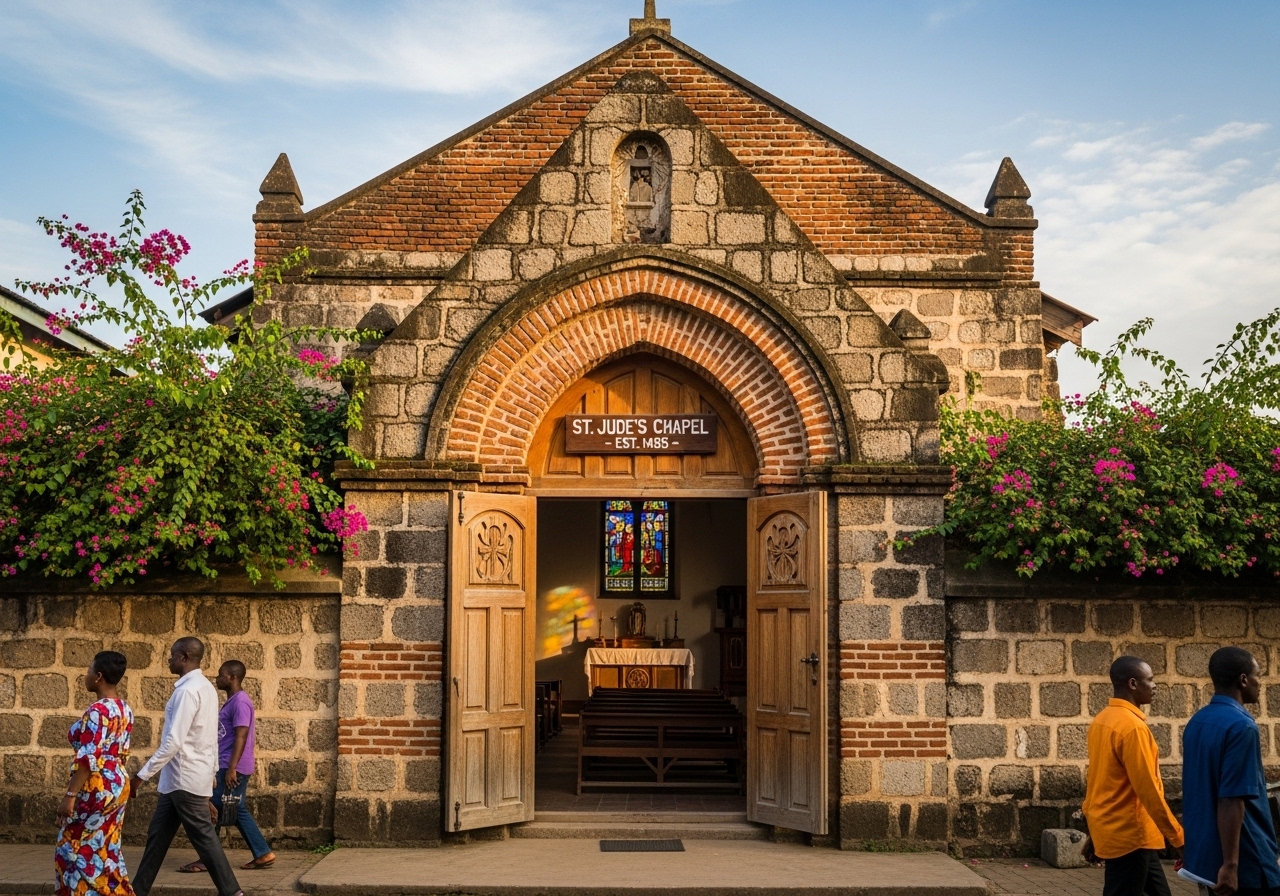
A Church Older Than You Think
If you ask most people in Benin City about the oldest church, they’ll probably mention Holy Cross Cathedral or Christ the King Catholic Church. And they’d be wrong.
Hidden in plain sight on Akpakpava Road sits a architectural gem that predates them all: Holy Aruosa Cathedral.
Built in 1506—yes, you read that right, over 500 years ago—this church has a story so fascinating, most Nigerians have never heard it.
Here’s the twist: it wasn’t originally a Christian church at all.
The Oba Who Met the Portuguese
Let’s rewind to 1486.
Portuguese explorers arrive in the powerful Benin Kingdom. The Oba at the time, Oba Esigie, is intrigued by these foreign visitors and their religion. Unlike many African rulers who would later resist Christianity, Esigie actually sends his son to Portugal to learn about Catholicism.
When his son returns, something remarkable happens. The Oba doesn’t convert to Christianity entirely, but he does something even more interesting—he creates a syncretic religious space.
Holy Aruosa (meaning “Holy Spirit” in the Edo language) becomes a bridge between traditional Benin religion and Christianity. Think of it as Nigeria’s first attempt at religious dialogue, centuries before modern interfaith programs.
What Makes This Church Special?
The Architecture
Holy Aruosa Cathedral doesn’t look like your typical church.
The original structure combined Portuguese architectural influences with traditional Benin design. The walls tell stories—literally. They’re decorated with brass plaques depicting both Christian and traditional Benin imagery, showing the cultural fusion that defined early Christianity in the region.
The Royal Connection
This isn’t just any church—it’s a royal church.
The Oba of Benin is traditionally the head of Holy Aruosa, making it one of the few churches in Nigeria with direct royal authority. Even today, important palace ceremonies sometimes include rituals at Holy Aruosa.
The Unique Worship Style
Step inside during a service, and you’ll experience something you won’t find anywhere else in Nigeria.
The worship blends Catholic liturgy with traditional Edo religious practices. There are prayers in Latin, Edo, and English. You’ll hear organ music alongside traditional drums. It’s Christianity, but not as you know it.
Why You’ve Never Heard of It
Here’s the uncomfortable truth: Holy Aruosa’s syncretic nature makes people uncomfortable.
Mainstream Christians often don’t acknowledge it because they see the traditional elements as “pagan.”
Traditional religionists sometimes view it as betrayal of pure Edo culture.
Historians argue about whether it even counts as a “real” church given its unique fusion.
So it exists in this fascinating limbo—too Christian for traditionalists, too traditional for Christians. The result? Most people just… ignore it.
What Happened to the Original Structure?
The 1897 British invasion of Benin Kingdom damaged many historical structures, including Holy Aruosa.
The original 1506 building was partially destroyed when British forces looted Benin City, taking the famous Benin Bronzes and destroying much of the kingdom’s architectural heritage.
What stands today is a reconstruction, built in the early 1900s on the same site, maintaining the original design as much as possible. Some original elements remain, making it still one of Nigeria’s oldest church structures.
Visiting Holy Aruosa Today
Location: Akpakpava Road, Benin City (near the Oba’s Palace)
Services: Held in Edo, English, and occasionally Latin
Best time to visit: Sunday mornings to experience the unique worship, or weekday afternoons for quiet exploration
What to expect:
- Friendly attendants who love sharing the history
- Beautiful brass decorations and historical plaques
- A peaceful atmosphere away from the city’s bustle
- Photo opportunities (ask permission first!)
Important: This is a sacred space. Dress modestly and be respectful of ongoing worship or ceremonies.
Other Historic Churches in Benin City
While Holy Aruosa takes the crown for oldest, Benin City has other historic churches worth exploring:
Holy Cross Cathedral (1930s) – The Catholic cathedral that most people think is the oldest
St. Paul’s Anglican Church (1950s) – Beautiful colonial architecture in the heart of the city
Christ the King Catholic Church (1960s) – Known for its towering spires
But none can match Holy Aruosa’s 500+ year legacy.
Why This History Matters
Holy Aruosa’s story challenges our assumptions about Christianity in Nigeria.
We often think of Nigerian Christianity as something imposed by colonial missionaries in the late 1800s. But Holy Aruosa proves that Nigerians were engaging with Christianity on their own terms much earlier—adapting it, questioning it, and making it their own.
It’s a reminder that African Christianity isn’t just imported Western religion. It’s a living tradition shaped by African initiative, creativity, and spirituality.
The Controversy Continues
Even today, Holy Aruosa sparks debate.
Some Christian leaders wish it would “fully convert” and drop the traditional elements. Some traditional chiefs wish it would abandon Christianity entirely. The church itself remains committed to its unique identity—neither fully one nor the other, but something distinctly Benin.
In a Nigeria increasingly polarized along religious lines, maybe Holy Aruosa’s 500-year-old experiment in religious fusion is more relevant than ever.
FAQs
Is Holy Aruosa a “real” church? That depends on your definition. It has Christian elements, conducts Christian liturgy, and identifies as a church. But it also maintains traditional practices most mainstream churches reject. You decide.
Can non-members visit? Yes! Visitors are welcome, especially on Sundays. Just be respectful.
Is it still connected to the Oba’s Palace? Yes. The Oba of Benin maintains ceremonial authority over Holy Aruosa.
Why isn’t it more famous? Its syncretic nature makes it controversial. Most churches don’t want to acknowledge it, and tourism boards aren’t sure how to market it.
Is it safe to visit? Absolutely. The area around Akpakpava Road is safe during daytime hours.
Final Thoughts
Next time you’re in Benin City, skip the usual tourist spots for an hour and visit Holy Aruosa Cathedral.
Stand in a building that has witnessed over 500 years of Nigerian history. A place that saw the rise and fall of the Benin Kingdom, survived British colonialism, and continues to exist today as a testament to Nigeria’s complex religious heritage.
It’s not perfect. It’s not mainstream. But it’s undeniably Nigerian—a story of adaptation, resistance, and survival that deserves to be told.
Have you visited Holy Aruosa Cathedral? Share your experience in the comments below!
Written for Networknewss.com.ng | Uncovering Nigerian church history