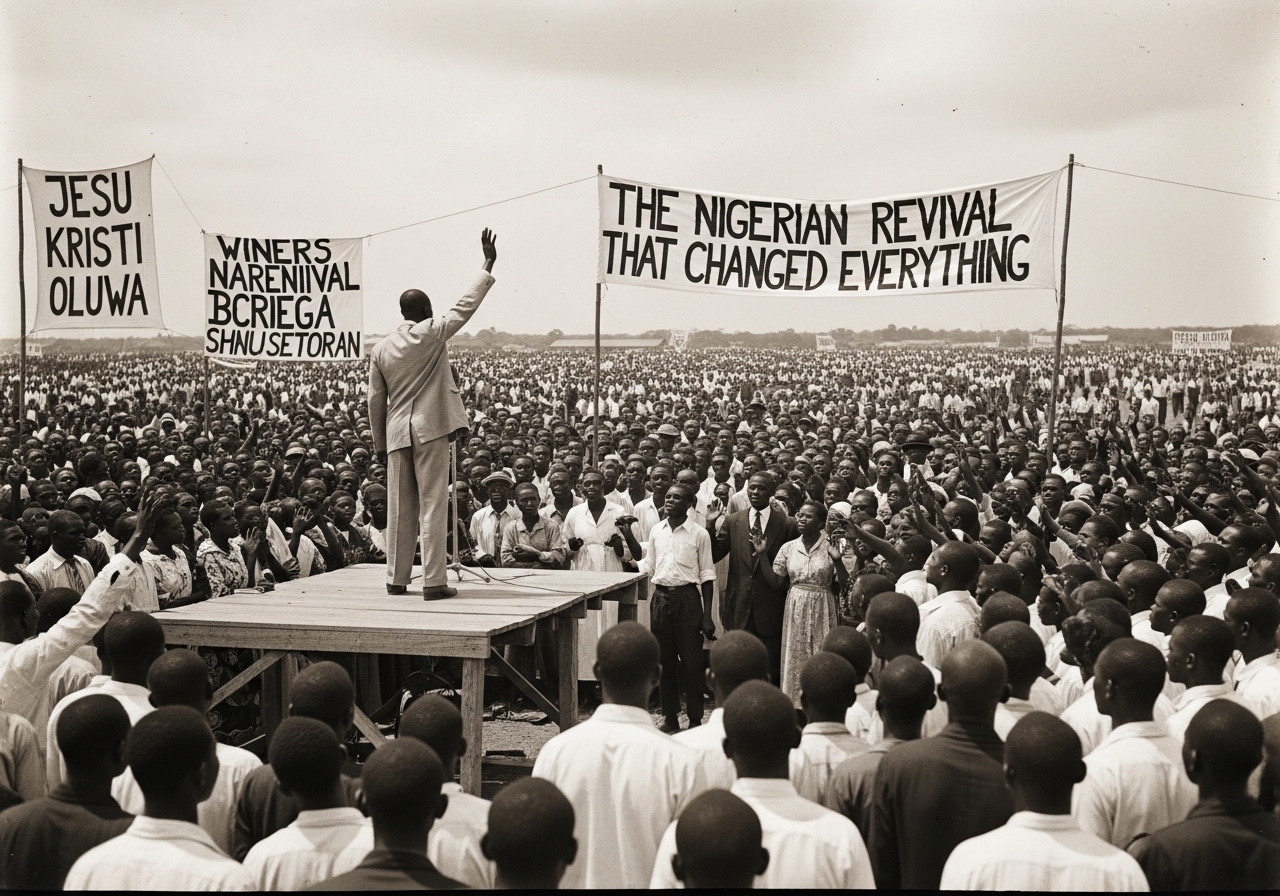
The Prophet Who Shook Colonial Nigeria
Picture this: It’s 1930. A young road construction worker in Ilesha, Osun State, suddenly collapses at work. His colleagues rush to him, thinking he’s having a seizure.
But Joseph Ayo Babalola wasn’t sick. He was hearing from God.
What happened next would spark the most significant spiritual awakening in Nigerian history—a revival so powerful that colonial authorities tried to shut it down, traditional rulers converted by the thousands, and the entire religious landscape of Nigeria was permanently transformed.
Yet most Nigerian Christians today have never heard his name.
How It All Started
Joseph Babalola was nobody special. Just a 28-year-old steamroller operator working on the Ilesha-Ogbomosho road.
But on that ordinary workday in July 1930, he received an extraordinary message: “Leave your work and go preach the gospel. Destroy all idols and use prayer and the water of life for healing.”
Babalola did something crazy—he actually obeyed.
He left his job (the equivalent of quitting a government job today) and started preaching in villages across Yorubaland. His message was simple but radical: “Turn from idols. Jesus heals. Repent and believe.”
The Miracle That Changed Everything
In October 1930, Babalola arrived in Oke-Oye, a small village near Ilesa. The town was in crisis—a smallpox outbreak was killing people daily. The traditional priests had tried everything. Nothing worked.
Babalola gathered the villagers and made a bold declaration: “If you burn your idols and turn to Christ, God will heal your sick.”
What happened next sounds like something from the Book of Acts.
The villagers burned their idols. Babalola prayed over water from a nearby stream. People who drank it began recovering from smallpox—not just a few, but hundreds. The epidemic stopped within days.
News spread like wildfire.
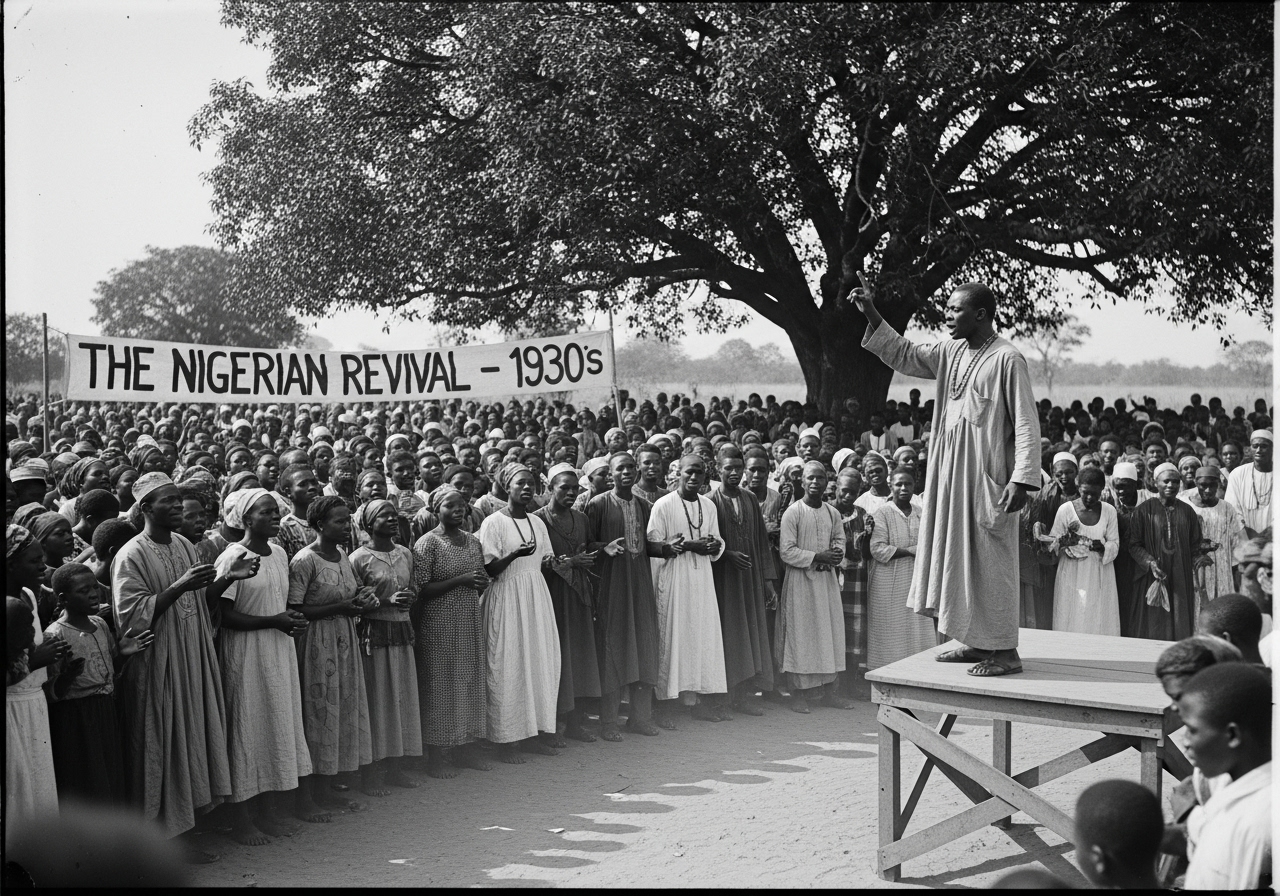
The Revival Explodes
Within weeks, thousands were trekking to wherever Babalola preached.
The scenes were wild:
- Massive bonfires of traditional religious objects
- People confessing secret sins publicly
- Healings happening left and right
- Entire villages converting overnight
- Traditional priests surrendering their charms
One eyewitness account described seeing “smoke from burning idols rising from villages across Yorubaland like sacrifices to heaven.”
The revival wasn’t just spiritual—it was social revolution.
What Made This Revival Different?
Unlike missionary Christianity that often came with European culture attached, this was African-led, African-style Christianity.
Babalola preached in Yoruba. He understood the culture. He directly confronted traditional religion on its own terms—not with theological arguments, but with power demonstrations that people could see and experience.
This wasn’t Western Christianity imported wholesale. This was Nigerian Christianity finding its own voice.
The Movement Grows
By 1931, the revival had spread beyond Babalola. Other revivalists emerged:
D.O. Odubanjo – A schoolteacher who joined the movement and helped organize it
Sophia Odunlami – A powerful female preacher (yes, women led too!)
Isaac Akinyele – An elite who abandoned his comfortable life to join
Together, they formed what would become the Christ Apostolic Church (CAC)—now one of Nigeria’s largest denominations with millions of members worldwide.
The Colonial Government Gets Nervous
Here’s what the British didn’t expect: a spiritual movement that threatened their control.
The revival was making people fearless. Converts stopped participating in forced labor. They questioned colonial authority. They organized independently of government oversight.
In 1932, colonial officials arrested Babalola, accusing him of “causing public disturbance.” They imprisoned him for 18 months, hoping to kill the movement.
It backfired spectacularly.
Babalola’s imprisonment only increased his legend. When he was released in 1933, the revival erupted even larger than before.
The Revival’s Lasting Impact
1. Birth of Indigenous Churches
Before the 1930s, Christianity in Nigeria was mostly mission churches—Anglican, Methodist, Catholic—led by Europeans or European-trained Africans.
The revival proved Africans could lead powerful Christian movements without European approval. It birthed the Aladura movement (praying people)—indigenous Pentecostal churches that emphasized prayer, fasting, healing, and spiritual warfare.
Today’s megachurches—RCCG, Winners Chapel, MFM—all trace their spiritual DNA back to this movement.
2. Prayer Culture
The revival established prayer as central to Nigerian Christianity. All-night prayer vigils, prayer mountains, fasting chains—all these became normal because of the 1930s revival.
Babalola would pray for hours, sometimes days. That intensity became the standard.
3. Healing Ministry
The emphasis on divine healing that characterizes Nigerian Christianity today? Started here.
Babalola’s healing ministry set the template: prayer + faith + anointed water = miracles. Sound familiar? Every healing service in Nigeria today follows this pattern.
4. Women in Ministry
While controversial then (and still debated now), the revival elevated women into leadership roles unusual for that era.
Women like Sophia Odunlami and Christianah Olatunrinle became powerful preachers with large followings. This opened doors that mission churches had kept firmly closed.
5. Mass Evangelism
Before the revival, Christianity spread slowly through mission schools and hospitals. The revival proved mass evangelism worked—one powerful preacher could win thousands in days.
This became the model: big crusades, miracle services, mass conversions. Every modern Nigerian evangelist follows Babalola’s playbook.
What Happened to Babalola?
After the explosive 1930s, Babalola continued ministering until his death in 1959.
He never sought fame or wealth. He lived simply, traveled constantly, and kept preaching the same message that started it all: “Repent. Believe. Jesus heals.”
When he died, thousands attended his funeral. Colonial officials who once imprisoned him now acknowledged his contribution to Nigerian society. Traditional rulers who once opposed him mourned his passing.
The Forgotten Legacy
Here’s the sad part: Despite fundamentally shaping Nigerian Christianity, Babalola is barely taught in churches today.
Why?
Partly because the revival happened outside missionary Christianity’s structure. Western church historians largely ignored it. Nigerian church history wasn’t systematically documented.
Also, denominational politics. Every group claims the revival heritage but downplays the others’ contributions.
The result? Most Nigerian Christians enjoy the fruits of the revival without knowing its roots.
Lessons for Today’s Church
1. Indigenous Leadership Matters
The revival succeeded because it was Nigerian-led and culturally relevant. Babalola didn’t import Western Christianity—he presented Jesus in ways Yoruba people understood.
Today’s most successful Nigerian churches follow this model: culturally grounded while biblically faithful.
2. Power Demonstrations Still Matter
Babalola didn’t win converts through arguments—he demonstrated God’s power through healing. In a culture familiar with spiritual power, he showed Jesus was more powerful.
Nigerian Christianity remains experiential, not just intellectual. We want to encounter God, not just know about Him. The revival established this.
3. Revival Threatens Establishments
Both colonial government and traditional religious authorities opposed the revival because it threatened their control.
Real revival always does. If everyone’s comfortable with your Christianity, you’re probably not doing it right.
4. One Person Can Change a Nation
Babalola was a road worker with no formal theological training. Yet his obedience to God’s call transformed millions of lives and shaped Nigeria’s spiritual trajectory for generations.
Never underestimate what God can do through ordinary people who say “yes.”
The Revival’s Ripple Effects
The 1930s revival didn’t just affect churches—it changed Nigerian society:
Education: Revival converts built schools across Yorubaland, increasing literacy rates
Healthcare: Emphasis on hygiene and prayer reduced disease
Social Reform: Converts abandoned harmful traditional practices
Women’s Rights: Female preachers challenged patriarchal norms
Indigenous Identity: Proved Africans could lead significant Christian movements
Some effects were problematic—excessive rejection of all traditional culture, sometimes replacing one fundamentalism with another. But overall, the revival’s societal impact was profound.
Why This Story Matters Now
Nigeria faces similar challenges today that it faced in the 1930s:
- Spiritual hunger amid moral crisis
- Need for indigenous solutions to our problems
- Desire for authentic spirituality that works in our context
- Search for heroes who represent true service, not just success
The 1930s revival reminds us that transformation is possible. That God still moves powerfully in Nigeria. That ordinary Nigerians anointed by God can change the nation.
We don’t need to import solutions from abroad. We have revival history right here.
FAQs
Was Joseph Babalola educated?
He had basic primary education and worked as a steamroller operator. His theological training came through the revival itself and mentorship from mission-trained pastors who joined the movement.
Is the Christ Apostolic Church (CAC) still around?
Yes! CAC is now a major denomination with churches across Nigeria and internationally. It’s headquartered in Ibadan.
Did the revival spread beyond Yorubaland?
Initially concentrated in Yoruba areas, the revival’s influence spread nationwide. Similar movements emerged in Igboland and other regions, partly inspired by news of the Yoruba revival.
What happened to the “anointed water” practice?
It remains controversial. Some churches continue using blessed water for healing, while others view it as unbiblical. The practice traces directly to Babalola’s ministry.
Are there books about this revival?
Yes, but they’re mostly academic or out of print. “The Aladura Churches in Nigeria” by Harold Turner covers it. More accessible popular histories are needed.
Final Thoughts
The next time someone claims Nigerian Christianity is too emotional, too focused on miracles, or too different from “proper” Christianity, remember the 1930s revival.
This is our Christianity. Born from our encounter with Jesus. Shaped by our culture and our needs.
Joseph Babalola and thousands like him didn’t copy Western Christianity—they experienced Jesus for themselves and expressed it in authentically Nigerian ways.
That’s not syncretism. That’s incarnation.
The gospel taking flesh in Nigerian soil, speaking Nigerian languages, addressing Nigerian problems.
The 1930s revival proved it could happen. The question is: can it happen again?
Have you heard about the 1930s revival before? Does your church trace its roots to this movement? Share in the comments!
Written for Networknewss.com.ng | History & Heritage