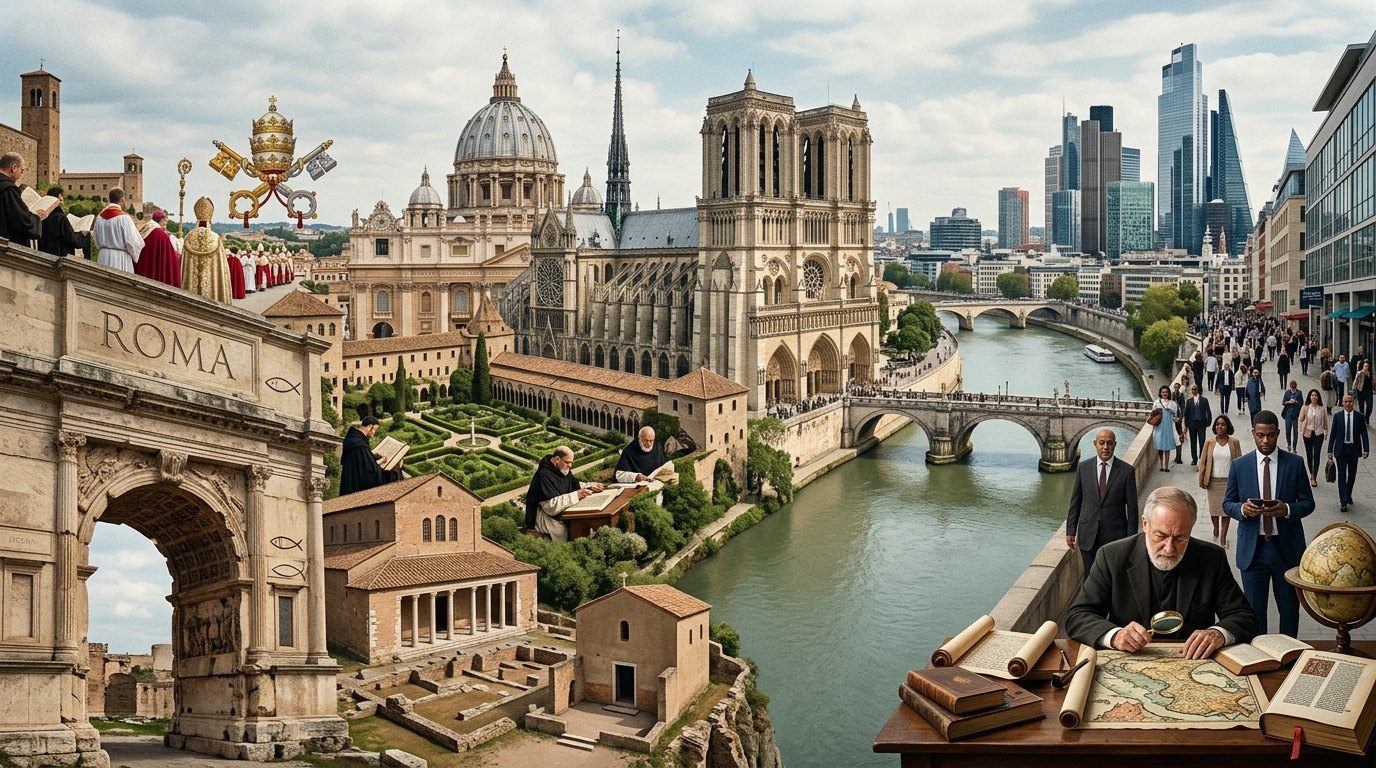
Few institutions in human history have shaped the world quite like the Catholic Church. With over one billion members today and a history stretching back two thousand years, it has been a force for education, charity, and spiritual comfort on one hand, and a participant in war, conquest, and suppression on the other.
To understand the Catholic Church honestly is to resist the temptation of two extremes: neither romanticizing it as a faultless divine institution nor dismissing it as nothing more than an engine of control.
The truth, as with most things that have endured for millennia, is far more layered.
The First Centuries: A Movement Born in Persecution
Christianity did not begin as a powerful institution. It began as a persecuted minority movement in the Roman Empire, built around the teachings of Jesus of Nazareth and spread by his apostles after his crucifixion around 30 AD. The early believers gathered in homes, worshipped in secret, and were periodically executed for their faith.
The Apostle Peter, regarded by Catholics as the first pope, was crucified upside down in Rome around 64 AD under Emperor Nero. Paul of Tarsus, whose letters form a large portion of the New Testament, was beheaded in the same city around the same period.
For nearly three centuries, Christians lived under the threat of imperial persecution.
The turning point came in 313 AD when Emperor Constantine issued the Edict of Milan, granting religious tolerance throughout the Roman Empire.
By 380 AD, under Emperor Theodosius I, Christianity had become the official state religion of Rome. The small persecuted movement had become the faith of an empire, a shift that would define the next thousand years of Western history.
The Rise of the Papacy and Medieval Power
As the Roman Empire declined in the West during the 5th century, the Bishop of Rome gradually assumed not just spiritual but political authority over large parts of Europe. Pope Leo I, who served from 440 to 461 AD, is widely credited with cementing the doctrine of papal supremacy.
When the Huns under Attila threatened Rome in 452 AD, it was Leo I who personally rode out to negotiate with them, a moment that cemented the papacy as a political force.
The Medieval period saw the Catholic Church reach the height of its earthly power.
Popes crowned and deposed kings. Church courts tried cases across Europe. Monasteries preserved classical learning during the so-called Dark Ages, and cathedral schools eventually gave rise to the first universities in Bologna, Paris, and Oxford. The Church also organized the Crusades, a series of military campaigns launched between 1095 and 1291 to recover the Holy Land from Muslim rule.
For Catholics, these were sacred wars. For the populations in their path, including Jewish communities massacred across the Rhineland in 1096 and Eastern Christians caught in the crossfire, the Crusades left a legacy of violence that history cannot overlook.
The Inquisition: A Dark Chapter That Demands Honesty
No honest account of Catholic history can avoid the Inquisition. Beginning in the 12th century and intensifying in the 15th and 16th centuries, particularly under the Spanish Inquisition established in 1478 by Ferdinand and Isabella, Church tribunals investigated, tortured, and in some cases executed those accused of heresy, witchcraft, or Jewish and Muslim practice in secret.
The Spanish Inquisition alone is estimated to have executed between three thousand and five thousand people over its roughly three-hundred-year history.
Historians debate the exact numbers and motivations behind the Inquisition, and some argue that its brutality has been exaggerated over centuries of anti-Catholic propaganda.
What is not in dispute is that real people suffered and died as a result of Church-sanctioned persecution. Galileo Galilei was forced to recant his support for heliocentrism in 1633 under threat of torture, a case the Church itself acknowledged as an error in 1992 under Pope John Paul II.
These episodes do not define the whole of Catholicism, but they are woven into its history, and a fair account requires naming them directly.
The Reformation and the Church’s Response
By the early 16th century, corruption within the Church had become impossible to ignore.
The selling of indulgences, payments that supposedly reduced time in purgatory, was widespread. Popes like Alexander VI, who served from 1492 to 1503, were notorious for nepotism and immoral conduct. In 1517, a German monk named Martin Luther nailed his Ninety-Five Theses to the door of a church in Wittenberg, sparking the Protestant Reformation. What followed was a split in Western Christianity that has never been fully healed.
The Catholic Church responded with the Counter-Reformation, a genuine effort at internal reform. The Council of Trent, which met from 1545 to 1563, addressed corruption, clarified doctrine, and raised the standard of priestly education.
The Jesuit order, founded by Ignatius of Loyola in 1540, became the intellectual and missionary vanguard of a renewed Catholicism, establishing schools and universities across Europe and sending missionaries to Asia, Africa, and the Americas. The reform was real, even if it came too late to prevent the permanent fracture of Western Christianity.
Catholicism, Colonialism, and the Mission Field
The story of Catholic missions is one of the most morally complex chapters in the Church’s history. When European powers began colonizing the Americas, Africa, and Asia from the 15th century onward, Catholic missionaries followed and in many cases preceded them.
In some places, missionaries like Bartolome de las Casas actively defended indigenous populations against colonial brutality. Las Casas documented the atrocities committed by Spanish colonizers in his 1542 work, A Short Account of the Destruction of the Indies, and spent decades arguing before the Spanish crown for the rights of native peoples.
Yet the Church was also entangled in systems of conquest and enslavement. The 1493 papal bull Inter Caetera issued by Pope Alexander VI effectively divided the newly discovered world between Spain and Portugal, providing theological cover for colonial expansion.
In Africa, Catholic missionaries often worked alongside or just behind colonial administrators, and the suppression of local cultures and religions was frequently part of the evangelical project. The full picture contains genuine sacrifice and genuine complicity, sometimes from the same institution, and sometimes from the same individual.
The Modern Church: Reforms, Scandals, and Reckoning
The Second Vatican Council, held from 1962 to 1965 under Popes John XXIII and Paul VI, represented the most significant internal reform of the Church in four centuries. Vatican II opened the Mass to be celebrated in local languages rather than Latin, promoted dialogue with other faiths, and affirmed religious freedom in ways that would have been unthinkable a century earlier. For many Catholics, it was a long-overdue breath of fresh air. For traditionalists, it went too far and too fast.
The late 20th and early 21st centuries brought a reckoning the Church had long avoided.
The global clergy sexual abuse scandal, which exploded into public view with investigations in Boston in 2002 and spread to revelations in Ireland, Australia, Chile, Germany, and dozens of other countries, exposed systemic failures of leadership and accountability.
Thousands of victims came forward with accounts of abuse by priests, and evidence mounted that Church authorities had routinely transferred offending clergy rather than reporting them to civil authorities.
Pope Francis, elected in 2013, has repeatedly acknowledged the Church’s failures on this issue and has moved to strengthen accountability structures, though critics argue the reforms have not gone far enough.
What History Asks of Us
The Catholic Church is not a monolith. It is two thousand years of human beings, some saints and some sinners, trying to live out a faith in the middle of history. It built hospitals and universities. It preserved ancient texts through centuries of chaos. It produced Francis of Assisi, Teresa of Avila, and Oscar Romero. It also launched Crusades, operated inquisitions, and failed thousands of children in its care. Holding both of these truths at once is not a betrayal of faith. It is what honesty requires.
For the billions of Catholics around the world, and particularly for the rapidly growing Catholic communities across Africa and Latin America, this history is not a reason to abandon the faith. It is a reason to engage with it seriously, to demand accountability from its institutions, and to build the kind of Church that its best moments have always pointed toward. History is not a courtroom where a verdict must be rendered. It is a teacher, and what it teaches here is worth sitting with carefully.
Frequently Asked Questions
When was the Catholic Church officially founded? Catholics trace the founding of the Church to the ministry of Jesus Christ and the commissioning of Peter as the first leader of the apostles, around 30 AD. The institutional Church as a recognized structure developed over the following centuries, with the Bishop of Rome gradually assuming the central authority now associated with the papacy.
How many people are Catholic today? As of recent estimates, there are approximately 1.3 billion Catholics worldwide, making Catholicism the largest single Christian denomination and one of the largest religious bodies on earth. The fastest growth is currently occurring in sub-Saharan Africa and parts of Asia.
What is the difference between the Catholic Church and other Christian denominations? The Catholic Church holds that it is the original church founded by Christ and that the Pope holds supreme authority over all Christians. Other denominations, such as Protestant and Eastern Orthodox churches, reject papal authority either partially or entirely. Catholics also hold distinctive doctrines on the Eucharist, the role of Mary, purgatory, and the authority of sacred tradition alongside Scripture.
Did the Catholic Church apologize for the Inquisition? Pope John Paul II issued a broad request for forgiveness in 2000 for sins committed by members of the Church throughout history, which many interpreted as including the Inquisition. The Vatican also published an extensive historical study of the Inquisition in 2004 that acknowledged its abuses, though critics argued the document minimized the scale of the suffering involved.