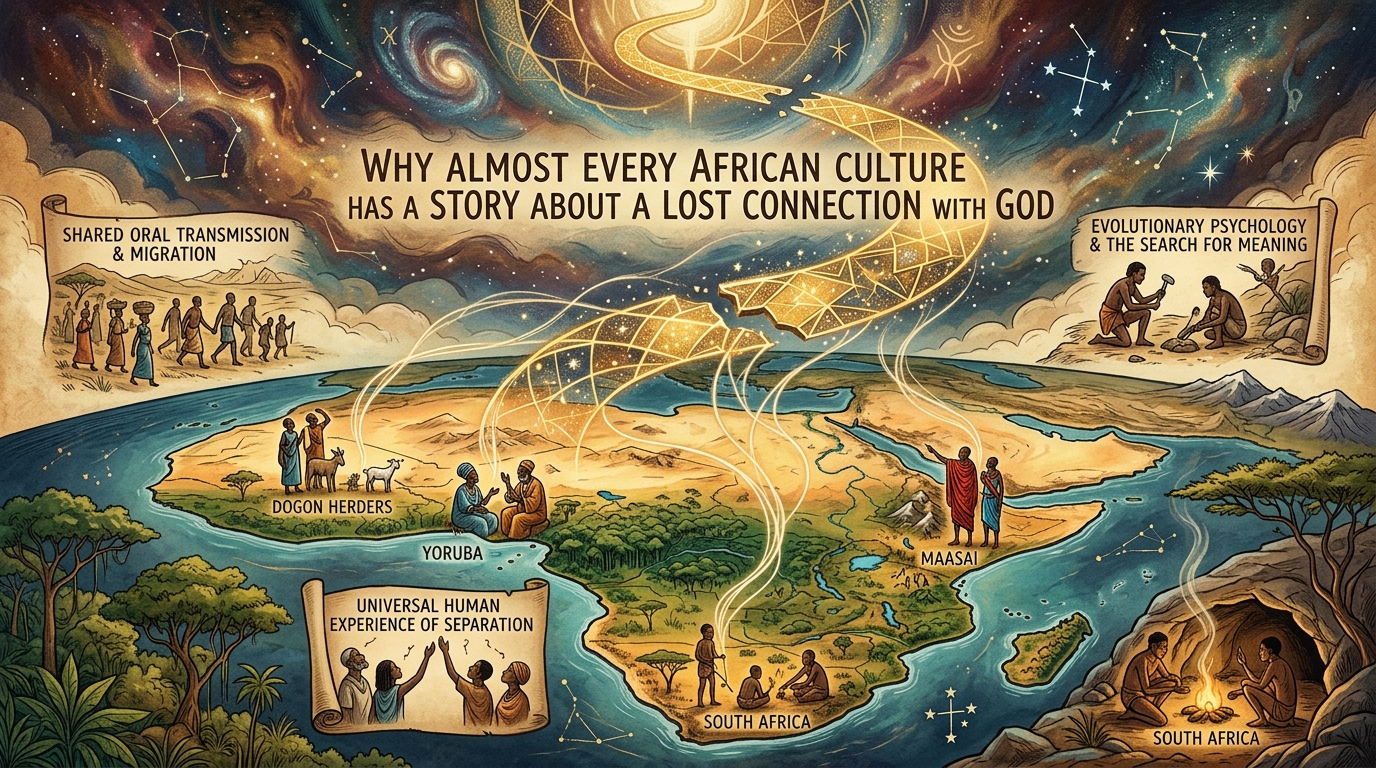
There is a story told among the Akan people of Ghana that has quietly fascinated scholars, theologians, and ordinary people for generations.
In the beginning, God lived close to the earth. So close that people could reach up and touch him. He was not distant or abstract or unreachable. He was simply there, overhead, present, accessible, woven into the fabric of daily life in a way that made the boundary between the human world and the divine world almost invisible.
And then something happened.
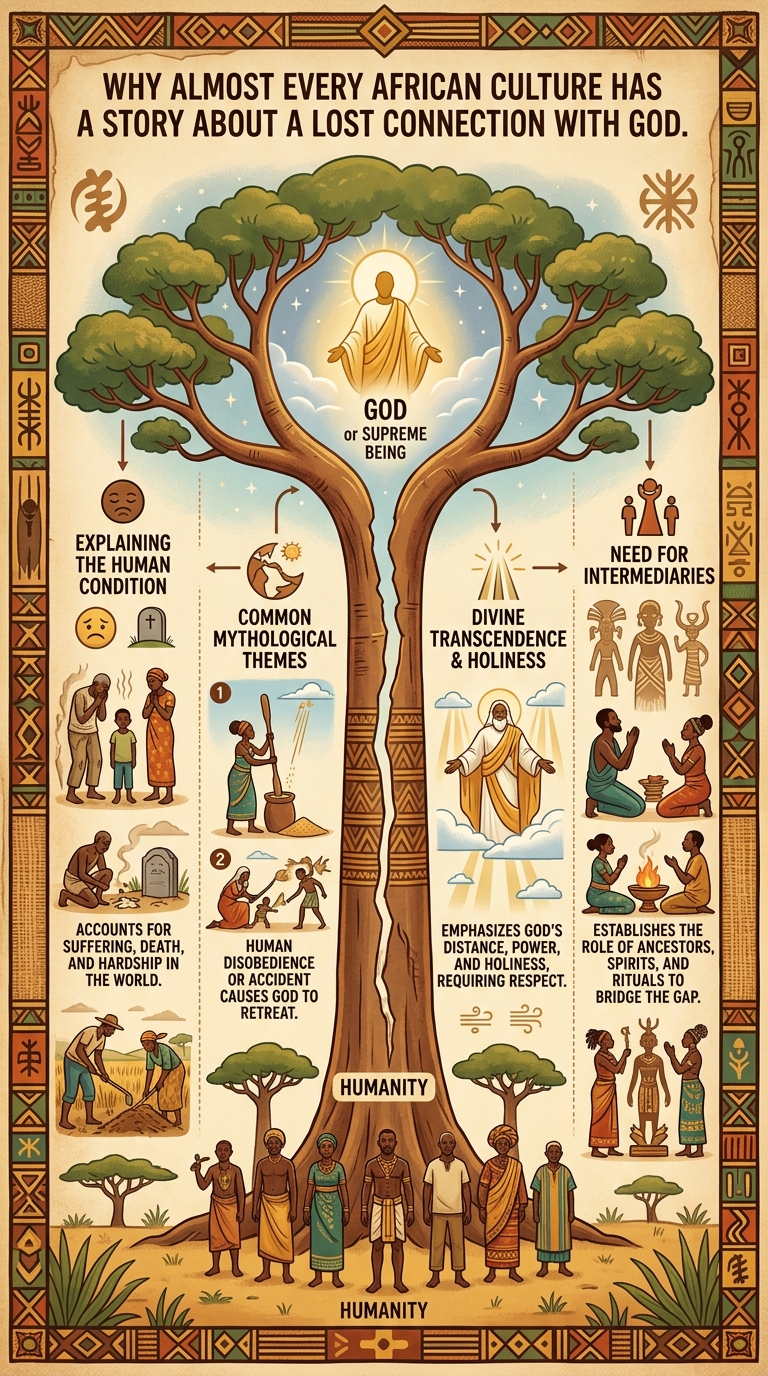
The exact details vary depending on which village tells the story and which elder you ask. But the core event is consistent. A woman, pounding fufu, kept hitting God with her pestle as she raised it above her head.
God, disturbed by the repeated contact, moved away. He went higher. And higher. Until he was so far above the earth that people could no longer reach him at all.
The woman tried to fix it. She told her children to stack the mortars one on top of another, building a tower toward heaven to reach God again. They stacked and stacked until they were just one mortar short of reaching him. She told them to take the bottom mortar and put it on top. They did. And the whole tower collapsed.
God has been far away ever since.
I want you to sit with that story for a moment. Because it is not a Nigerian story. It is not a biblical story. It is a Ghanaian story, told by people who had never read Genesis, who had no access to scripture, who had developed this narrative entirely from within their own cultural and spiritual experience.
And yet.
It describes a paradise lost. A closeness with God that was broken by human action. An attempt to reach God again through human effort that ended in failure and collapse.
Sound familiar?
This article is about one of the most remarkable patterns in all of African religious history. Almost every African culture, from West Africa to East Africa, from the Sahara to the Cape, has a story about a time when God was close and something went wrong. A story about lost connection, about the gap between humanity and the divine, about a rupture that happened at the beginning of things and has never been fully repaired.
And when you put those stories alongside the Bible, something extraordinary happens.
The Pattern Across Africa
Before we go deeper, let me show you how widespread this pattern actually is. Because it is not one or two isolated stories. It is a pattern so consistent across such a vast and diverse continent that it cannot be dismissed as coincidence or cultural borrowing.
Among the Dinka people of South Sudan, there is a story that in the beginning a rope connected heaven and earth. God and human beings communicated freely through this rope. Then a greedy woman struck the rope with her hoe while trying to cultivate more land, and the rope broke. God withdrew to heaven and the connection was severed. Since that day, God has been far and humans have been left to face suffering, disease, and death without direct access to him.
 Among the Mende people of Sierra Leone, the story says that God originally lived on earth among people and spoke to them directly. Human beings became disrespectful, taking God for granted, treating his presence as ordinary rather than sacred. God withdrew in response to their ingratitude and has been distant ever since.
Among the Lozi people of Zambia, God and humanity lived together in the beginning. A conflict arose, involving pride and disobedience, and God separated himself from human beings, moving to a place beyond ordinary reach.
Among the Nuer people of Ethiopia and South Sudan, there was originally a tree that connected heaven and earth. A hyena, representing chaos and destruction, gnawed through the tree and severed the connection between the divine and human worlds.
Among the Yoruba people of Nigeria, as we explored in a previous article on this blog, Olodumare is understood as so transcendent and so far above ordinary human existence that direct access requires mediation through the orishas. The distance between Olodumare and ordinary human beings is itself a form of lost proximity, a recognition that the divine and human worlds are separated in a way that was not always the case.
Among the Igbo people, the supreme being Chukwu is understood as good and the source of all good things, but also as distant from daily human affairs in a way that requires intermediaries. The chi, the personal spiritual guardian, serves partly as a mediator between the individual human being and the divine source of all life.
The pattern repeats across the continent with remarkable consistency. God was close. Something went wrong. God moved away. Humanity has been trying to bridge the gap ever since.
What Makes This Pattern So Remarkable
The thing that strikes me most about this pattern is not just its existence but its specificity.
These are not vague stories about general spiritual distance. They are specific narratives about a specific event in which a specific rupture occurred between God and humanity. They describe a before and an after. A time when things were right and a time when things went wrong. A paradise and a fall.
They also, almost universally, locate the cause of the rupture in human behavior rather than in divine abandonment. God did not leave because he stopped caring. God moved away because of something people did, something involving pride, or carelessness, or greed, or disobedience, or a failure to treat the sacred with appropriate reverence.
The theological implication is profound. These stories are not just explaining why God seems distant. They are confessing that humanity is responsible for the distance. They are acknowledging a moral and spiritual failure at the origin of things that created the gap between the human world and the divine world.
That is not a primitive superstition. That is a sophisticated theological insight. And it is an insight that the Bible shares completely.
Genesis and the African Stories Side by Side
Genesis 3 describes the original rupture between God and humanity with a specificity and a depth that no other ancient text matches. But the African stories, read alongside Genesis, illuminate it from angles that the Western theological tradition has sometimes missed.
Genesis describes a garden, a place of original closeness between God and human beings, where God walked in the cool of the day and spoke directly with Adam and Eve. It describes a specific act of disobedience, the eating of the forbidden fruit, that broke the relationship. It describes God withdrawing, the couple being sent out of the garden, the entrance of suffering and death and toil into human experience. It describes the gap that opened between the divine and human worlds and the longing to bridge it.
The Akan story of the woman with the pestle and the collapsing tower of mortars describes the same arc in different images. Closeness. A human action that disturbed the divine. God moving away. Human effort to restore the connection failing completely.
The Dinka story of the broken rope describes the same arc. Original connection. Human carelessness or greed causing the break. The severing of direct communication between heaven and earth.
The Mende story of God withdrawing because of human ingratitude describes the same arc. Presence taken for granted. Relationship damaged by human failure. God moving to a distance.
These are not identical stories. They differ in their details, their imagery, their cultural specifics. But they are describing the same fundamental reality from different cultural vantage points. The reality that something went wrong at the beginning of the human story. That the gap between God and humanity is not natural or original. That it is the result of a rupture. And that human beings are responsible for that rupture.
Why These Stories Exist
The question that naturally arises is why. Why do so many African cultures, independently of each other and independently of the biblical tradition, have stories that describe this same fundamental pattern?
There are several possible explanations and they are not mutually exclusive.
The first is what theologians call general revelation. The Apostle Paul argues in Romans 1 that the knowledge of God is available to all human beings through the created world and through conscience. No human culture is entirely without some awareness of the divine. If that is true, then the universal human sense that something has gone wrong in the relationship between God and humanity, expressed differently in different cultures but consistently present, may itself be a form of genuine spiritual knowledge, an awareness of a real rupture that every human being carries somewhere in their consciousness.
The second explanation is the common origin of humanity itself. If all human beings descend from common ancestors, as both the Bible and modern genetics suggest, then memories of the original relationship with God and the original rupture may have been carried forward in oral traditions across generations and across the migrations that spread human beings across the African continent and beyond.
The stories differ because time and distance and cultural change have shaped them differently. But the core memory persists because it is real.
The third explanation, which complements both of the others, is that these stories reflect a universal human experience of spiritual longing. Every human culture across history has sensed that something is missing. That there is a dimension of existence that human beings were made for but do not currently have full access to.
That the gap between how things are and how things were meant to be is real and significant. African cultures expressed that longing in stories about lost connection with God because that is exactly what the longing is about.
What the Gospel Says to These Stories
Here is where this becomes personally significant for every African Christian reading this article.
The gospel of Jesus Christ is not an alien message imported into Africa from elsewhere. It is the answer to a question that Africa has been asking for a very long time.
Every African story about lost connection with God is a story about a problem that has not yet been solved. The woman’s tower of mortars collapsed. The rope broke and could not be repaired. The tree was cut down and no human effort could replant it. The attempts to restore the connection through human initiative all failed.
The gospel says that what human beings could not do, God did. That God did not wait for humanity to build a tower high enough to reach him. He came down. In the person of Jesus Christ, the God who had moved away in response to human failure crossed the distance himself, in the opposite direction, from above to below, from divine to human, from heaven to earth.
The incarnation is God answering the question that African stories have been asking since before the missionaries arrived. How do we get back to where we were? How do we restore what was broken? How do we cross the distance that our own failure created?
The answer is not a taller tower. The answer is not a longer rope. The answer is a God who loved humanity enough to make the crossing himself.
That answer resonates in Africa not because it is foreign but because Africa has always known the question. The African stories of lost connection are not obstacles to the gospel. They are preparation for it. They are the longing that the gospel satisfies.
What This Means for How We Share the Gospel in Africa
Understanding this pattern has practical implications for how Nigerian and African Christians share their faith with people who are not yet believers.
Too often, African evangelism treats traditional African spirituality as purely negative, as something to be condemned and discarded before the gospel can take root. Traditional stories are dismissed as primitive or demonic. The spiritual framework that people have grown up with is treated as an enemy of the gospel rather than as a preparation for it.
The pattern of lost connection stories suggests a different approach. When an African elder tells a story about a time when God was close and something went wrong, a wise Christian response is not to dismiss that story but to say, yes, you are right, something did go wrong, and here is what God did about it.
The African story of lost connection is true as far as it goes. It correctly identifies the problem. What it lacks is the solution. And the solution is exactly what the gospel provides.
Paul used this approach in Athens in Acts 17, pointing to the altar inscribed to an unknown God and saying, what you worship as something unknown I am going to proclaim to you. He did not dismiss Athenian spirituality. He completed it.
African Christianity at its best does the same thing. It takes seriously the genuine spiritual knowledge that African cultures have preserved, acknowledges what is true in it, and then offers the completion that only the gospel provides.
That is not compromise. That is wisdom. And it is an approach that the pattern of African lost connection stories invites us to take seriously.
FAQs
Q: Are African creation and fall stories the same as the biblical account? A: No. They share significant thematic overlap, particularly around the ideas of original closeness with God, a rupture caused by human action, and the resulting distance between the divine and human worlds. But they differ significantly in their details, their theological depth, and their understanding of how the rupture can be healed. The biblical account is uniquely specific about the nature of the problem and uniquely complete in its description of the solution.
Q: Does the existence of these stories prove that all religions lead to God? A: No. The existence of these stories suggests that human beings universally carry some awareness of God and some sense of spiritual rupture and longing. But awareness of the problem is not the same as knowledge of the solution. African lost connection stories correctly identify that something went wrong. Only the gospel correctly identifies what God did about it and how the connection can be restored.
Q: Should African Christians tell these traditional stories in church? A: Using traditional stories as bridges to the gospel, the way Paul used the altar to the unknown God, is a legitimate and historically effective evangelistic approach. The key is to use them as pointers toward the gospel rather than as substitutes for it, and to be clear about where traditional stories end and biblical revelation begins.
Q: Why do the African stories place the blame on women in some cases? A: The Akan story of the woman with the pestle is one example of this pattern. Biblical scholars and African theologians have noted that the tendency to blame women for spiritual rupture appears in many cultures, not just African ones, and reflects both the universal human tendency to deflect blame and specific cultural dynamics around gender. The biblical account places responsibility on both Adam and Eve, with Adam specifically called to account for his own failure regardless of Eve’s role.
Q: Is there an African culture that has no story about lost connection with God? A: Scholars who have studied African traditional religion extensively, including John Mbiti whose work African Religions and Philosophy is the most comprehensive study of the subject, have found the pattern of original closeness with God and subsequent rupture to be nearly universal across African cultures. While specific details vary enormously, the core pattern of lost connection appears consistently enough to be considered a characteristic feature of African traditional religious thought.
Africa has always known that something went wrong.
From Ghana to South Sudan, from Sierra Leone to Zambia, from Nigeria to Ethiopia, the stories have been told around fires and under trees and in the compounds of elders for longer than anyone can remember. God was close. Something happened. God moved away. And humanity has been reaching upward ever since, building towers of mortars that always collapse one mortar short of heaven.
The gospel does not come to Africa as a stranger bringing news of a problem Africa never knew existed. It comes as the answer to the oldest question Africa has ever asked.
How do we get back to where we were?
The tower could not reach heaven. But heaven reached down.
That is the gospel. And Africa, in its deepest stories and its oldest longings, has always been ready to hear it.
Written for Networknewss.com.ng | History & Heritage