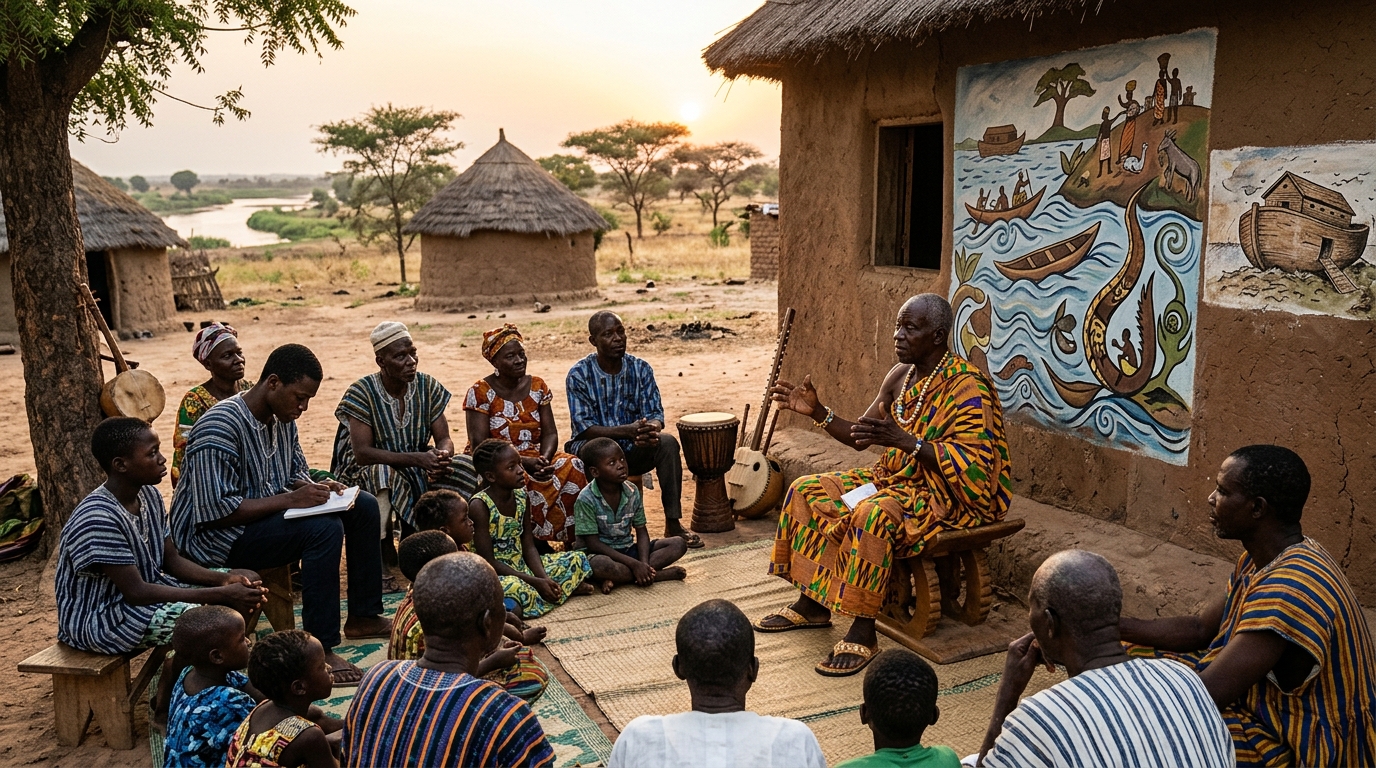
Let me tell you about a story told by the Yoruba people of Nigeria that most Nigerian Christians have never heard.
Long ago, before the world was as it is now, there was a great flood. The waters rose and covered the earth. Almost everything was destroyed. Only a small number of people survived, saved by divine intervention at the last possible moment. When the waters receded, the survivors emerged into a changed world and life began again from that remnant.
Sound familiar?
Now here is what makes this interesting. That story was not read from a Bible. It was not taught by a missionary. It was not borrowed from the book of Genesis. It existed in Yoruba oral tradition before Christianity ever arrived in West Africa. It was being told around fires and in the compounds of elders long before any European missionary ship appeared on the horizon.
And the Yoruba are not alone.
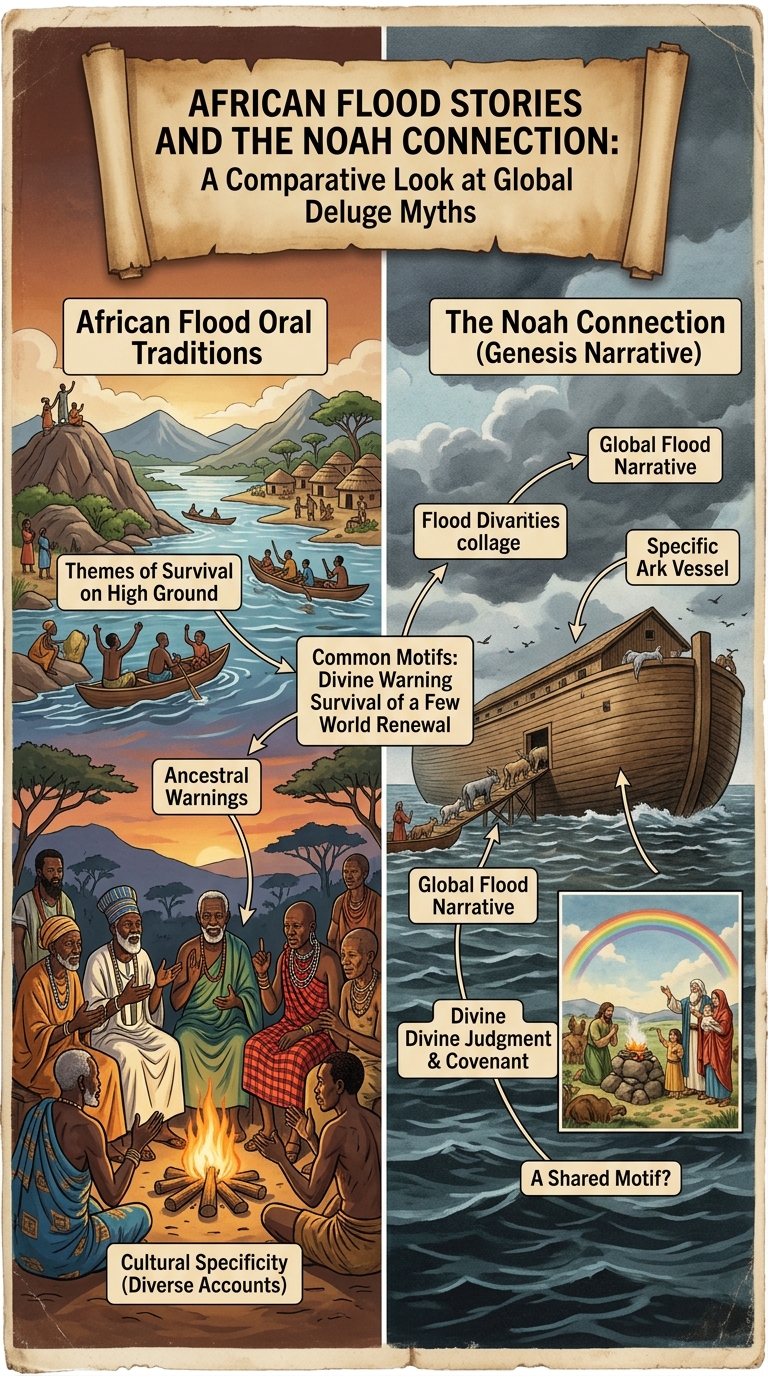
Across Africa, from West Africa to East Africa, from the forests of the Congo to the highlands of Ethiopia, cultures that developed in complete isolation from each other and from the biblical tradition carry stories about a great flood that destroyed the world and a small group of people who survived it.
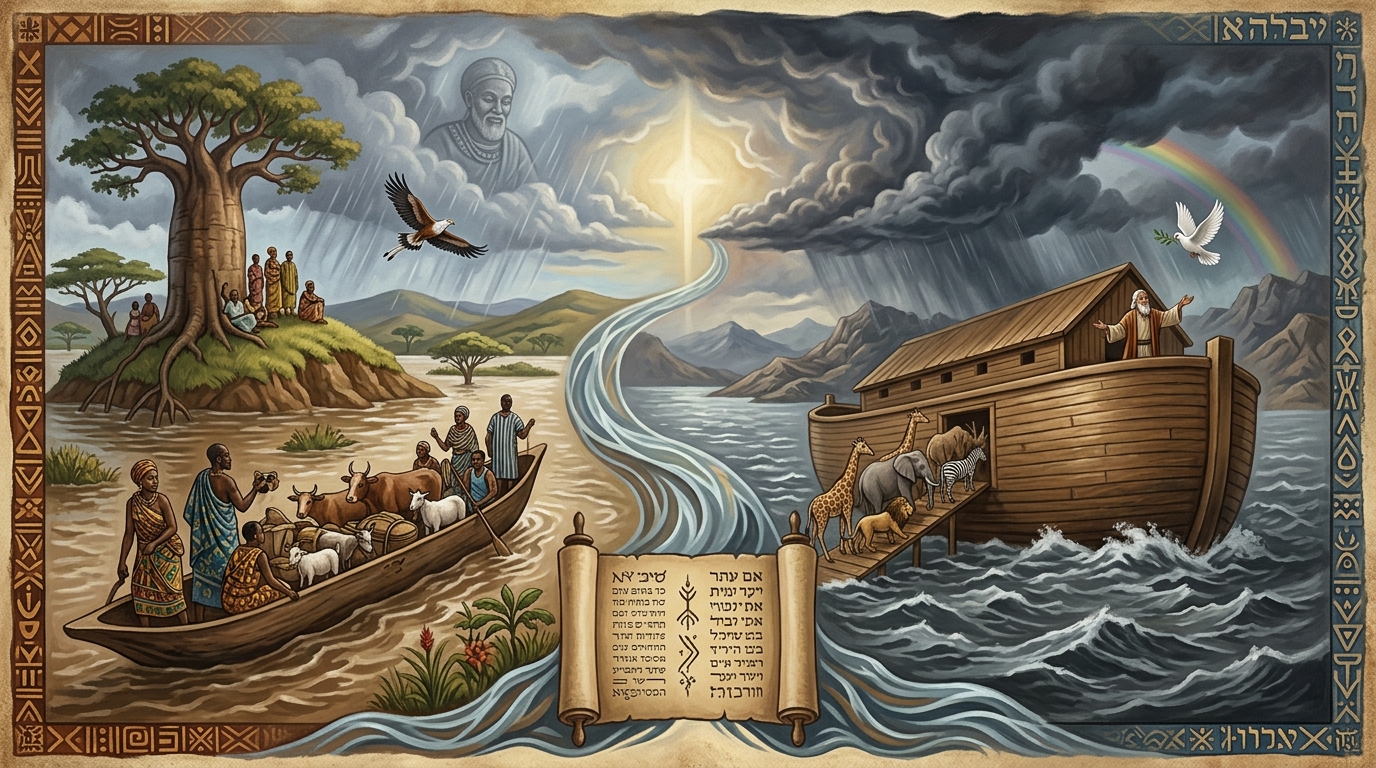 The question that has fascinated scholars, theologians, and curious believers for generations is simple and profound at the same time.
Why?
Why does almost every human culture on earth, including cultures across Africa that had no contact with the Bible, carry a memory of a catastrophic flood? Why do these stories share such specific and consistent details? And what does it mean for African Christians who read Genesis and find something there that their own ancestors were already telling stories about?
This article is about those questions. And the answers are more extraordinary than most people realize.
The Global Flood Story Phenomenon
Before we focus on Africa specifically, it helps to understand the scale of what we are dealing with.
Flood stories exist in virtually every major culture on earth. Scholars have catalogued over 200 distinct flood narratives from cultures across every inhabited continent. Mesopotamian cultures had the Epic of Gilgamesh, which contains a flood story with remarkable similarities to Genesis, including a boat, a divine warning, animals taken aboard, and birds sent out to find land. Ancient Greek mythology had the story of Deucalion, who built a chest and survived a flood sent by Zeus to destroy wicked humanity. Hindu tradition has the story of Manu, who was warned by a fish to build a boat and survived a great flood. Indigenous cultures across North America, South America, Australia, and the Pacific Islands carry flood stories of their own.
The universality of this pattern is one of the most discussed phenomena in the study of comparative religion and anthropology. It is too widespread to be explained by cultural borrowing. The stories appear in cultures that had no contact with each other, in languages that share no common roots, in traditions that developed independently across thousands of years.
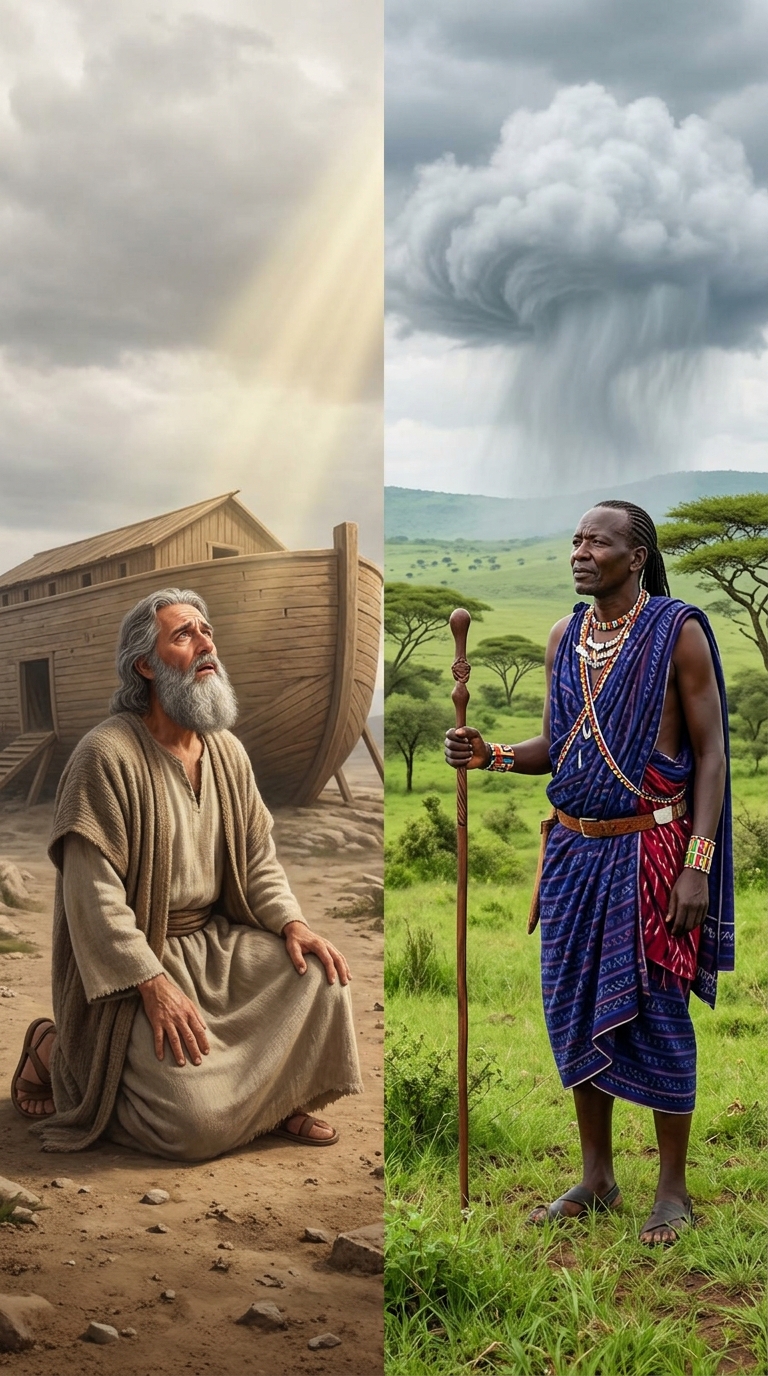 Something happened. And the memory of it, shaped differently by different cultures across time and distance, persisted in the oral traditions of humanity with remarkable consistency.
Africa is part of this global pattern. And its flood stories deserve to be examined seriously rather than dismissed or overlooked.
The Yoruba Flood Story
The Yoruba tradition contains references to a great primordial flood connected to the orisha Olokun, the deity associated with the deep waters of the ocean and with the mysteries of the sea.
In some versions of the story, Olokun became angry and unleashed a great flood upon the earth. The waters rose and threatened to destroy everything. It was only through the intervention of Obatala, the orisha associated with creation and with purity, and ultimately through the authority of Olodumare, the supreme God, that the flood was restrained and life preserved.
What is significant about this story is not just the flood itself but the moral framework surrounding it. The flood in Yoruba tradition, as in Genesis, is connected to divine displeasure with the state of the world. The waters are not a random natural disaster. They are a response to a moral and spiritual problem. And survival is connected to divine protection and intervention rather than to human ingenuity alone.
The Yoruba story does not have a single righteous man building a boat and saving his family and the animals of the earth. But it shares with Genesis the fundamental conviction that the great flood was a moral event, not merely a meteorological one, and that those who survived did so because of divine mercy rather than by accident.
The Kwaya People of Tanzania
The Kwaya people who live near Lake Victoria in Tanzania have a flood story that is startling in its specific similarities to Genesis.
In the Kwaya story, a man named Noa, which is remarkably close to the biblical Noah, was warned by God that a great flood was coming. He was instructed to build a large boat and to take his family and animals aboard. The flood came and covered the earth. When the waters receded, Noa sent out birds to test whether the land was dry enough to return to. The birds came back at first, then eventually did not return, signaling that dry land was accessible.
Noa and his family emerged from the boat, offered a sacrifice to God, and began life again in the changed world.
The name. The warning. The boat. The family. The animals. The birds sent out to find land. The sacrifice after the flood. The similarities between the Kwaya story and Genesis 6 to 9 are so specific and so detailed that they cannot be explained as general cultural coincidence.
Something connects these stories. The question is what.
The Maasai Story of Tumbainot
The Maasai people of Kenya and Tanzania have a flood story centered on a righteous man named Tumbainot.
Tumbainot was a good man who feared God in a world that had become corrupt and violent. God warned him that a great flood was coming to destroy the wicked world. Tumbainot built a large boat, took his wives and children and pairs of animals aboard, and survived the flood that destroyed everything else.
When the waters receded, he sent out birds to check the state of the land. Eventually a dove returned carrying a branch, signaling that vegetation had returned and the land was habitable again. Tumbainot and his family emerged and began life anew.
The parallels with Noah’s story in Genesis are direct and detailed. The righteous man. The corrupt world. The divine warning. The boat. The pairs of animals. The birds sent out. The dove with the branch. The new beginning after the flood.
These details appear in both Genesis and in the Maasai oral tradition, which developed independently on the other side of the African continent from where the biblical narrative was recorded.
The Bachwa People of the Democratic Republic of Congo
The Bachwa, a pygmy people of the Congo forest, carry a flood story in which God warned a man to build a large raft because a great flood was coming. The man took his family and animals aboard. The rain fell for many days and the waters covered the earth. When the flood receded, the man and his family emerged and repopulated the earth.
Simple. Consistent. Parallel.
The Egyptian Connection
Egypt, as we have established in previous articles on this blog, is in Africa and was a major center of ancient civilization. Egyptian religious texts contain references to a primordial flood or inundation associated with the god Nun, the personification of the primordial waters from which creation emerged.
The Egyptian understanding of cosmic order involved the constant threat of the primordial waters returning to overwhelm creation. The annual flooding of the Nile was understood in this framework, as both a blessing that brought fertile soil and a reminder of the primordial waters that had to be held back for ordered life to continue.
The Egyptian flood mythology is less narrative than the Genesis account or the Yoruba and Maasai stories, more cosmological than historical. But it reflects the same fundamental awareness of a catastrophic encounter between humanity and water that shaped so much of the ancient world’s spiritual imagination.
What Explains These Parallels
Three main explanations have been offered for why flood stories appear so consistently across African and global cultures, and they are worth examining honestly.
The first explanation is a historical one. If a catastrophic flood actually occurred in the ancient past, an event of sufficient scale to affect human populations across a wide area, then the memory of that event would have been preserved in the oral traditions of the cultures that descended from the survivors. As those cultures spread and diversified across the earth over thousands of years, the core memory of the flood would have been carried with them, shaped differently by different cultural contexts but preserving specific details that pointed back to the original event.
This explanation takes the biblical account seriously as history. It suggests that Noah’s flood was a real event, that it affected humanity globally or at least extensively enough to leave a trace in the collective memory of civilizations across the world, and that the African flood stories are genuine memories of that same event, preserved through oral tradition across the generations that separated the original event from the cultures we can observe today.
The second explanation is a literary and cultural diffusion one. Under this view, flood stories spread from one culture to another through trade, migration, and cultural contact over thousands of years. The similarities between the stories reflect borrowing and adaptation rather than independent memory of the same event. Under this explanation, the Mesopotamian flood stories, which are among the oldest recorded, may have influenced later traditions across the ancient world through the networks of trade and cultural exchange that connected ancient civilizations.
The problem with this explanation as a complete account is that it struggles to explain the presence of detailed flood stories in cultures that were genuinely isolated from the ancient Near Eastern world, including indigenous cultures of the Americas and Australia, and some of the more remote African communities.
The third explanation combines elements of both. A real catastrophic event occurred, probably connected to the end of the last Ice Age when rising sea levels transformed coastlines and flooded low-lying areas across the world. The memory of that event was preserved in the oral traditions of the human communities that survived it and was carried across the world as humanity spread. Cultural contact and exchange then added specific details and shaped the stories in different directions. The result is the pattern of both specific similarity and significant variation that we actually observe across global flood traditions.
What African Flood Stories Mean for African Christianity
For African Christians, the existence of flood stories across African cultures carries a significance that goes beyond academic interest.
It means that African oral tradition, developed independently of the biblical text, preserves memories of events that the Bible also records. It means that the Bible is not describing events that happened in a distant world that has nothing to do with Africa. It is describing events whose echoes can be heard in African stories told around fires that the Bible’s authors never sat beside.
It means that when an African Christian reads Genesis 6 to 9 and hears the story of Noah, they are not reading a foreign story. They are reading the fullest and most detailed account of something that their own ancestors also remembered, even if the memory had been shaped differently by centuries of oral transmission.
This is not a small thing. It is a profound connection between the biblical narrative and the African cultural heritage that most African Christians have never been taught to see.
The God who sent the flood and preserved Noah in Genesis is the same God whose action in the world left traces in Yoruba stories about Olokun and in Maasai stories about Tumbainot and in Kwaya stories about Noa. African traditional religion did not have the full story. But it had pieces of a real story. And the Bible gives those pieces a context and a completion that makes sense of what the African traditions preserved.
 FAQs
FAQs
Q: Does the existence of African flood stories prove that Noah’s flood was historical? A: The widespread existence of flood stories across cultures that developed independently of each other is consistent with the biblical account being historical, but it does not constitute proof in the strict scientific sense. It is significant evidence that something catastrophic happened in the ancient past that left a trace in the collective memory of humanity. Biblical Christians have good reason to take that evidence seriously alongside the biblical text.
Q: Is the Kwaya story of Noa really independent of the Bible? A: This is genuinely debated among scholars. Some argue that the Kwaya story shows signs of biblical influence through missionary contact. Others argue that the specific details, particularly the name Noa and the bird sequence, suggest a tradition that predates missionary contact. The debate is not fully resolved. But even if missionary influence shaped the Kwaya story, the broader pattern of African flood narratives across cultures with no missionary contact remains significant.
Q: Why does God send floods in so many of these stories? A: The consistent association of floods with divine judgment on human wickedness across so many independent traditions is itself remarkable. It suggests a widespread human intuition that the natural world is morally connected to human behavior, that catastrophe is not merely random but reflects a disruption in the relationship between humanity and the divine. This intuition is consistent with the biblical worldview even when it appears in non-biblical traditions.
Q: Are there African flood stories where the survivor is warned because of righteousness? A: Yes. The Maasai story of Tumbainot is the clearest example, where the survivor is explicitly identified as a righteous man in a corrupt world, directly paralleling the biblical description of Noah as righteous in his generation. This specific moral dimension is one of the most striking parallels between the African stories and Genesis.
Q: Should African Christians use these stories in evangelism? A: Yes, in the same way Paul used the altar to the unknown God in Athens. African flood stories can serve as bridges to the fuller biblical account, helping people see that the God of the Bible is not a stranger to African experience but a presence whose actions left traces in African memory long before the missionaries arrived. The approach requires honesty about the differences between the traditional stories and the biblical account, but the similarities provide a genuine and powerful point of connection.
The stories were already being told before the missionaries arrived.
Around fires in Yorubaland, on the shores of Lake Victoria, in the forests of the Congo, in the highlands of Tanzania, African voices were describing a time when the waters rose and covered the earth, and a small group of people survived because of divine mercy, and life began again from that remnant.
They did not know they were telling a story that Genesis also tells. They did not know that their oral tradition and the biblical text were pointing at the same event from different angles across thousands of years of human history.
But they were.
And when an African Christian reads Genesis 6 to 9 today, they are not reading a foreign story imported from another world. They are reading the fullest version of a story that their own ancestors already knew something about, preserved in the oldest memories of the African people, waiting for the day when the complete account would arrive and the pieces would finally fall into place.
The flood came. Noah survived. And in African stories from Tanzania to Nigeria, the memory of that survival was never entirely lost.
Written for Networknewss.com.ng | History & Heritage