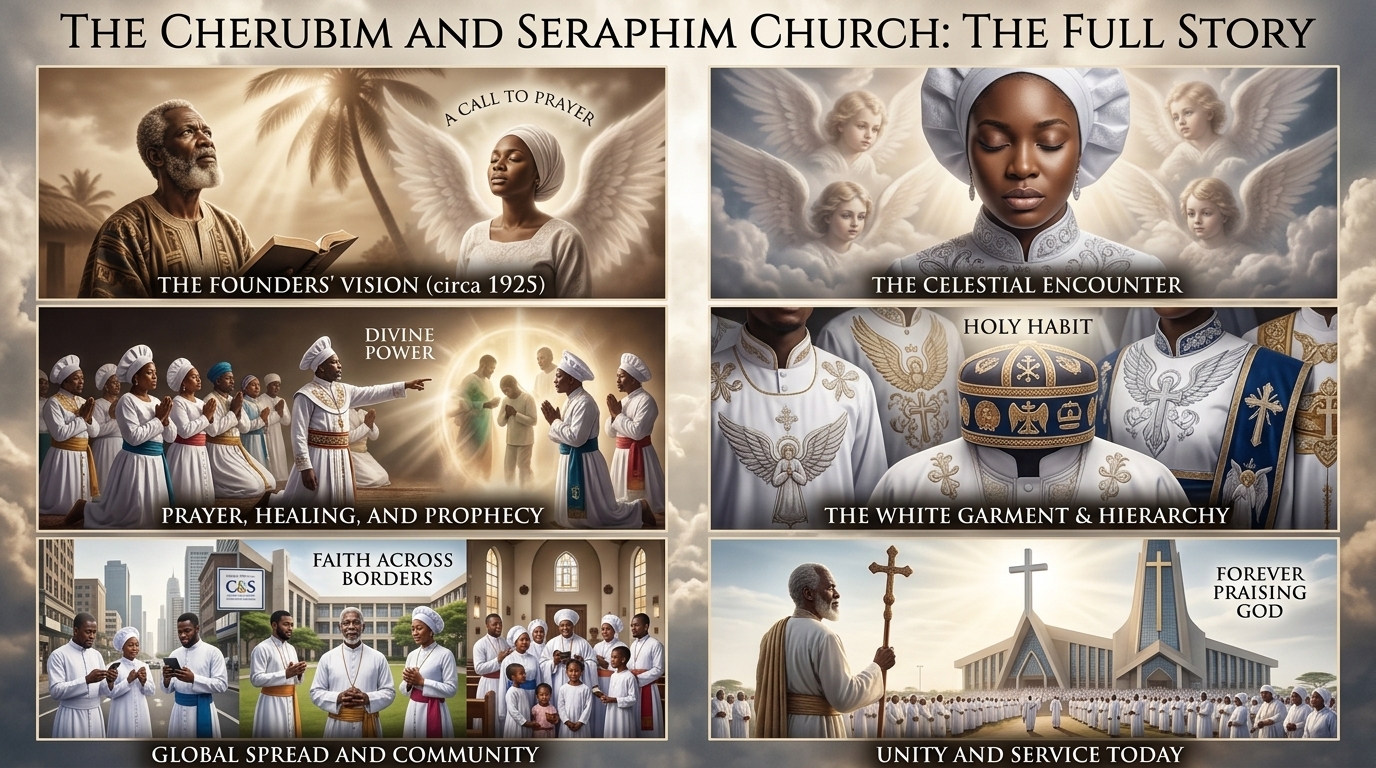
It started with a teenage girl having a vision.
Not a pastor. Not a bishop. Not a trained theologian with years of seminary education and a wall full of certificates. A teenage girl named Abiodun Akinsowon, sometime in 1925, who fell into a trance during a Corpus Christi procession in Lagos and did not wake up for three days.
When she finally opened her eyes, she described what she had seen. Angels. Heavenly beings surrounding the throne of God. A divine commission. Instructions about prayer, about holiness, about how the church in Nigeria needed to return to something it had lost.
Nobody in Lagos that day could have imagined what those three days of unconsciousness would eventually produce. The teenage girl’s vision became the foundation of one of Nigeria’s most distinctive, most controversial, most copied, and most enduring Christian movements. A movement that still fills white-robed congregations across Nigeria and the Nigerian diaspora every Sunday morning nearly a hundred years later.
This is the full story of the Cherubim and Seraphim Church. And it is a story that every Nigerian Christian should know.
Lagos in 1925 — The World the Movement Was Born Into
To understand why the Cherubim and Seraphim movement emerged when it did and why it struck such a deep chord with so many Nigerians, you need to understand what Lagos looked like in 1925.
The city was a colonial capital, the administrative center of British Nigeria, a place where European culture, African tradition, and a rapidly growing Christian presence were in constant and sometimes uncomfortable negotiation with each other. The mission churches, primarily Anglican, Methodist, and Catholic, had been established in Lagos for decades. They had built schools, trained clergy, and created a Christian community that was educated, literate, and increasingly prominent in Lagos society.
But something was missing. Or at least, many Nigerian Christians felt something was missing.
The mission churches operated according to European models of worship and church life. Services were conducted in structured, formal ways that reflected Victorian English religious culture more than anything indigenous to Yoruba spiritual experience. The deep African instinct for expressive prayer, for direct encounter with the spiritual world, for healing and prophecy and visible signs of divine power, had no real home in the established mission churches.
At the same time, the rapid social changes of colonial Lagos had created new anxieties. Traditional community structures were breaking down. The old spiritual support systems were losing their authority. People were facing diseases, economic hardship, and social dislocation without the spiritual resources that had sustained previous generations.
Into that gap walked Moses Orimolade. And everything changed.
Moses Orimolade — The Praying Man
Moses Tutulola Orimolade was not a young man when the movement began. He was already in his forties, a travelling evangelist from Ikare Akoko in present day Ondo State, known throughout Yorubaland as Baba Aladura, the praying father.
Orimolade had a physical disability that had limited his mobility since childhood. He walked with difficulty and traveled slowly. But he prayed with an intensity and a persistence that reportedly produced results that drew crowds wherever he went. Healing, deliverance, and answered prayer followed his ministry in ways that the formal mission church structures could not accommodate or explain.
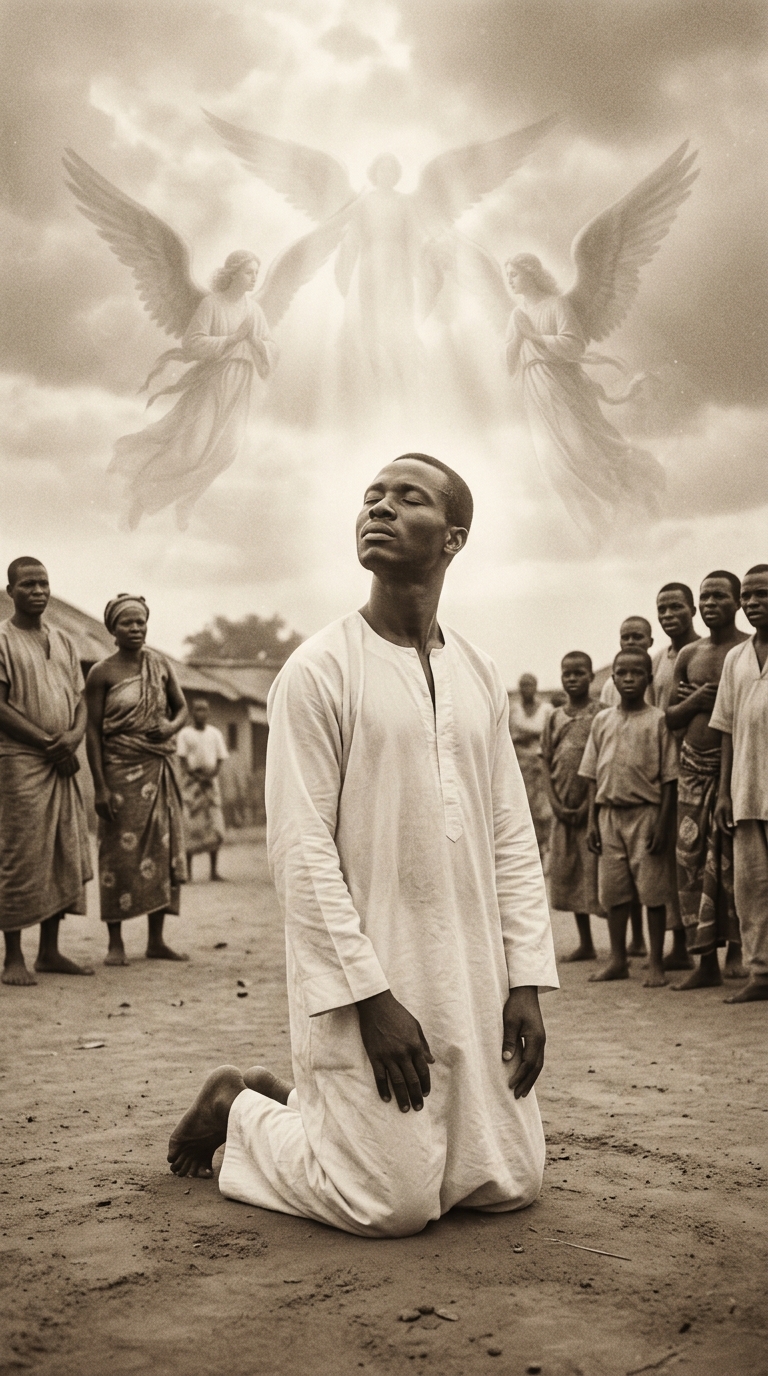 He arrived in Lagos sometime before 1925, preaching and praying in the open air, drawing people who were hungry for a form of Christianity that engaged with their deepest needs and fears in ways that felt immediate and powerful.
When the teenage Abiodun Akinsowon fell into her three-day trance, it was Orimolade who was brought to her bedside to pray for her recovery. He prayed. She woke up. And the encounter between the elderly praying man and the young woman with the vision created a partnership that would birth a movement.
The Birth of the Movement
After Abiodun Akinsowon recovered, she and Orimolade began meeting together with a small group for prayer. The meetings were informal at first, held in homes and open spaces, centered on intense prayer, fasting, and what they understood as the direct operation of the Holy Spirit.
The name Cherubim and Seraphim came directly from Akinsowon’s vision. She had seen the cherubim and seraphim, the angelic beings described in Isaiah 6 and in the book of Revelation, surrounding the throne of God in worship. The movement named itself after these heavenly worshippers as a declaration of its aspiration. To worship God with the same intensity and purity as the angels around his throne.
The white robes that became the movement’s most distinctive visual signature also came from the founding vision. White, the color of holiness and purity, became the required dress for worship. Members came to services barefoot as a sign of standing on holy ground, drawing directly from Moses removing his sandals before the burning bush in Exodus 3.
The early movement attracted people rapidly. The combination of intense prayer, expectation of healing and prophecy, direct engagement with the spiritual world, and a worship style that felt genuinely African rather than European colonial, resonated deeply with Lagos Christians who had felt spiritually homeless in the mission church structures.
Word spread beyond Lagos. By the late 1920s, Cherubim and Seraphim prayer groups were forming across Yorubaland, and the movement was beginning its transformation from a Lagos prayer group into a regional religious phenomenon.
The Split That Happened Too Soon
Here is the painful part of the story that most accounts of the Cherubim and Seraphim movement either gloss over or skip entirely.
Within a few years of the movement’s founding, Orimolade and Akinsowon separated. The details of the split are disputed and the full truth is probably buried in the kind of interpersonal complexity that always accompanies the early stages of religious movements. But the split was real and it had lasting consequences.
Akinsowon eventually moved in a different direction from Orimolade’s continuing ministry. The movement that they had founded together began fragmenting into different factions, each claiming legitimacy from the original founding vision and each developing its own structure, leadership, and practices.
This fragmentation is the defining characteristic of the Cherubim and Seraphim story. Almost from the very beginning, the movement was splitting. New branches formed. Leaders disagreed. Disputes over authority, over doctrine, over practice, over money, produced divisions that multiplied over decades until the landscape of Cherubim and Seraphim Christianity became almost impossibly complex.
Today there are dozens of distinct Cherubim and Seraphim organizations in Nigeria, each with its own head, its own structure, and its own claim to represent the authentic continuation of Orimolade and Akinsowon’s original vision. The most prominent include the Cherubim and Seraphim Movement Church, the Holy Order of Cherubim and Seraphim, the Eternal Sacred Order of Cherubim and Seraphim, and many others.
They all wear white robes. They all worship barefoot. They all trace their origin to Lagos in 1925. And they cannot agree on almost anything else.
What Made the Movement Distinctive
Despite the fragmentation, the Cherubim and Seraphim movement developed a set of distinctive characteristics that set it apart from both the mission churches it emerged from and the Pentecostal movements that came after it.
The white robes and bare feet became the most immediately recognizable markers. But they were more than visual symbols. They represented a theology of holiness, of separation from the world, of approaching God with deliberate reverence. When a C&S member removes their shoes at the entrance to a prayer house, they are making a statement about the sacred nature of the space they are entering and the God they are approaching.
Prayer was and remains absolutely central. The movement took seriously the New Testament injunctions to pray without ceasing, to devote yourselves to prayer, to watch and pray. Extended prayer sessions, all night vigils, prayer with fasting, and corporate intercession for specific needs became the defining activities of C&S life. The movement did not just talk about prayer. It prayed, for hours, for days, for years.
Healing was expected and sought actively. Members brought their sick to prayer houses with the expectation that God would intervene directly. Anointed water, blessed candles, and other sacred objects were used in healing prayer in ways that drew on both Christian tradition and African spiritual sensibilities.
Prophecy was central. In C&S gatherings, members received and shared prophetic messages, words of knowledge about specific situations, and visions that were understood as direct communications from God or from angels. This prophetic culture made C&S worship participatory in a way that formal mission church services were not. Ordinary members, not just leaders, could receive and share divine communication.
Dreams were taken seriously as a channel of divine communication. The founding vision of Akinsowon was itself a dream experience. C&S members brought their dreams to church for interpretation and prayer response. The spiritual world was understood as constantly communicating with the physical world through dreams, and the church’s role was partly to help members navigate and respond to those communications.
The C&S and the Aladura Movement
The Cherubim and Seraphim movement is one of several related movements that scholars group together under the term Aladura, which means praying people in Yoruba. The 1930 revival associated with Joseph Babalola and the Christ Apostolic Church was part of the same broader spiritual awakening, as was the Celestial Church of Christ founded by Samuel Bilewu Oshoffa in Benin Republic in 1947.
These movements shared a common spiritual DNA. They emerged from similar frustrations with mission church structures. They emphasized prayer, healing, prophecy, and direct encounter with the Holy Spirit. They developed distinctively African worship styles and organizational structures. And they grew with remarkable speed among populations hungry for a Christianity that felt alive and responsive to their real situations.
The Aladura movements collectively represent one of the most significant developments in African Christian history. They proved that African Christians could create their own expressions of Christian faith that were neither European imports nor simply traditional African religion with a Christian veneer. They were genuinely new, genuinely African, and genuinely Christian simultaneously.
The Cherubim and Seraphim was not the only Aladura movement but it was in many ways the prototype, the first significant example of what became a pattern repeated across Nigerian Christianity for the rest of the twentieth century.
The C&S Legacy in Modern Nigerian Christianity
You cannot understand modern Nigerian Christianity without understanding the Cherubim and Seraphim movement. Its influence extends far beyond its own membership.
The prayer culture that the C&S pioneered, the all night vigils, the intense corporate intercession, the expectation of healing and prophecy, the understanding of the spiritual world as immediately present and active, became the template for Nigerian Pentecostalism when it emerged in the 1970s and 1980s. The founders of modern Nigerian megachurches were not building on nothing. They were building on a prayer culture that the Aladura movements, and the C&S in particular, had established and normalized over decades.
The white robed congregations that fill streets across Lagos, Ibadan, Abeokuta, and every other Yoruba city every Sunday morning are the direct continuation of what Orimolade and Akinsowon began in 1925. In a Nigeria where Christianity has become spectacularly diverse, the C&S remains one of the most visually distinctive and instantly recognizable expressions of Nigerian faith.
The movement has also spread internationally with the Nigerian diaspora. C&S churches exist in the United Kingdom, the United States, Canada, and across Europe, carrying the white robes and the prayer culture of Yoruba Christianity into the Nigerian communities scattered across the world.
The Unresolved Questions
The Cherubim and Seraphim story also raises questions that Nigerian Christianity has never fully resolved.
The first is the question of women in leadership. The movement was co-founded by a teenage girl whose vision literally created it. Yet the formal leadership of most C&S organizations has historically been dominated by men. The tension between the female founding vision and the male institutional structure is one the movement has lived with uncomfortably for nearly a century.
The second is the question of fragmentation and unity. The dozens of competing C&S organizations represent a failure of Christian unity that has weakened the movement’s collective witness and confused its members and observers alike. Every attempt at reunion has so far failed. The original split between Orimolade and Akinsowon set a pattern that has been repeated at every level of the movement’s life.
The third is the question of syncretism. Critics of the C&S movement, including some Nigerian Pentecostals, argue that the use of blessed water, candles, and other sacred objects, combined with the emphasis on dreams and visions and angelic beings, represents a dangerous blending of Christian and traditional African spiritual practices. Defenders argue that these practices have genuine biblical foundations and that the critics are applying a Western theological standard that reflects European cultural prejudice more than biblical truth.
These debates have not been resolved. They are still active in Nigerian Christian discourse today.
FAQs
Q: What is the difference between the different C&S organizations in Nigeria? A: The main divisions are historical, stemming from various splits since the 1920s. The Eternal Sacred Order of Cherubim and Seraphim, founded by Orimolade himself before his death, and the Holy Order of Cherubim and Seraphim, associated with later leadership developments, are among the most prominent. They share the same founding story, the same white robes, and similar worship practices but have separate leadership structures and sometimes differ on specific doctrinal and practical questions.
Q: Is the Cherubim and Seraphim Church Pentecostal? A: The C&S is generally classified as part of the Aladura or African Initiated Church tradition rather than Pentecostalism proper, though it shares significant characteristics with Pentecostalism including emphasis on the Holy Spirit, healing, and prophecy. It predates the major Pentecostal movements in Nigeria and developed its distinctive characteristics independently of the international Pentecostal movement.
Q: Do C&S members believe in the Bible? A: Yes. The Bible is central to C&S belief and practice. The distinctive practices of the movement, the white robes, bare feet, use of water, emphasis on angels, are all justified by C&S members through biblical references. The movement understands itself as recovering biblical Christianity rather than departing from it.
Q: Why do C&S members worship barefoot? A: The practice derives from Exodus 3:5 where God tells Moses to remove his sandals because he is standing on holy ground. C&S theology understands the prayer house as holy ground in the same sense, requiring the same reverence that Moses showed before the burning bush.
Q: What happened to Abiodun Akinsowon? A: After separating from Orimolade, Akinsowon continued her own ministry and lived until 1994, dying at an advanced age. She remained a significant figure in C&S history but the full story of her later life and ministry is less documented than the founding period. Her longevity meant that she outlived Orimolade, who died in 1933, by over sixty years.
A teenage girl fell into a trance during a church procession in Lagos in 1925.
Three days later she woke up with a vision of angels and a sense of divine commission that she could not shake and could not explain away.
She met an elderly praying man who had been walking slowly across Yorubaland for years, healing the sick and calling people back to God, waiting for something he could not yet name.
Together they began praying. Others joined. White robes appeared. Shoes were removed. The prayer house became holy ground. And something that had never existed before in Nigerian Christianity came into being, an expression of Christian faith that was genuinely African, genuinely biblical, and genuinely alive in ways that the formal mission church structures had not been able to produce.
Nearly a hundred years later, the white robes are still being worn. The prayers are still being prayed. The visions are still being received. The movement that a teenage girl’s trance began in 1925 is still going, fragmented and flawed and remarkable and irreplaceable, one of the most distinctively Nigerian things that Nigerian Christianity has ever produced.
Abiodun Akinsowon deserved better than the historical footnote she has too often been reduced to.
And the Cherubim and Seraphim movement deserves to be known, fully and honestly, by every Nigerian Christian who benefits from the prayer culture it helped create.
Written for Networknewss.com.ng | History & Heritage