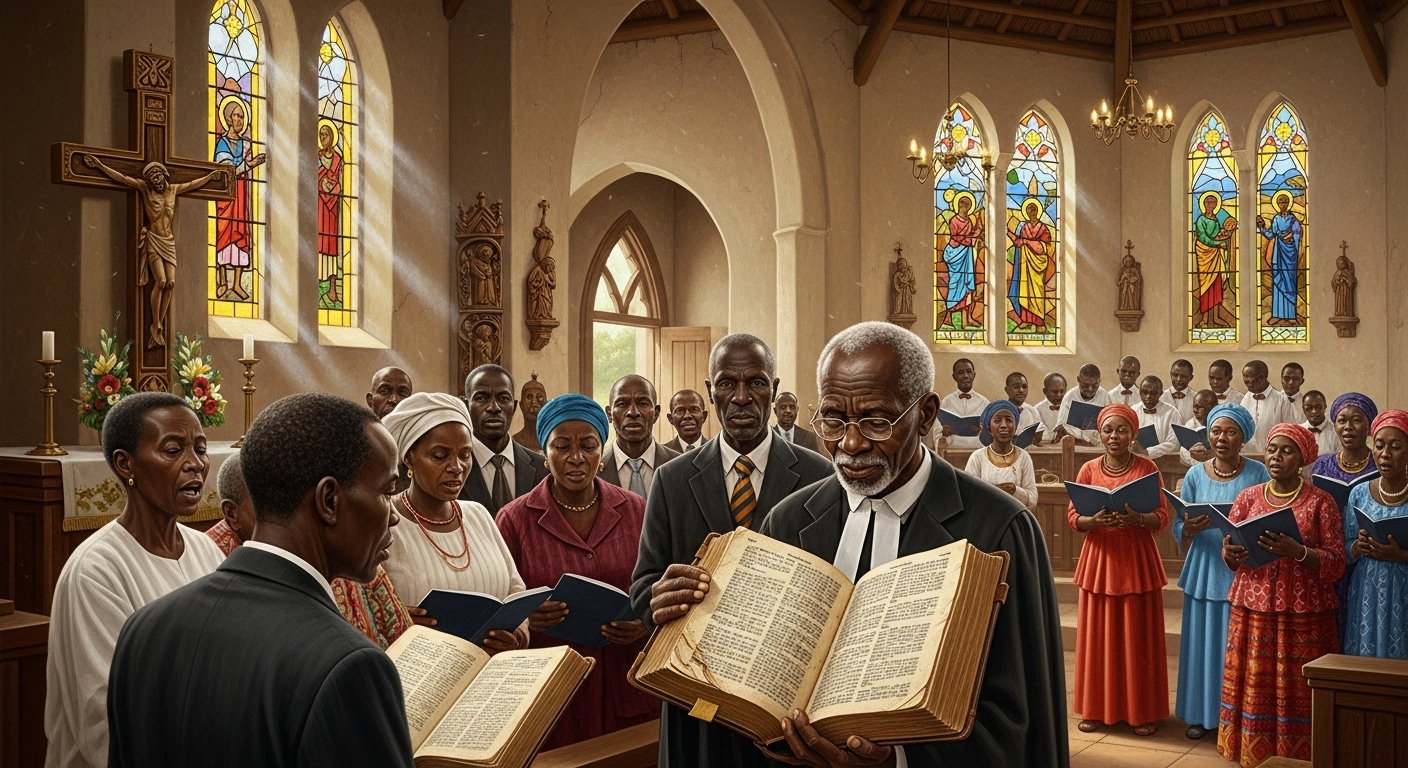
Every Nigerian Christian Should Know How to Study the Bible. Here Is Why Most Don’t.
Let me describe something that happens in Nigerian churches every single week.
A church member reads a Bible passage at home during the week.
They sit with it. They think about it.
They reach an understanding that feels genuine — personal, even. Something clicks.
Then Sunday comes. The pastor preaches on that same passage. And says something completely different.
The church member looks around. Everyone is nodding. Everyone is saying amen. So they quietly file away their own reading. Probably wrong.
Probably presumptuous. Probably the kind of independent thinking that gets you labeled a troublemaker in certain circles. And they move on.
This repeats. Week after week. Year after year. Until the church member stops reading the Bible with their own mind entirely.
Until it becomes a book that only experts can properly handle. Until the only legitimate interpretation is whatever comes from the pulpit.
And that is exactly where some pastors — not all, but some — want you to be.
Dependent. Unquestioning. Unable to evaluate what you are being taught because you have never developed the capacity to do so.
This article is for every Nigerian Christian who wants to change that.
The Reformation Was About This Exact Problem
The Protestant Reformation in sixteenth century Europe was not primarily about theology. It was about access.
Martin Luther translated the Bible into German so that ordinary German people could read it themselves.
William Tyndale translated it into English. He was burned at the stake for doing so — because the religious establishment of his day understood clearly that widespread personal Bible reading would destroy their ability to control what people believed.
They were not wrong about that. And their response tells you everything you need to know about why the ability to read scripture personally is dangerous to a certain kind of power.
Samuel Ajayi Crowther translated the Bible into Yoruba for the same reason.
Because he believed Yoruba people deserved to encounter God’s word directly, without a gatekeeper standing between them and the text.
The Nigerian church today generally affirms personal Bible reading. Most pastors will tell you to read your Bible daily.
But there is a significant difference between reading and studying.
Reading gives you exposure.
Studying gives you understanding. And understanding is what protects you.
A congregation of serious Bible students is much harder to mislead than a congregation of passive Bible readers. That fact alone explains why genuine Bible study is not always encouraged as enthusiastically as Bible reading.
You Need Tools. And Most of Them Are Free.
You cannot build a house with your bare hands. Bible study works the same way.
Start with your translation. The King James Version is beautiful and historically significant, but its seventeenth century English creates genuine barriers.
Many passages that seem clear in the KJV are being misread because the language has shifted in meaning over four hundred years. Do not let that be your only translation if you are studying seriously.
The New International Version is widely used and readable.
The English Standard Version stays closer to the original Greek and Hebrew, slightly less smooth but more useful when specific words matter.
The New Living Translation prioritises clarity and natural English — excellent for understanding the overall feel of a passage.
The practical rule is this: use at least two translations whenever you study a passage.
If the NIV and ESV agree on what a verse means, you can be reasonably confident. If they differ significantly, that difference itself is worth investigating.
A study Bible is the next thing worth owning. The NIV Study Bible, the ESV Study Bible, the CSB Study Bible — all of them include notes that give historical context, explain difficult terms, and flag important interpretive questions.
They do not replace your thinking. They inform it.
And then there are the free tools. Bible Gateway, Blue Letter Bible, Bible Hub. Multiple translations. Commentaries.
Greek and Hebrew word studies. All free.
All available on the phone in your pocket right now. In 2026, a Nigerian Christian with internet access has no excuse for lacking serious study tools. They are all free.
The Verse You Have Seen on Every Church Bulletin
Let me give you the most Nigerian example I can think of.
Jeremiah 29:11. “For I know the plans I have for you, declares the Lord, plans to prosper you and not to harm you, plans to give you hope and a future.”
This verse is everywhere. Church bulletins. Car stickers.
Preached as a personal promise of financial and physical prosperity to anyone bold enough to claim it. You have heard it a hundred times. You may have it framed on your wall.
Now read the context.
God is speaking to Jewish exiles who have been violently deported from their homeland and are now living as captives in Babylon.
The very next verse tells them to build houses and settle down — in Babylon. Verse 10 tells them they will be there for seventy years before any restoration happens.
God is not promising instant prosperity.
He is promising faithfulness to people in a very long, very painful season of captivity.
He is saying: I have not forgotten you. I know where you are. I know how this ends. But you are going to be here a while, so settle in.
Understanding that context does not kill the verse. It makes it more powerful — and more honest. It speaks directly to Nigerians in long, grinding seasons of difficulty who need to know that God has not forgotten them. Not to Nigerians expecting a windfall next Sunday.
That is what context does. It protects the meaning that was actually there.
Ask These Questions Every Time
Good Bible study runs on good questions. Not the questions that confirm what you already believe — the ones that genuinely interrogate the text.
What did this mean to its original audience?
Who wrote this? Who were they writing to? What situation were they addressing? These questions stop you from importing your own assumptions into ancient texts that were written for specific people in specific circumstances.
What kind of writing is this?
The Bible contains historical narrative, poetry, prophecy, wisdom literature, letters, apocalyptic vision. Each communicates differently. Psalms express emotion poetically and should not always be read as doctrinal statements. Proverbs gives general wisdom, not absolute guarantees. Revelation uses symbolic imagery meant to evoke, not specify. Reading poetry as history creates serious misunderstandings. So does reading history as poetry.
What is the main point?
Every passage has one central thing it is trying to say. Find that before you pull out individual verses. A verse understood apart from its passage’s main argument is a verse half understood.
How does this connect to the rest of scripture?
If your interpretation requires you to dismiss or explain away other clear passages, your interpretation is almost certainly wrong. Scripture does not contradict itself on fundamental matters.
Commentaries Are Not a Sign of Weak Faith
Some Nigerian Christians feel that using commentaries means you lack the faith to receive revelation directly from the Holy Spirit. I understand where that comes from. But it is a mistake.
The Holy Spirit gave gifts of teaching to the church. Men and women who have spent their entire lives studying the original languages of scripture, the historical context of biblical books, and centuries of interpretation have produced extraordinary resources. Using their work is not a lack of faith. It is wisdom.
John Stott’s commentaries on New Testament books are clear, accessible, and reliable in a way that very few resources match. Gordon Fee’s work on Paul’s letters is outstanding. Derek Kidner on Psalms and Proverbs is among the best available anywhere. These were scholars who loved God, loved the scriptures, and spent decades earning the right to be heard on these texts. You do not have to agree with everything they say. But dismissing their work because you prefer to receive revelation unmediated is not spirituality. It is pride dressed up as faith.
Study Together, Not Just Under Authority
The best Bible study combines personal study with genuine communal conversation. Not the model where one person teaches and everyone else receives. The model where a group of people come having read the same passage, bring their observations and questions, and actually discuss them.
Small groups done this way produce Christians who know why they believe what they believe. Who can think through difficult passages. Who are not wholly dependent on a single leader for all their spiritual nutrition. Who can recognise when something being taught from the front does not line up with what the text actually says.
This kind of community is not a threat to good church leadership. It is the goal of good church leadership. Ephesians 4 says pastors and teachers exist to equip the saints — not to do all the ministry themselves while everyone else watches. A congregation of mature Bible students is the sign of a healthy church. Not a problem for one.
One Caution Worth Taking Seriously
Personal Bible study without humility becomes its own form of error. Church history is full of people who studied privately, decided they alone had understood correctly, and proceeded to cause significant damage.
The corrective is not to stop studying. The corrective is to hold your conclusions with appropriate humility. To remain in genuine conversation with the broader Christian community. To stay open to being wrong.
The goal is not to become the person who has all the answers and corrects everyone else. The goal is to be a serious, humble, curious student of the scriptures — someone who reads, thinks, questions, wrestles, and never stops learning.
That person is much harder to manipulate. Much harder to mislead. And much more useful to God and to the people around them.
Questions People Actually Ask
Is it disrespectful to question my pastor’s interpretation?
No. The Bereans in Acts 17 questioned the Apostle Paul himself — they checked what he was teaching against the scriptures daily, and they were specifically commended for it. A pastor teaching truth has nothing to fear from honest questions. If questioning is treated as rebellion in your church, that response itself deserves your careful attention.
Where should a new reader start?
The Gospel of Mark is the shortest gospel, moves quickly, and gives you the core story of Jesus in concentrated form. From there, read Luke and Acts together — they form one continuous narrative by the same author. Then Romans for a systematic overview of the gospel.
How much time should I spend each day?
Fifteen focused minutes of careful reading and genuine reflection produces more understanding than an hour of passive reading. Consistency matters more than duration. Daily engagement, even briefly, builds understanding over time in ways that occasional marathon sessions cannot.
What if my study leads me somewhere different from what my church teaches?
Take it seriously. Research further. Read thoughtful scholars on different sides of the question. Discuss it honestly with mature Christians you trust. Hold your conclusion with humility — you may be right, you may be wrong, and working through it carefully is itself what spiritual maturity looks like. Not every disagreement means you should leave your church. But not every church position deserves unquestioning acceptance either.
The Bible was not written to be understood only by people with seminary degrees and impressive titles.
It was written for fishermen and farmers. For slaves and queens. For the highly educated and the barely literate. It has been translated into thousands of languages precisely because its message belongs to every human being — and not to a special class of interpreters standing between ordinary people and the text.
Nigerian Christians deserve to encounter that message directly. Personally. With the full engagement of their own minds, their own questions, and their own honest wrestling with what it says.
That is not rebellion against the church.
That is the church at its absolute best.
Written for Networknewss.com.ng | Faith