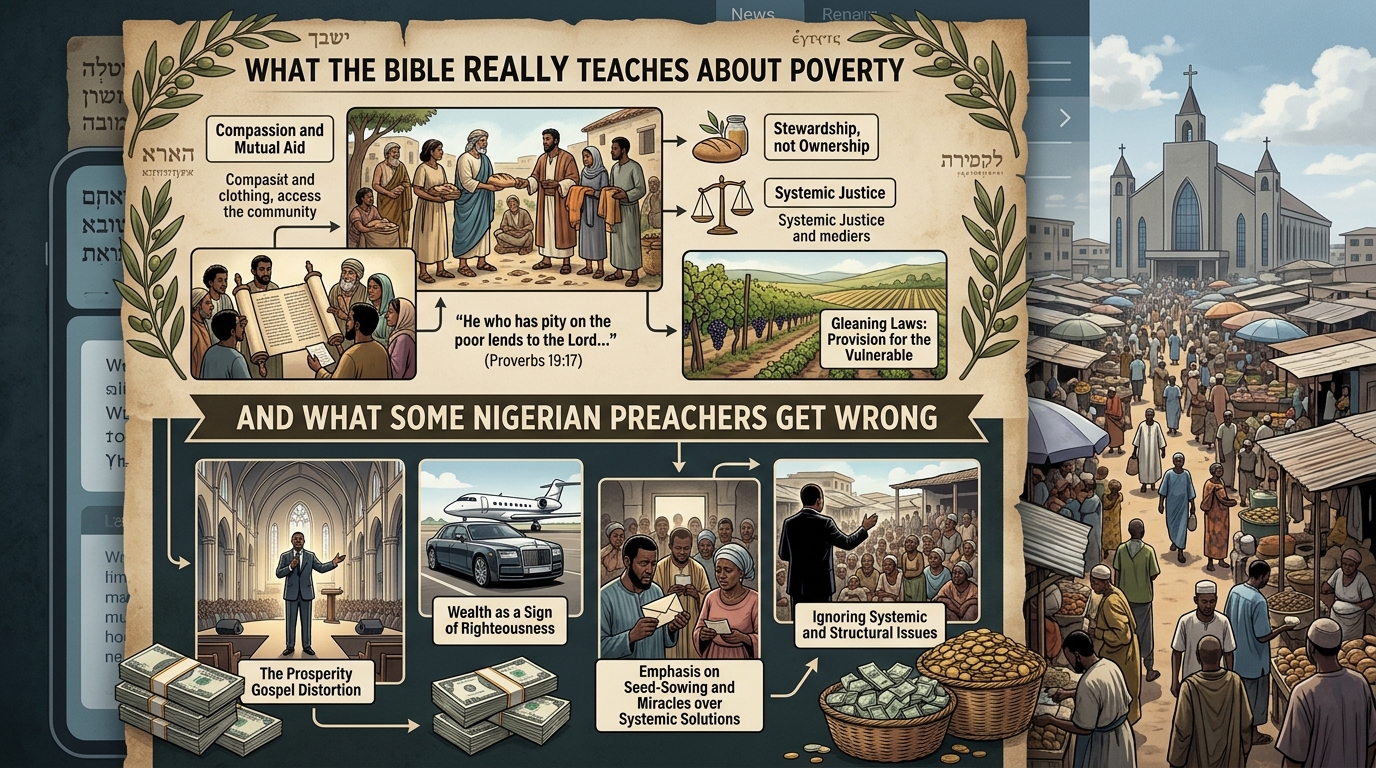
I want to say something that might make some people uncomfortable.
But I think it needs to be said — and I think deep down, many Nigerian Christians already feel it even if nobody in their church is saying it out loud.
The prosperity gospel that dominates so much of Nigerian Christianity today is not the full picture of what the Bible teaches about wealth and poverty. In some important ways, it is not even close to the full picture.
I am not saying God does not bless people. I am not saying faith does not matter. I am not saying your pastor does not love you.
I am saying that when a hungry congregation is told that their empty accounts are evidence of insufficient faith, and then their tithes and offerings are collected — something has gone wrong.
Theologically wrong, morally wrong.
And the Bible is clear enough about this that we owe it to ourselves to look honestly at what it actually says.
What the Old Testament Really Says
The prosperity gospel loves the Old Testament. Abraham’s wealth.
The blessings of Deuteronomy 28. Proverbs 10:22 — “The blessing of the Lord brings wealth.” These are real scriptures. Nobody is denying them.
But the same Old Testament contains things the prosperity gospel never quotes.
Proverbs 28:6 says — “Better is a poor man who walks in his integrity than a rich man who is crooked in his ways.”
The same book being used to promise you financial breakthrough is also telling you that a poor man with integrity is worth more than a wealthy man without it.
The Psalms — which prosperity preachers love to quote for breakthrough, are also full of righteous poor people crying to God not because of their sin but because of injustice done to them. 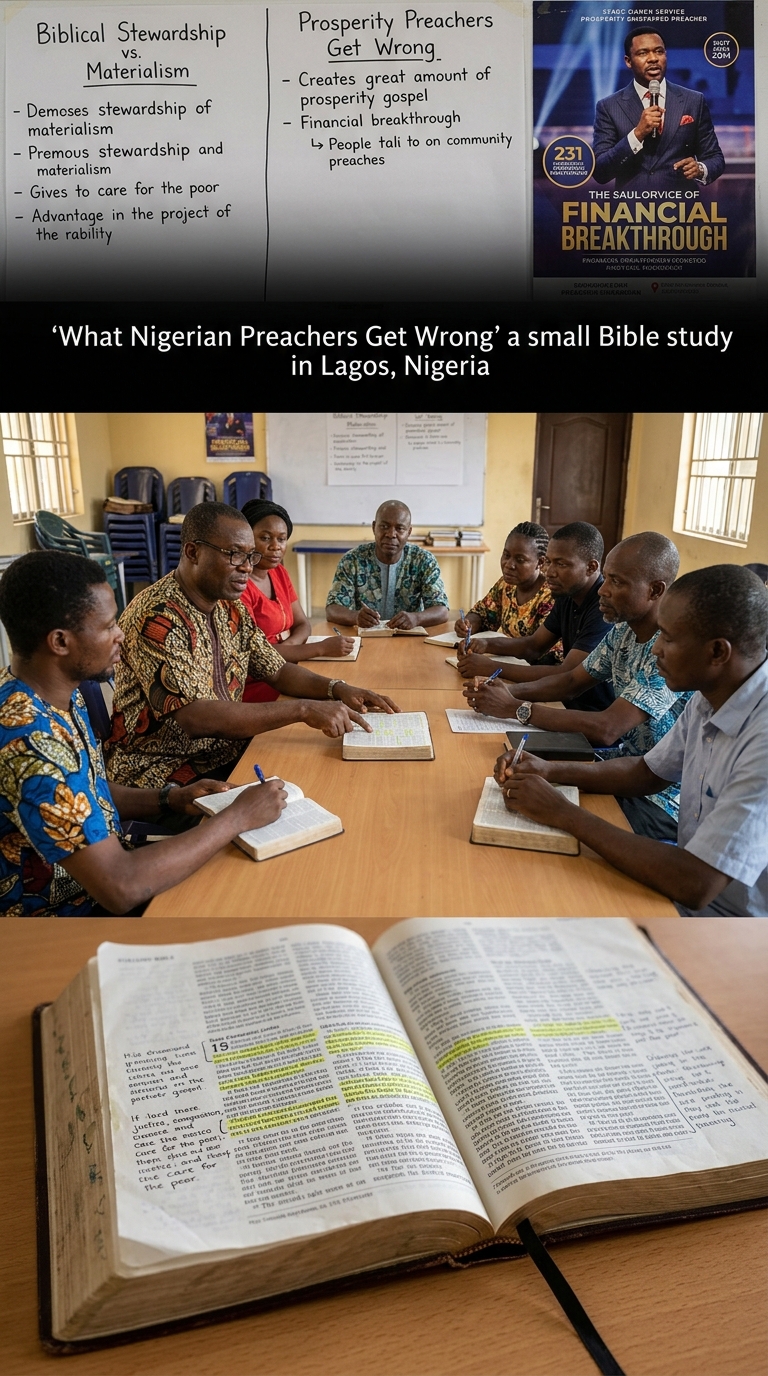
Psalm 9, Psalm 10, Psalm 12 — all of them describe the righteous poor being crushed by the powerful wicked.
And the psalmists do not conclude that the poor deserve their poverty. They conclude that God is furious at those doing the oppressing and that justice is coming.
Then there are the prophets. Isaiah. Amos. Micah. Jeremiah. These men spent enormous energy condemning the systems and the people that created and maintained poverty.
Amos 5 contains one of the most direct economic critiques in all of scripture. God says he despises the religious ceremonies the worship, the songs, the offerings of people who trample the poor and push aside the needy in the marketplace.
God is not telling those people to tithe more. He is telling them to stop oppressing people.
What Jesus Actually Taught
If the Old Testament is complicated for prosperity theology, the New Testament is even more so.
Because Jesus talked about money more than almost any other subject. And what he said is genuinely difficult to fit into a prosperity framework.
The Beatitudes in Matthew 5 open with — “Blessed are the poor in spirit, for theirs is the kingdom of heaven.” Luke’s version is more direct still “Blessed are you who are poor, for yours is the kingdom of God.”
Jesus is not describing a temporary condition to be overcome through enough faith and enough giving. He is declaring God’s particular solidarity with those who have little.
The rich young ruler in Mark 10 walked away from Jesus sad because he had great wealth he was unwilling to give up.
Jesus did not chase him down and offer a softer version of discipleship. He let him go.
Then he said something that should make every prosperity preacher pause “How hard it is for the rich to enter the kingdom of God. It is easier for a camel to go through the eye of a needle than for a rich man to enter the kingdom of God.”
His disciples were shocked. Jesus did not walk it back.
Zacchaeus in Luke 19 is celebrated not because he became wealthy but because he gave half his possessions to the poor and restored fourfold what he had taken dishonestly. Jesus called that salvation. Not financial breakthrough. Giving it away.
And then there is the parable of Lazarus and the rich man in Luke 16. A poor man covered in sores sits at the gate of a wealthy man who ignores him completely. Both die.
The poor man goes to paradise. The rich man goes to torment. Jesus does not say the rich man was evil or criminal.
He simply had good things in his lifetime while Lazarus had nothing — and he did nothing about it.
That parable should keep every comfortable Christian awake at night. It keeps me thinking.
What the Early Church Actually Did
The earliest Christians did not practice prosperity theology. They practiced something much closer to the opposite.
Acts 2 and Acts 4 describe the Jerusalem church sharing possessions so radically that there was not a needy person among them. People sold property and land and brought the money to the apostles for distribution according to need.
This was not tithing to a building fund. This was genuine redistribution — people voluntarily making sure that nobody in their community went without.
Paul’s letters repeatedly address the obligation of wealthier congregations to support poorer ones.
His famous collection for the Jerusalem church in 2 Corinthians 8 and 9 was not a fundraising campaign.
It was an act of solidarity between communities — one group sharing with another in genuine material need.
And James 2 is perhaps the most direct of all. “If a brother or sister is poorly clothed and lacking daily food, and one of you says to them — go in peace, be warmed and filled — without giving them the things needed for the body, what good is that?”
James does not say pray for their financial breakthrough. He does not say teach them to tithe more so they can unlock their blessing. He says give them what they need.
What Nigerian Preachers Get Wrong
Let me be fair here. The prosperity gospel is not built on nothing.
God does bless people materially. Abraham was wealthy. Solomon was wealthy.
There is no sin in having resources.
But the prosperity gospel makes moves that the Bible simply does not support.
The first move is treating wealth as the primary evidence of God’s favor.
The Bible treats righteousness, integrity, and faithfulness as the primary evidence of God’s favor.
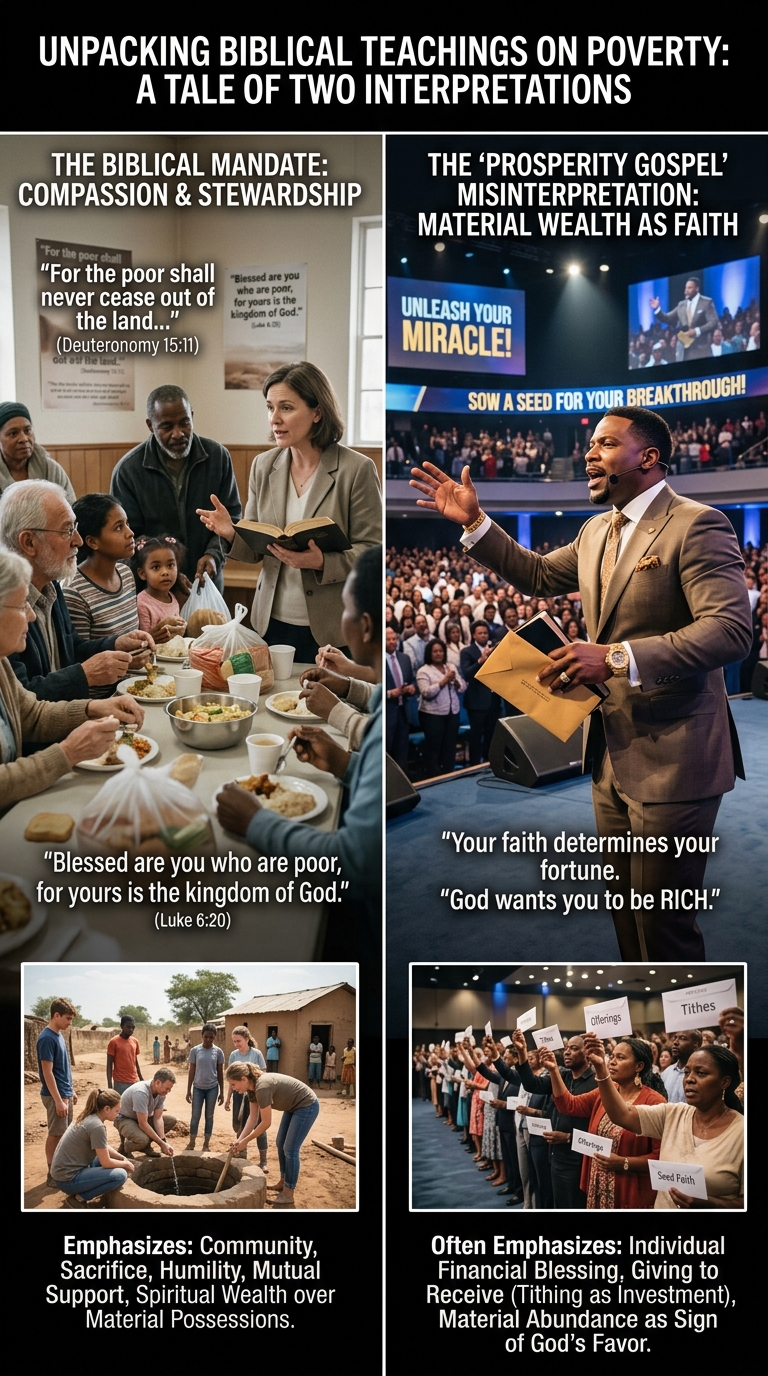 It specifically and repeatedly warns that wealth is often acquired through injustice and maintained through exploitation.
The second move is treating poverty as primarily a spiritual problem with a spiritual solution.
The Bible treats poverty as primarily a structural problem with a justice solution. The prophets did not tell poor people to tithe more.
They told powerful people to stop stealing from the poor. Those are very different messages.
The third move is the one I find hardest to forgive.
Exploiting the genuine faith and desperate hope of people who are already struggling.
When a pastor stands before a congregation that cannot afford three meals a day and tells them their poverty is evidence of insufficient faith and then collects their money, that pastor has crossed a line that the Bible addresses directly and harshly.
What Nigerian Christianity Needs Instead
This is not an argument for the church to ignore material poverty or tell people that their financial situation does not matter.
God cares about the material wellbeing of his people. Prayer is real. Provision is real.
But a Christianity that is honest about scripture would do several things differently.
It would preach about structural injustice, about the systems and policies that concentrate wealth among the few while millions go without.
It would hold the powerful accountable rather than only celebrating them. It would direct its own considerable resources toward genuine need rather than larger buildings and private aircraft.
And it would look a struggling Christian in the eye and tell them the truth, your poverty is not evidence that God has abandoned you or that your faith is weak. And then it would work concretely to change their circumstances.
That is a harder gospel to preach. It makes fewer people wealthy quickly. It is less exciting than a breakthrough testimony.
But it is closer to what Jesus actually taught. And in the end, that is the only thing that matters.
FAQs
Q: Is it wrong to be wealthy as a Christian?
A: No. The Bible does not condemn wealth itself. It warns repeatedly about the love of money, the danger of trusting in wealth, and the obligation of those with resources to be generous. Wealth becomes a problem when it replaces God, when it is obtained through injustice, or when it is hoarded while others suffer nearby.
Q: Does God want Christians to be rich? A: The Bible is far more concerned with Christians being righteous, generous, and faithful than with them being financially prosperous. Jesus promised his followers persecution, suffering, and eternal life. Financial abundance was never part of the core promise.
Q: Is tithing biblical?
A: Tithing has clear Old Testament roots and was part of the system that supported the Levitical priesthood and provided for the poor in Israel. Its direct application to New Testament Christianity is genuinely debated among biblical scholars. The New Testament emphasizes generous giving according to ability and need rather than a fixed percentage requirement.
Q: What should I do if my pastor teaches prosperity gospel?
A: Study the scriptures for yourself. Read widely. Ask honest questions. You are responsible for your own biblical understanding and not just what you are told from a pulpit. Good questions to ask include — what is the context of this passage? What does the rest of the Bible say about this topic? Who benefits from this interpretation?
The Bible’s teaching on poverty is not comfortable for anyone.
It challenges the poor to hold on to faith and dignity.
It challenges the comfortable to examine their resources and their obligations honestly. It challenges preachers to be truthful rather than popular.
And it challenges the church to be a genuine community of solidarity rather than a platform for individual enrichment.
That challenge is worth taking seriously. Even when especially when it costs something.
Written for Networknewss.com.ng | Faith