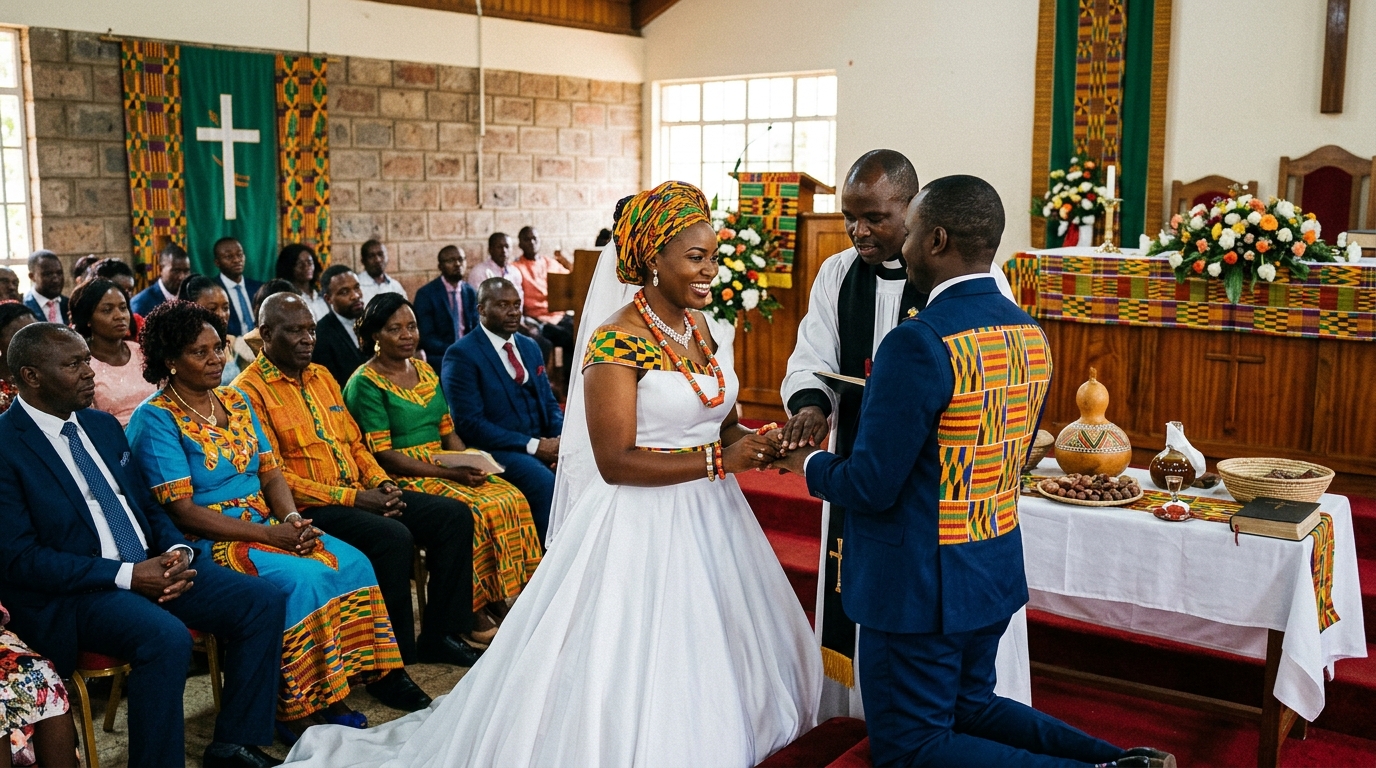
Let me tell you about a wedding I heard about in Enugu.
The family had done everything properly. The wine carrying. The kola nut. The bride price negotiation that lasted three hours and involved both families eating, arguing, laughing, and eating some more.
The elder prayed in Igbo, calling on the ancestors and on God simultaneously, the way that generation did without seeing any contradiction in it.
The young woman found her husband in the crowd and handed him the cup. Everyone cheered.
The next day they went to church. White dress. Suit. Vows before a pastor. Hymns.
A sermon about Ephesians 5. Two rings exchanged. Photographs outside the church door.
Same couple. Same week. Two completely different ceremonies.
And if you asked either family which one was the real wedding, you would get a complicated answer.
This is the situation that millions of Nigerian Christian families navigate every generation.
Two wedding traditions, one rooted in centuries of African culture, one imported through Christianity and colonialism, sitting side by side, sometimes in tension, sometimes in harmony, always in conversation.
How did this happen?
How did African traditional marriage and Christian wedding ceremonies end up in the same family, in the same week, in the same generation? And what does the Bible actually say about any of it?
That is what this article is about.
What African Traditional Marriage Actually Was
Before we talk about how Christianity changed African marriage, we need to understand what African traditional marriage actually was, because most people, including many Nigerians, have a simplified or distorted version of it in their heads.
African traditional marriage was not a single ceremony.
It was a process, sometimes lasting months or even years, involving multiple stages of negotiation, payment, ritual, and community recognition.
It was not primarily a romantic event between two individuals.
It was a covenant between two families, and in some understandings, between two lineages extending back through the ancestors and forward through the children yet to be born.
Among the Yoruba, the marriage process involved the introduction of families, the payment of eru iyawo or bride price items, the formal handing over of the bride, and various ceremonies that differed by family and by region.
Among the Igbo, the ime ego or bride price negotiation was central, accompanied by the palm wine ceremony in which the bride carried wine through the gathering and presented it to her chosen husband, publicly identifying him before both families.
Among the Efik and Ibibio, fattening rooms prepared young women for marriage in ways that combined physical preparation with spiritual and social initiation.
In all these traditions, certain things were consistent. Marriage was public, not private.
It involved community witnesses, not just the two individuals. It was covenantal, creating obligations between families that extended beyond the couple themselves.
It was accompanied by prayer and spiritual acknowledgment, calling on God, ancestors, and spiritual powers to witness and bless the union.
And critically, it was considered genuinely and completely valid.
A couple who had completed the traditional marriage process was fully married in the eyes of their community, their families, their ancestors, and their God.
No additional ceremony was required to make the marriage real.
When Christianity Arrived and Complicated Everything
When Christian missionaries arrived in Nigeria in the nineteenth century, they encountered African marriage traditions and largely did not know what to make of them.
Some missionaries were genuinely thoughtful and tried to understand what they were seeing.
They recognized that bride price was not the same as purchasing a wife, that the communal nature of African marriage reflected values the Bible itself affirmed, and that the spiritual dimensions of traditional marriage pointed toward a genuine understanding of marriage as sacred covenant.
But many missionaries, shaped by Victorian English culture as much as by biblical theology, saw African marriage practices primarily as problems to be corrected. Bride price was interpreted as commodifying women.
Polygamy, which existed in some communities, was treated as straightforwardly sinful. Traditional prayers invoking ancestors were seen as incompatible with Christian faith.
The entire framework of communal family negotiation was viewed through a cultural lens that valued individual romantic choice above family and community.
The result was that missionary Christianity introduced a new model of marriage into Nigeria, the church wedding, modeled on English Victorian practice, with a white dress, a church ceremony, a pastor officiating, and individual vows exchanged before God.
This new model was presented not just as a Christian addition to existing practice but as the only legitimate Christian form of marriage.
Couples who had only done traditional marriage were sometimes told they were living in sin. Church membership could depend on having a church wedding.
The traditional ceremony was tolerated at best and condemned at worst.
The tension this created has never fully resolved. It is still being negotiated in Nigerian Christian families right now.
What the Bible Actually Says About Marriage Ceremonies
Here is something that surprises many Nigerian Christians when they encounter it for the first time.
The Bible does not prescribe a specific marriage ceremony. There is no biblical wedding service.
There are no biblical vows in the sense of specific words that must be said. There is no biblical requirement for a religious officiant to pronounce a couple married.
The Old Testament describes marriages happening in various ways. Isaac married Rebekah by taking her into his mother’s tent, and she became his wife.
Jacob served Laban seven years for Rachel and then seven more after being given Leah first.
Boaz married Ruth through a legal process conducted at the city gate before community elders, with no religious ceremony described.
The New Testament does not establish a Christian marriage ceremony either.
Jesus attended a wedding at Cana and performed his first miracle there, but the ceremony itself is not described.
Paul writes extensively about marriage in Ephesians 5 and 1 Corinthians 7, but he describes the nature and obligations of marriage rather than prescribing how a wedding ceremony should be conducted.
The consistent biblical requirements for marriage are consent, covenant, public witness, and faithfulness.
A marriage should be freely entered, it should be a binding commitment, it should be witnessed by the community, and the couple should be faithful to each other. These are the biblical essentials.
By those standards, a properly conducted Igbo or Yoruba or Efik traditional marriage ceremony meets every biblical requirement. It involves consent, it creates a binding covenant, it is witnessed publicly by both families and the community, and it establishes a framework of faithfulness and mutual obligation.
The white dress and the church service are English cultural additions. They are not biblical requirements.
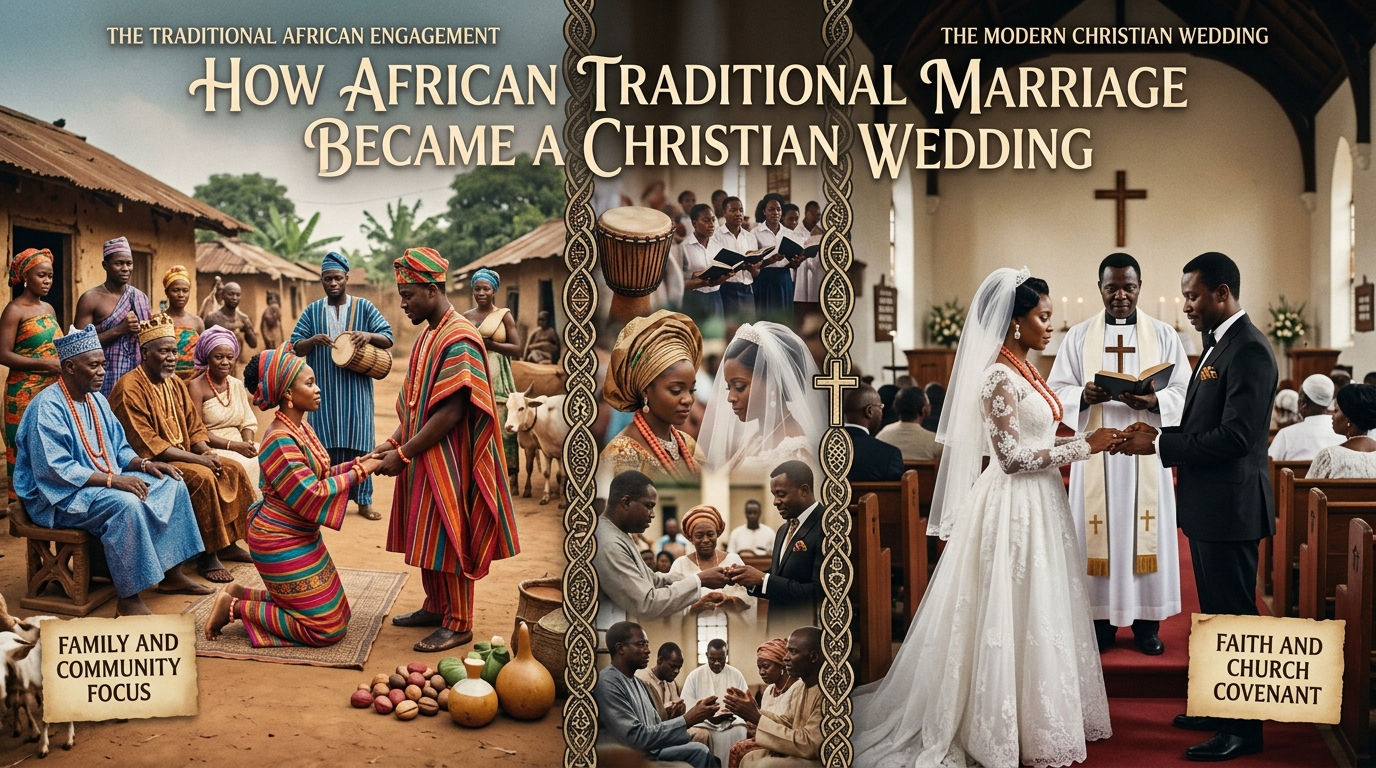 How the Two Traditions Found Their Uneasy Peace
Over the generations since Christianity arrived in Nigeria, a complex accommodation has developed between traditional marriage and church wedding that varies by region, by denomination, and by family.
In most southern Nigerian families today, traditional marriage, which Yoruba families call the introduction or engagement and Igbo families call the igba nkwu or wine carrying, is conducted first.
This is understood as the legally and culturally binding marriage. It is what makes the couple married in the eyes of their families and their community.
The church wedding follows, sometimes the next day, sometimes weeks later. For many families it is understood as the religious blessing of a marriage already made, a way of bringing the union before God in the context of the church community.
Some families are explicit about this understanding. The traditional marriage is the real marriage, they say, and the church ceremony is the thanksgiving.
Others reverse the framing and insist that only the church wedding counts before God, with the traditional marriage being a cultural formality.
Most families simply hold both without resolving the tension between them, which is perhaps the most Nigerian response possible.
The Bride Price Question
No conversation about African Christian marriage is complete without addressing bride price honestly, because it remains one of the most debated and most misunderstood aspects of African marriage tradition.
Bride price, known as owo ori in Yoruba and ime ego in Igbo, is the payment made by the groom’s family to the bride’s family as part of the marriage negotiation.
It has been criticized by some Western observers and some Nigerian feminists as commodifying women, treating them as property that can be purchased.
This criticism misunderstands what bride price actually means in its cultural context.
In traditional African understanding, bride price is not a purchase price.
It is a symbol of value, a public acknowledgment that the woman leaving her family is precious and that her loss to her birth family is real and significant.
It creates reciprocal obligation between the two families. It is an expression of honor, not ownership.
The Bible itself contains something very similar.
In ancient Israelite practice, the mohar was a payment made by the groom or his family to the bride’s family.
Jacob worked seven years, then seven more, as a form of bride price for Rachel.
The system of bride price in the Old Testament was understood not as commodification but as covenant-making, a tangible expression of commitment between families.
Many African Christian theologians have argued that bride price, properly understood, is more consistent with biblical marriage theology than the Western romantic model that replaced it, because it takes seriously the covenantal, communal, and family dimensions of marriage that the Bible itself emphasizes.
The legitimate concerns about bride price are real.
When families demand excessive amounts that young men cannot afford, delaying marriages and creating financial hardship, that is a genuine problem.
When bride price is used to control divorced women or prevent them from leaving abusive marriages, that is a serious abuse of the tradition.
These are problems worth addressing honestly.
But the tradition itself, in its original meaning, reflects values that the Bible affirms rather than contradicts.
What a Genuinely Christian African Marriage Looks Like
The question that Nigerian Christians are really wrestling with when they navigate traditional and church wedding ceremonies is a deeper one. What does a genuinely Christian marriage look like for an African person, in an African context, in the twenty-first century?
The answer is not simply to adopt Western Christian wedding practices wholesale and abandon African tradition.
That approach has produced generations of Nigerians who feel culturally homeless, neither fully African nor fully at home in a European-derived Christian culture.
The answer is also not to simply continue traditional practices unchanged and add a church service as a formality.
That can leave the deeper spiritual meaning of Christian marriage, the covenant before God, the calling to mutual love and sacrifice modeled on Christ’s love for the church, as an afterthought rather than the center.
The most honest and most faithful answer is integration. A marriage that takes seriously both the communal, covenantal, family-centered wisdom of African tradition and the Christ-centered, grace-saturated vision of marriage that the New Testament describes.
A ceremony that honors both the ancestors who established the tradition and the God who instituted marriage in the first place.
That integration looks different in different families and different communities.
There is no single formula. But it begins with taking both traditions seriously rather than dismissing either one.
FAQs
Q: Is a traditional marriage valid before God without a church ceremony?
A: Theologically, yes. The Bible does not require a church ceremony for a marriage to be valid. The biblical requirements of consent, covenant, and public witness are met by a properly conducted traditional marriage. Many African Christian theologians hold this position. However individual denominations have their own requirements for church membership and sacramental participation, so couples should understand what their specific church requires.
Q: Is bride price biblical?
A: The Bible contains similar practices in the Old Testament, suggesting that the principle behind bride price, honoring the bride’s family and creating covenant between families, has genuine biblical precedent. The specific amounts and practices vary culturally and should be governed by fairness, mutual respect, and genuine honor rather than financial exploitation.
Q: Can Christians include traditional prayers and invocations in their wedding?
A: This is genuinely debated among Nigerian Christians. Most would agree that prayers directed to God are appropriate in any context. Prayers that invoke ancestors as spiritual mediators or that call on traditional deities are more contested and depend on the theological convictions of the couple and their families.
Q: Why do some churches require couples to have a church wedding before recognizing their marriage?
A: This is a denominational policy rather than a direct biblical requirement. Churches have practical and pastoral reasons for these policies, including wanting to be sure couples have received premarital counseling and have made their commitment publicly before the congregation. But it is worth understanding that these are church policies, not universal biblical mandates.
Q: Is a white wedding dress biblical?
A: No. The white wedding dress is a relatively recent Western tradition, popularized in the nineteenth century after Queen Victoria wore white at her wedding in 1840. Before that, brides in Europe wore various colors. It has no biblical origin and no theological significance, despite sometimes being associated symbolically with purity.
The Nigerian Christian couple who does their traditional marriage on Saturday and their church wedding on Sunday is not confused or compromised. They are navigating something genuinely complex, the meeting of two traditions, each with real wisdom and real limitations, each pointing in its own way toward the sacred covenant that marriage is supposed to be.
The African tradition says marriage is bigger than two people. It involves families, communities, ancestors, and the future. That is true, and the Bible agrees.
The Christian tradition says marriage is a covenant before God, modeled on Christ’s self-giving love, and pointing toward something eternal. That is also true, and African tradition at its best has always understood marriage as sacred.
The couple who holds both of those truths together, who honors their family and their faith simultaneously, who refuses to let either culture or religion flatten the full meaning of what they are doing, that couple is not compromising.
They are being fully African and fully Christian at the same time.
And that, when you think about it, is exactly what Nigerian Christianity at its best has always been.
Written for Networknewss.com.ng | Faith