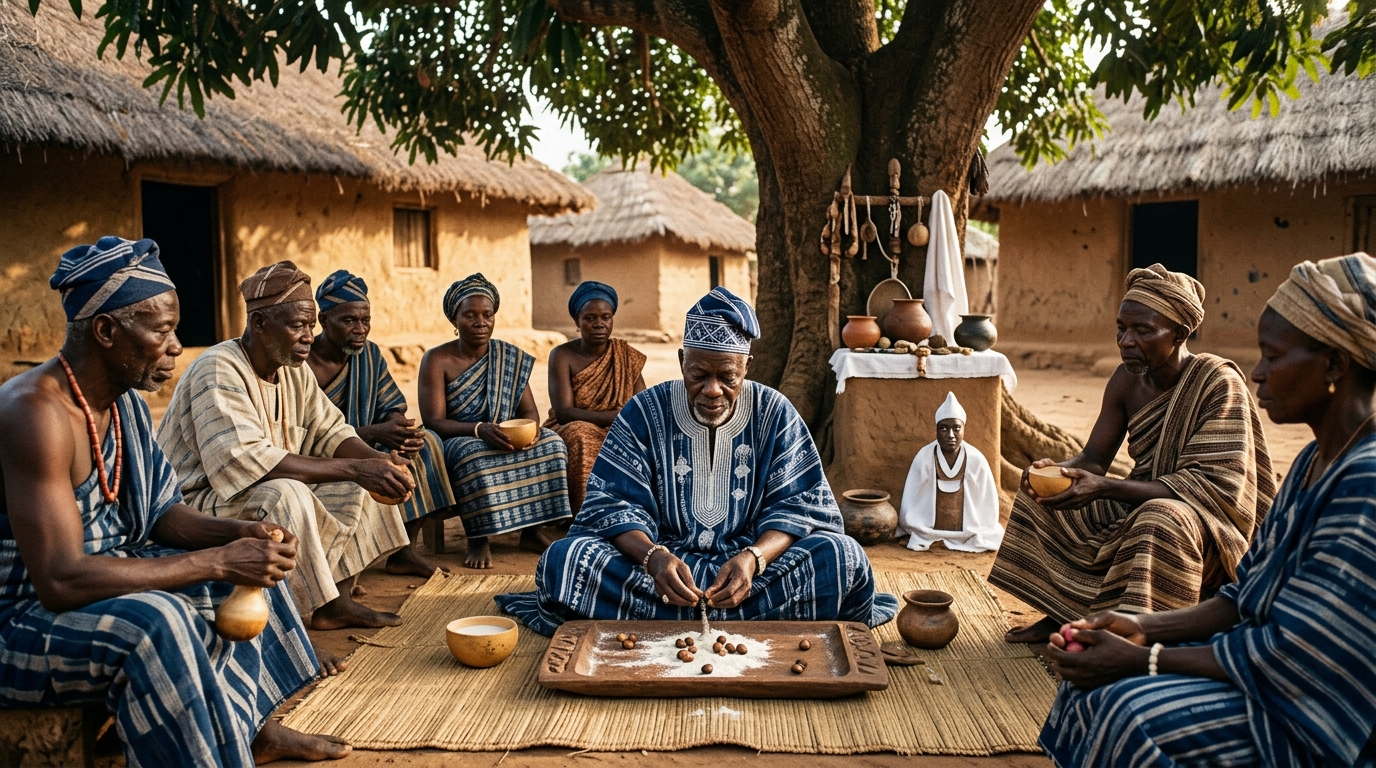
I want to start this with something that might surprise you.
When the first Christian missionaries arrived in Yorubaland in the nineteenth century, they expected to meet people who had no concept of God.
People who worshipped idols blindly, who had no spiritual framework, no theology, no understanding of a supreme being.
What they found instead stopped some of them completely in their tracks.
The Yoruba people already believed in one supreme God.
They already had a name for him. They already understood him as the creator of all things, as the source of all life, as a being so great and so holy that ordinary humans could not approach him directly.
His name was Olodumare.
And the more carefully the missionaries studied what the Yoruba believed about Olodumare, the more uncomfortable some of them became.
Because what the Yoruba believed about God, before any missionary ever set foot on their soil, was not as far from the Bible as anyone had assumed.
This is that story.
Who Exactly Is Olodumare
The name Olodumare is ancient. Nobody alive today can say with certainty how old it is, because Yoruba traditional religion was passed down orally for centuries before anyone wrote it down. But the concept behind the name is clear and consistent across every part of Yorubaland, from Lagos to Ibadan, from Ile-Ife to Ilorin.
Olodumare is the supreme being. The owner of all things. The source from which everything originates and to which everything ultimately returns.
The name itself breaks down meaningfully in Yoruba. Olo means owner.Odu carries a sense of something vast, great, and complete. Mare suggests permanence and continuity. Put it together and you get something close to — the owner of all that is vast, eternal, and complete.
Not an idol. Not a local deity. Not a spirit of the river or the forest. The supreme being above all other beings.
Samuel Ajayi Crowther, the freed slave who became Africa’s first Anglican bishop and who was himself Yoruba, wrote extensively about Olodumare after his return to Nigeria as a missionary. He was struck by how the Yoruba concept of the supreme being overlapped with the God of the Bible in significant ways. His observations were so detailed and so thoughtful that they influenced how subsequent missionaries approached Yoruba religion entirely.
What the Yoruba Believed Olodumare Was Like
Traditional Yoruba theology — and yes, it deserves to be called theology, because it was a serious, systematic body of thought about the nature of the divine — attributed specific qualities to Olodumare that are worth examining carefully.
He was the creator of everything. Yoruba oral tradition teaches that Olodumare created the universe, the earth, human beings, and all living things. This was not creation through one of the lesser orishas acting independently. The orishas were agents and intermediaries. Olodumare was the source. The creative power behind everything that exists originated with him.
He was all-knowing. The Yoruba described Olodumare as Oba Orun — the King of Heaven — who saw and knew all things. Nothing was hidden from him. Human actions done in secret were visible to Olodumare even when they were invisible to other people. This understanding of divine omniscience was deeply embedded in Yoruba moral teaching.
He was all-powerful. Nothing could resist Olodumare’s will. Nothing could overpower him. The lesser spiritual beings — the orishas — were powerful, yes, but their power was derived power, power that Olodumare had given them. His own power was original and unlimited.
He was just. Yoruba traditional religion taught that Olodumare was the ultimate source of moral order. Right and wrong were not arbitrary human inventions. They were grounded in the nature of Olodumare himself. He rewarded good and ultimately held people accountable for evil, though the mechanisms for this accountability were understood differently than in Christianity.
He was beyond direct human reach.
This is perhaps the most fascinating aspect of Yoruba theology. The Yoruba understood Olodumare as so great, so transcendent, so far above ordinary human existence, that people did not typically pray to him directly. They approached him through the orishas — spiritual intermediaries who were more accessible, more specialized, more responsive to particular human needs.
This was not because Olodumare did not care about human beings. It was because the distance between his greatness and human smallness was so vast that direct access required mediation.
The Orishas — Intermediaries, Not Gods
This is the point where many Nigerian Christians, when they hear about Yoruba traditional religion, immediately become uncomfortable. The orishas. Sango. Ogun. Yemoja. Osun. Are these not idols? Are these not the false gods that Christianity came to replace?
The question deserves a careful and honest answer rather than a quick dismissal.
In Yoruba traditional theology, the orishas were not independent gods in competition with Olodumare. They were created spiritual beings — powerful, specialized, and capable of intervening in human affairs — who existed beneath Olodumare and derived their power from him.
Some scholars of Yoruba religion have compared the orisha to the angels in biblical theology. Not equal to God. Not independent of God. But spiritual beings created by God, given specific roles and powers, and capable of interacting with human beings in ways that the transcendent supreme being did not always do directly.
This comparison is not perfect, and many Nigerian Christians would dispute it strongly. But it is worth taking seriously rather than dismissing, because it helps explain why the Yoruba theological framework was not as alien to the biblical worldview as the early missionaries initially assumed.
What is clear is that Olodumare, in traditional Yoruba thought, was not one deity among equals. He was the supreme being, above and beyond all other spiritual realities. The orishas existed within the world he made. They operated within the order he established. And ultimately they were accountable to him.
Ori — The Personal Divine
One of the most profound and distinctive elements of Yoruba spiritual thought is the concept of Ori.
Ori literally means head, but in Yoruba spiritual understanding it refers to something much deeper. Your Ori is your personal spiritual identity, your destiny, the divine portion that was given specifically to you before your birth. It is the most personal form of spiritual reality in Yoruba thought — more immediately connected to you than any orisha, more specifically yours than any external spiritual force.
The Yoruba believed that before a person was born into the physical world, their soul knelt before Olodumare and chose its Ori — its destiny, its life path, its fundamental spiritual character. This choice was made in the spiritual realm and then forgotten at birth. But it shaped everything that followed.
This is why in Yoruba thought, no orisha is more important to an individual than their own Ori. You might pray to Sango for protection or to Osun for fertility. But if your Ori does not align with what you are seeking, no orisha can override it. Your Ori is the most fundamental spiritual reality of your personal existence.
For Nigerian Christians reading this, the concept of Ori raises interesting questions about destiny, divine purpose, and the nature of calling that are worth sitting with rather than dismissing.
What Happened When Christianity Arrived
When Christianity arrived in Yorubaland, it did not arrive in spiritual emptiness. It arrived in a world already saturated with serious, sophisticated thinking about God, about destiny, about moral order, and about the relationship between human beings and the divine.
This created both opportunity and complexity.
The opportunity was real. Because the Yoruba already believed in Olodumare, missionaries did not have to convince them that a supreme God existed. They already knew. What the gospel offered was something additional and specific — the claim that this supreme God had entered human history personally, in the person of Jesus Christ, to reconcile human beings to himself directly rather than through intermediaries.
For many Yoruba people, that claim resonated deeply. The idea that the great, transcendent Olodumare had made himself accessible — not through orishas or mediators but through his own Son — was not alien to their spiritual framework. In some ways it completed it.
The complexity was also real. Christianity asked Yoruba converts to abandon the orishas entirely, to reject the entire system of spiritual intermediaries that had organized their religious life for generations. For many people this was not merely a theological change. It was a cultural rupture, a break from ancestors, from community, from identity.
This tension — between embracing Christ and abandoning Yoruba spiritual culture entirely — has never been fully resolved in Yoruba Christianity. It shows up in debates about prayer styles, about spiritual warfare, about the meaning of traditional ceremonies, about what a Yoruba Christian can and cannot participate in.
These are not easy questions. And pretending they are easy has never helped anyone.
What This Means for Yoruba Christians Today
Understanding what your Yoruba ancestors believed about God before Christianity arrived does not weaken your Christian faith. In my view, it actually has the potential to deepen it.
It shows that God was not absent from Yoruba people before missionaries came. The knowledge of a supreme being, the moral order grounded in divine nature, the sense that human beings are spiritually significant and destined — these were already present. Theologians call this general revelation, the knowledge of God that is available to all human beings through creation and conscience, even without the specific revelation of scripture.
Paul makes this argument directly in Romans 1:19 to 20. The knowledge of God is accessible to all people through the created world. No nation, no culture, no people has ever been entirely without it.
Yoruba traditional belief in Olodumare is one of the most striking examples of this principle in African religious history. The Yoruba knew something real about God. Christianity, at its best, did not come to erase that knowledge. It came to complete it, to name the God they already sensed, and to reveal what that God had done in Christ to bring human beings back to himself.
That is a richer and more honest story than the version that says Christianity arrived among a people who knew nothing about God.
And it is a story that Yoruba Christians especially have every reason to be proud of.
FAQs
Q: Is Olodumare the same as the Christian God?
A: This is one of the most debated questions in African Christian theology. Most Nigerian Christian scholars would say that Olodumare and the God of the Bible are not identical — the God of the Bible has revealed himself specifically in scripture and in Jesus Christ in ways that go far beyond what Yoruba tradition knew. But many would also say that Yoruba belief in Olodumare represents a genuine, if incomplete, awareness of the true God, consistent with what Paul describes in Romans 1 and Acts 17.
Q: Should Yoruba Christians know about traditional religion?
A: Yes, for the same reason that Jewish Christians benefit from knowing the Old Testament. Understanding where your people came from spiritually helps you understand your own faith more deeply and engage more honestly with the culture around you.
Q: Are the orishas real spiritual beings?
A: Christian theology, including most Nigerian Pentecostal theology, would say that the spiritual beings behind the orishas are real but are not to be worshipped or invoked. The biblical framework understands the spiritual world as genuinely populated with created spiritual beings, some of which are in rebellion against God. Engagement with them outside the authority of Christ is considered spiritually dangerous.
Q: Did any Yoruba people believe in Olodumare alone without the orishas?
A: Yes. There is historical evidence of individuals and communities within Yoruba tradition who emphasized Olodumare above the orishas and maintained a more monotheistic practice. These cases were not the majority, but they existed and are significant.
—
The Yoruba did not meet an unknown God when Christianity arrived. They met, in the fullness of the gospel, the God they had always sensed was there, the one their ancestors called Olodumare, now revealed personally and completely in Jesus Christ.
That is not a small thing. That is one of the most profound moments in the entire history of African Christianity.
And it happened right here, in Nigeria, in Yorubaland, among a people whose spiritual intelligence and theological depth the world has never fully appreciated.
Written for Networknewss.com.ng | History & Heritage