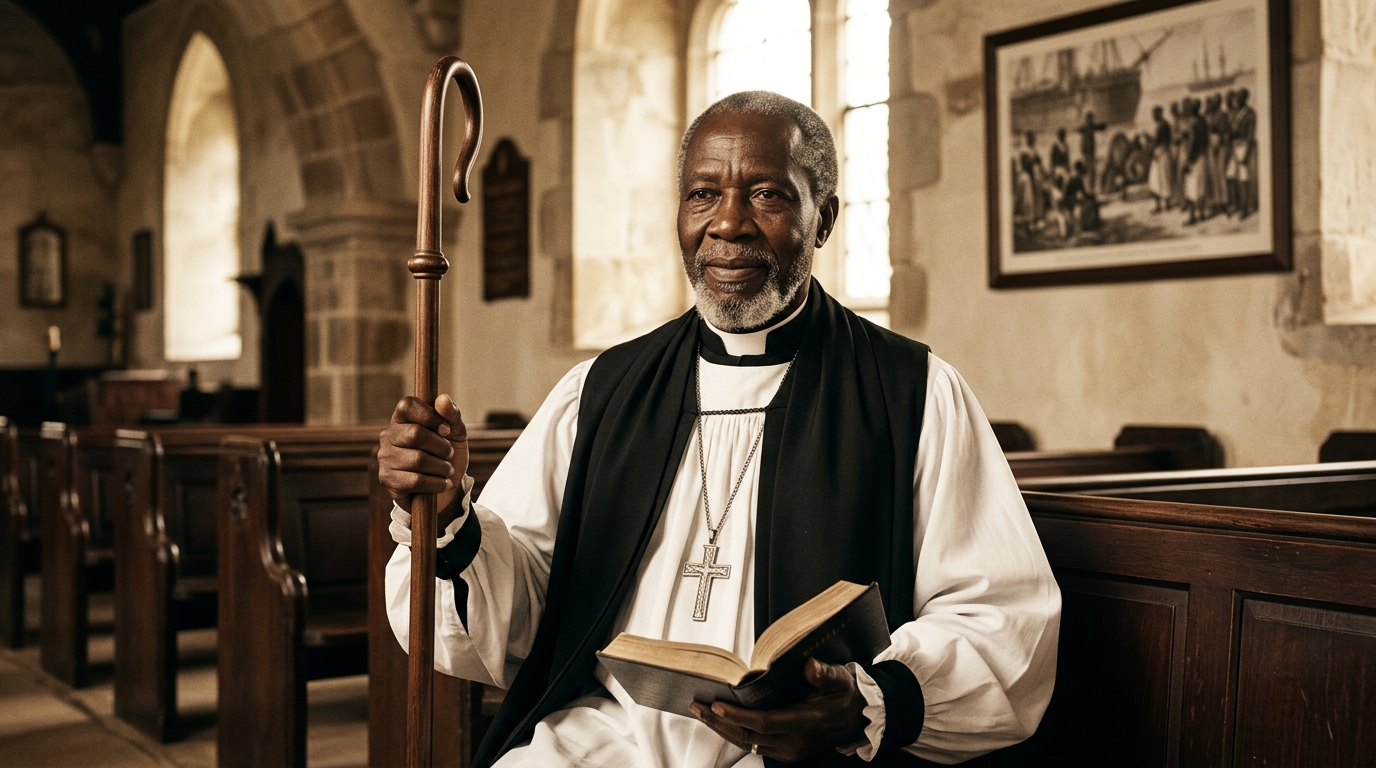
I want to ask you something honestly. Did anyone ever teach you about Samuel Ajayi Crowther in church? In school? Anywhere?
Because they never taught me either. And that is a problem — because this man’s story is one of the most extraordinary things that has ever happened in African Christian history, and most Nigerian Christians have never heard his name.
Let me tell you about him.
The Boy From Osogun
His name was Ajayi. He was twelve years old when slavers raided his village of Osogun, a small Yoruba town in present-day Oyo State, in 1821.
The attack came without warning. Houses burned. Families were torn apart.
Young Ajayi was seized, chained, and marched toward the coast with hundreds of others. He was terrified. He was alone.
And he had absolutely no idea that this moment of total darkness was actually the beginning of the most remarkable life in Nigerian Christian history.
That same boy, taken from his home in chains, would one day stand in Canterbury Cathedral in England and be consecrated as a bishop. The first African bishop the Anglican Church had ever ordained.
Chew on that for a moment.
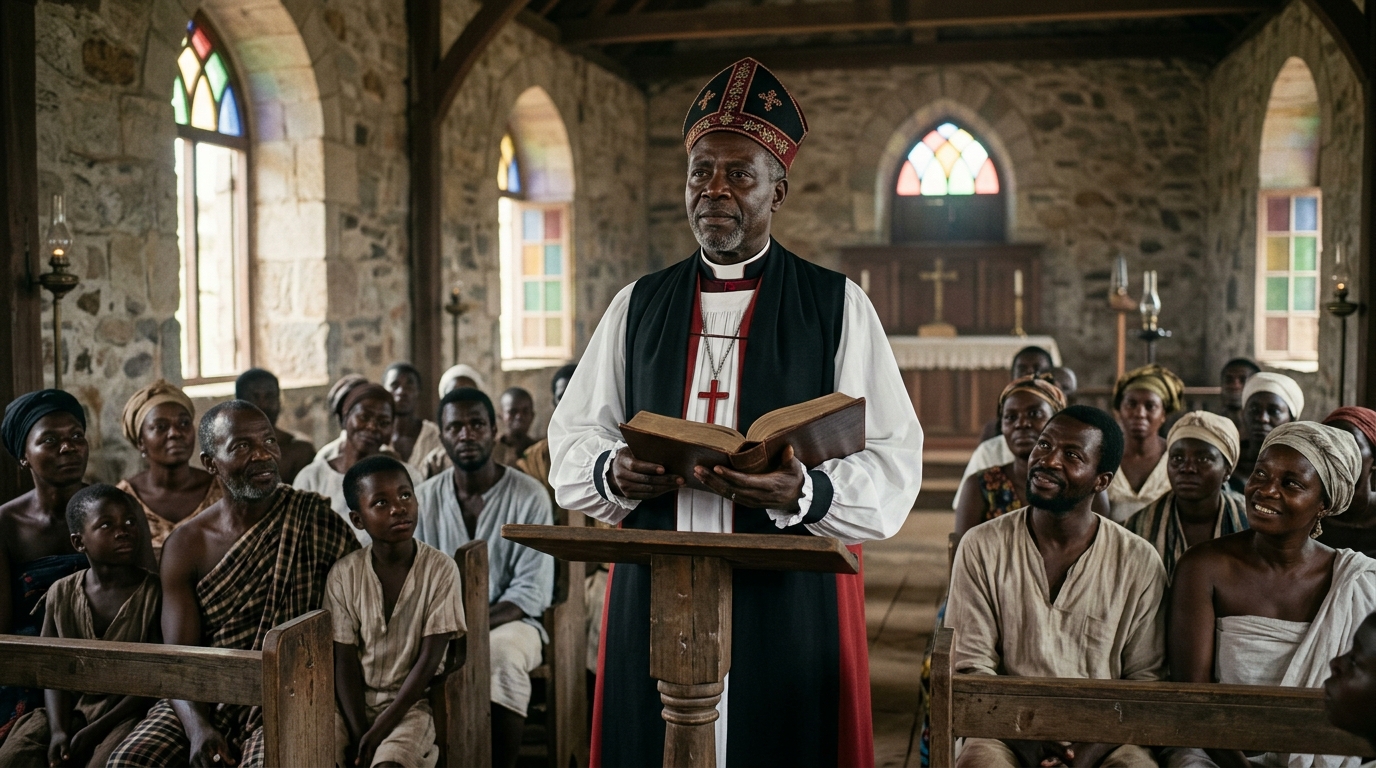 The Rescue
Ajayi spent months being passed between slave traders. Eventually he was loaded onto a Portuguese slave ship headed for the Americas. If that ship had completed its journey, you and I would never have heard his name.
But in 1822, a British Royal Navy patrol intercepted the ship and freed the captives. Ajayi was taken to Freetown, Sierra Leone, a colony set up specifically for freed slaves and that is where everything changed.
In Freetown, he encountered Christian missionaries for the first time.
He enrolled in a Church Missionary Society school and proved to be something special.
Languages came to him like breathing he eventually spoke Yoruba, English, Igbo, Hausa, Nupe, and several other languages fluently. His teachers noticed. The church noticed.
In 1825, at around sixteen years old, he was baptized and took the name Samuel Ajayi Crowther.
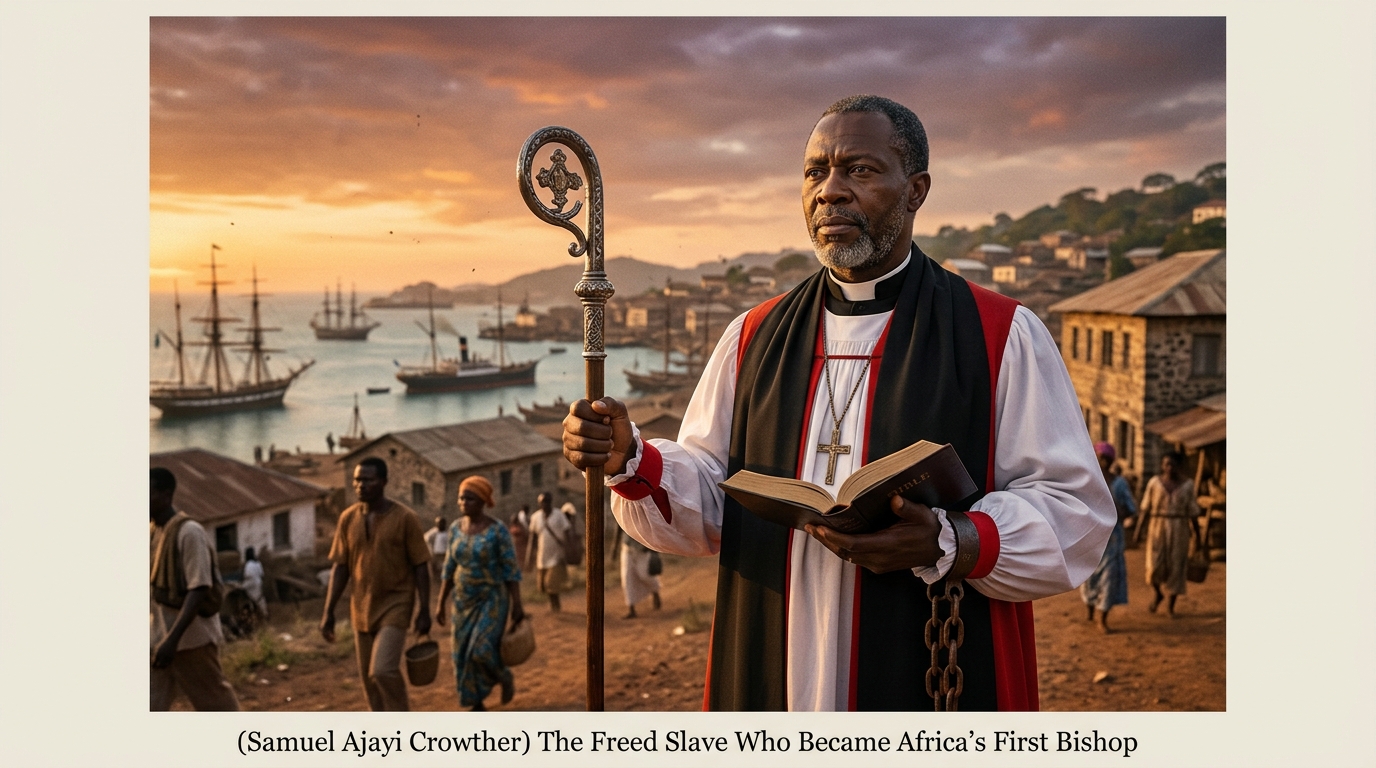 From Classroom to Cathedral
What Crowther achieved next is the kind of thing that makes you stop and marvel at what God can do with one willing person.
The CMS sent him to England in 1826 for further education, one of the first Africans ever to study there under missionary sponsorship.
He came back, became a teacher, then a catechist, then a full missionary.
In 1843 he became the first African ever ordained as an Anglican priest.
Then he joined the Niger Expeditions of the 1840s and 1850s, traveling deep into Nigerian territory, making contacts, planting seeds of faith.
He translated the entire Bible into Yoruba. He compiled Yoruba and Igbo dictionaries. He wrote language grammars.
The man was doing the work of ten people.
And then came 1864.
The Day That Changed African Christianity Forever
On June 29, 1864, Samuel Ajayi Crowther was consecrated as Bishop of the Niger Territories at Canterbury Cathedral in England.
Think about what that means. The boy who was kidnapped from Osogun.
The child who crossed the Atlantic in a slave ship. Standing in one of the most famous cathedrals in the world. Being made a bishop.
He was sixty-five years old. And the significance was not just personal.
That moment was a declaration to the entire world, Africans could lead the church. Not just attend it. Not just receive from it. Lead it.
The Reunion That Would Break Anyone
Here is the part of Crowther’s story that gets me every time.
Years after being separated during the slave raid, Crowther was traveling through Abeokuta in present-day Ogun State on a missionary journey. And he found his mother, Afala, and his sister alive, in that community, not knowing whether their son and brother was dead or alive.
The reunion was overwhelming. Crowther baptized his mother and sister shortly after.
The woman who had mourned her son as lost now watched him lead worship as an ordained minister of God.
If that is not a God story, I do not know what is.
What Happened in His Later Years
It was not all smooth. In his later years, younger European missionaries began questioning Crowther’s leadership of the Niger Mission. Some of it was genuine organizational concern. But a lot of it was racism — the growing colonial belief that Africans simply were not capable of leading anything significant.
The painful irony is almost too much. The first African bishop, being told by European latecomers that Africans cannot lead.
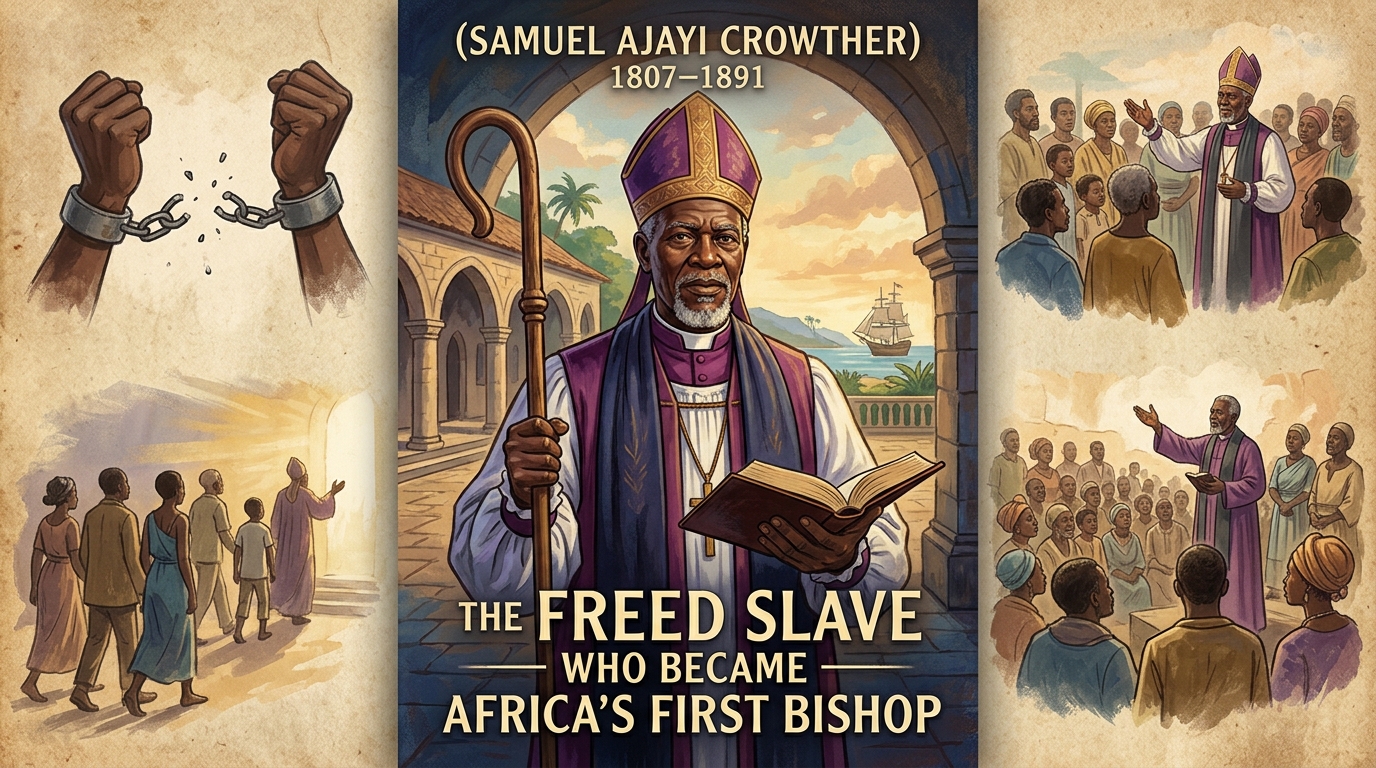 Crowther handled it with a grace that honestly puts most of us to shame. He never attacked publicly.
He never retaliated. He kept preaching, kept translating, kept mentoring Nigerian clergy until his body gave out.
He died on December 31, 1891, in Lagos.
Why Nigeria Must Remember Him
Every Nigerian who reads the Bible in Yoruba is reading a translation that Crowther produced. Every African Anglican bishop ordained since 1864 walks a path he opened.
Every Nigerian Christian who leads their own church or ministry consciously or not owes something to the precedent he established.
Yet his name is barely mentioned in Nigerian churches today. Most believers have never heard of him.
That needs to change.
What His Life Says to You Today
Three things stand out to me from Crowther’s life that are directly relevant to anyone reading this.
First God’s plan for your life cannot be destroyed by what people do to you. Slavery was designed to permanently erase people.
It took everything from Ajayi. Everything except what God had placed inside him. Whatever has been taken from you, that principle still holds.
Second faith and intelligence belong together.
Crowther was a deep scholar and a devoted believer at the same time.
He did not choose between his mind and his faith. He used both fully. Nigerian Christianity needs more of that combination today.
Third dignity is maintained, not begged for.
When people tried to diminish him, Crowther did not collapse or retaliate. He kept doing the work. His quiet, consistent faithfulness was itself a form of resistance that outlasted every attack against him.
FAQs
Q: Where is Samuel Ajayi Crowther buried? A: He is buried at the Cathedral Church of Christ, Marina, Lagos — one of the oldest Anglican churches in Nigeria.
Q: Is the Yoruba Bible still based on his translation? A: His 1884 translation has been revised multiple times, but his foundational work remains the basis of Yoruba scripture in the Anglican tradition.
Q: Did he ever go back to his hometown? A: Yes. His missionary journeys took him through the Yoruba interior, including near Osogun where he was born. Those visits were deeply emotional for him.
Q: Why is he not better known in Nigerian churches? A: Partly because his connection to colonial missionary structures made him complicated for post-independence Nigerian Christianity to celebrate fully. Partly because Pentecostal and Aladura movements that dominate today trace different lineages. But awareness of his legacy is slowly growing.
Samuel Ajayi Crowther started life in chains. He ended it as a bishop. Everything in between is a testimony to what God does with broken beginnings and faithful hearts.
Nigeria should know this man. The church should tell his story. And if you have ever wondered whether God can still do something meaningful with your life given where you are starting from — read this story again.
Written for Networknewss.com.ng | History & Heritage