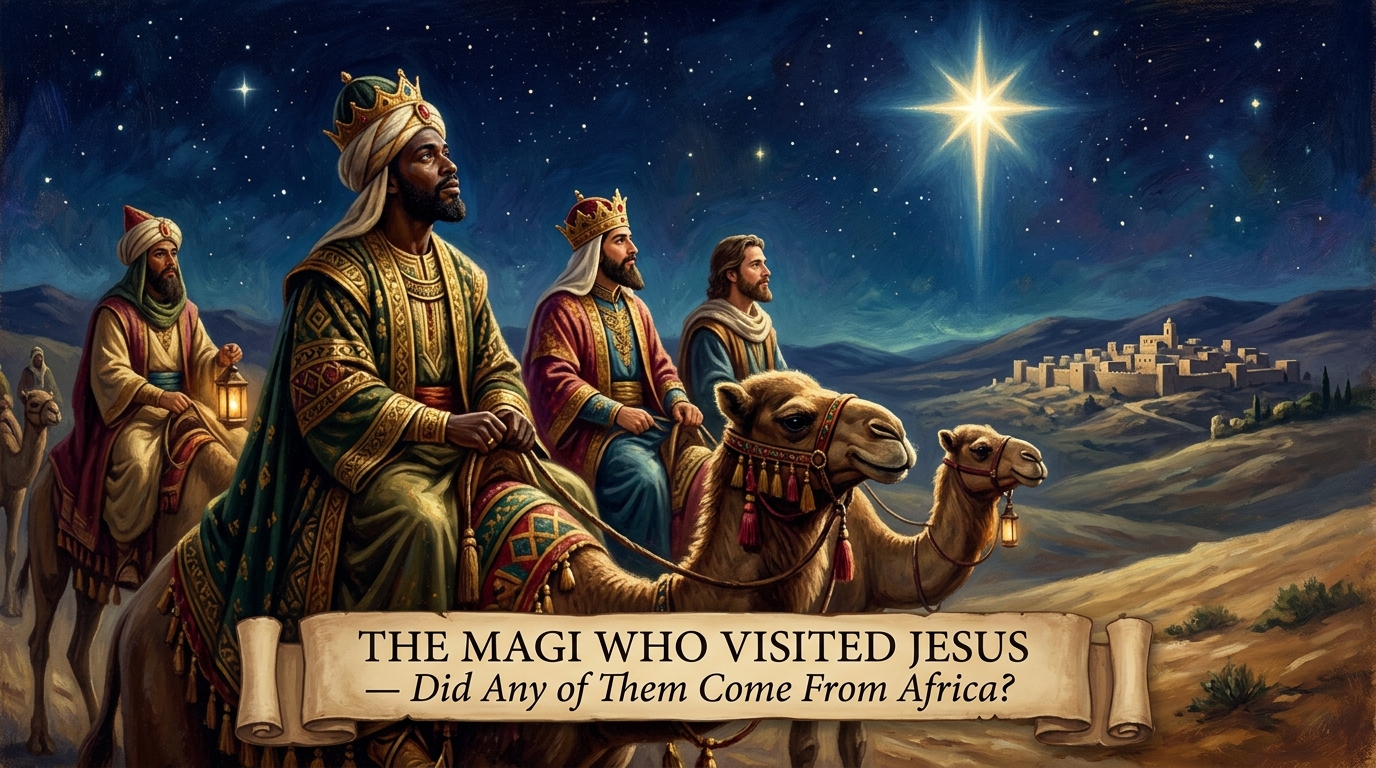
Every December, across Nigeria and around the world, nativity scenes are set up in churches, schools, and living rooms.
Three figures always appear. Robed in rich colours, carrying gifts, kneeling before a manger. We call them the three wise men, or the three kings.
We give them names — Caspar, Melchior, and Balthasar. We dress them in crowns. We sing songs about them.
We place them in our Christmas cards and our carol services as though their story is completely settled and completely understood.
It is not.
The story of the Magi is one of the most fascinating, most debated, and most misunderstood passages in the entire New Testament.
And buried inside that debate is a question that African Christians have every reason to ask seriously.
Did any of the Magi come from Africa?
The honest answer is more interesting than most people realize.
And getting to it requires us to go back to the text itself, strip away centuries of tradition and assumption, and ask what Matthew actually wrote, and what he did not write.
What the Bible Actually Says About the Magi
Open Matthew 2 and read it carefully, because most of what people think they know about the wise men is not actually in the text.
Matthew 2:1 to 2 says, “After Jesus was born in Bethlehem in Judea, during the time of King Herod, Magi from the east came to Jerusalem and asked, where is the one who has been born king of the Jews? We saw his star when it rose and have come to worship him.”
That is the introduction. Now notice what Matthew does not say.
He does not say there were three of them. The number three comes from the three gifts mentioned later — gold, frankincense, and myrrh — and tradition assumed one gift per visitor.
But Matthew never specifies the number. There could have been two Magi.
There could have been twelve. The Bible does not say.
He does not call them kings. The word Matthew uses is Magi, which is the plural of Magus.
This was a specific term in the ancient world referring to a class of learned men, astronomers, astrologers, interpreters of dreams and celestial signs, and advisors to royal courts.
They were not kings themselves.
The idea that they were kings came later, partly from an interpretation of Psalm 72:10 and Isaiah 60:3, which speak of kings bringing gifts and coming to the light of God’s glory.
He does not give them names. Caspar, Melchior, and Balthasar are names assigned by tradition, appearing in Christian writings several centuries after Matthew’s gospel was written. They are not in the Bible.
And critically for our purposes, he does not specify exactly where they came from. He says they came from the east. But east of Jerusalem could mean many things in the ancient world.
What Does “The East” Mean in Matthew’s Context
This is where the geographical question gets genuinely interesting.
In the ancient Near Eastern world, the term east was broad and contextual. From the perspective of Jerusalem, east could mean Arabia, Persia, Babylon, India, or even further. These are the directions most commentators have traditionally pointed to, and there are good reasons for each suggestion.
But here is what many people do not realize. In ancient geographical thinking, particularly as understood by Jewish writers and readers in the first century, the term east was sometimes used in ways that included northeastern Africa, particularly Ethiopia and Egypt.
The ancient world did not draw the same geographical boundaries we use today. Egypt, though we might think of it as south or southwest of Jerusalem, was sometimes referenced in terms of its eastern trade routes and its position relative to the Mediterranean world.
More importantly, the gifts the Magi brought — gold, frankincense, and myrrh — were products specifically associated with Africa and Arabia in the ancient world. Frankincense came primarily from the Horn of Africa and southern Arabia.
Myrrh came from the same region, particularly from what is today Ethiopia, Eritrea, Somalia, and Yemen.
Gold was associated with multiple ancient trading regions, but the ancient world’s most famous source of gold was Africa, particularly the region south of Egypt that the ancients called Ethiopia or Cush.
When Matthew’s original audience heard that visitors from the east arrived bearing frankincense, myrrh, and gold, some of them would have immediately connected those specific gifts to African and Arabian trade routes. The gifts themselves pointed toward Africa.
The Ethiopian and African Tradition
The Christian tradition that one of the Magi was African is ancient. It did not begin in modern times as a politically motivated revisionism. It has roots that go back well over a thousand years.
By the sixth century AD, the tradition of depicting one of the Magi as a dark-skinned African man was already established in Christian art.
The mosaic in the Basilica of Sant’Apollinare Nuovo in Ravenna, Italy, dating to around 565 AD, shows the Magi in procession.
Later artistic traditions in Europe consistently depicted one of the three wise men as African, with dark skin, often identified as Balthasar in the Western naming tradition.
The Ethiopian Christian tradition, which is one of the oldest continuous Christian traditions in the world, has always maintained that one of the Magi came from Ethiopia or the broader African region. The Ethiopian Orthodox Church, whose roots go back to the fourth century and whose connections to pre-Christian Jewish tradition go back even further, preserves this tradition as part of its understanding of African participation in the story of Jesus from the very beginning.
The Armenian Christian tradition, which is also ancient, gives the Magi different names and different origins from the Western tradition, suggesting that the identification of the Magi’s origins was never settled and was always understood as interpretive rather than factual.
The Queen of Sheba Connection
To understand why an African origin for one or more of the Magi is theologically plausible within the biblical framework, you need to understand the deep historical and spiritual connection between the region of ancient Ethiopia and Sheba and the story of Israel.
1 Kings 10 describes the Queen of Sheba traveling to Jerusalem to visit Solomon, bearing gifts of gold, spices, and precious stones.
She came from the south, from a region that ancient sources consistently associate with the Horn of Africa and the Arabian Peninsula.
She tested Solomon’s wisdom, was profoundly impressed, and returned to her own country.
2 Chronicles 9 repeats the story. And Jesus himself references the Queen of Sheba in Matthew 12:42, calling her the Queen of the South and saying she came from the ends of the earth to hear Solomon’s wisdom.
The Ethiopian tradition holds that the Queen of Sheba was an Ethiopian queen named Makeda, and that her son by Solomon, Menelik I, brought the Ark of the Covenant to Ethiopia. Whether or not one accepts this tradition, it establishes a deep and ancient biblical connection between the African region south of Egypt and the story of Israel’s God.
The Magi came to worship the one greater than Solomon. If learned men and women from the African region had been seeking the God of Israel since the time of the Queen of Sheba, it is not theologically implausible that some of their spiritual descendants would be among those who followed a star to Bethlehem a thousand years later.
What We Can Say With Confidence
Let me be honest about what the evidence allows us to say and what it does not.
We cannot say with certainty that any of the Magi were African.
Matthew does not specify their origins precisely enough for that claim to be made definitively.
Anyone who tells you with absolute confidence that one of the wise men was definitely from Africa is going beyond what the text supports.
What we can say with confidence is this. The Magi came from east of Jerusalem, a direction that in the ancient world was broad enough to include African trade routes and African kingdoms.
The gifts they brought were specifically associated with African and Arabian regions. The tradition of one African Magus is ancient, widespread, and predates modern racial politics by over a thousand years.
And the broader biblical narrative of Africa’s connection to Israel’s God, from Egypt to Ethiopia to the Queen of Sheba, makes African participation in the birth story of Jesus entirely consistent with everything else scripture tells us about Africa’s place in God’s purposes.
That is not nothing. That is actually quite a lot.
Why This Matters for African Christianity Today
Some Nigerian Christians might wonder whether this question is worth spending time on. Does it really matter where the Magi came from?
I think it does, for a specific reason.
The story that African Christianity has sometimes been forced to tell about itself is a story of lateness and dependency. Christianity came to us from elsewhere. We received what others brought. We were the last to arrive at the table.
The evidence of scripture and history tells a different story. Africa was present at the birth of Jesus, if the African Magus tradition is correct. Africa was present at the flight of the holy family into Egypt. An African carried the cross. An African was the first Gentile convert recorded in Acts. African theologians defined the doctrine of the Trinity and the nature of Christ. African missionaries brought the gospel back to their own people before European missionaries ever arrived.
The story of Africa in Christianity is not a story of lateness. It is a story of presence from the very beginning, in the stable, on the road to Golgotha, in the upper room’s aftermath, in the deserts of Egypt where the first monks prayed, in the libraries of Alexandria where the first systematic theology was written.
The Magi at the manger may well have included an African among their number. And even if we cannot prove it beyond doubt, the possibility alone is enough to remind us that Africa has never been absent from the story of God’s work in the world.
FAQs
Q: How many wise men were there really?
A: The Bible does not specify. Matthew mentions Magi in the plural but never gives a number. The tradition of three wise men developed from the three gifts mentioned. Some ancient traditions suggested as many as twelve Magi traveled to Bethlehem.
Q: Were the Magi astrologers and is that a problem for Christians?
A: The Magi were practitioners of a discipline that combined astronomy, astrology, and the interpretation of celestial signs. The fact that God used a star to lead them to Jesus suggests that God met them within their own framework of understanding and drew them toward truth. Most theologians see this as evidence of God’s willingness to reach people through unexpected means rather than as an endorsement of astrology.
Q: Where did the names Caspar, Melchior, and Balthasar come from?
A: These names appear in a Greek manuscript from around 500 AD. They were not universally adopted. The Armenian tradition uses different names entirely. The names are tradition, not scripture.
Q: Did the Magi visit Jesus in the stable on the night of his birth?
A: Almost certainly not. Matthew says they visited Jesus in a house, not a stable. Herod’s command to kill all boys two years old and under suggests the Magi may have arrived up to two years after the birth. The nativity scene tradition of placing the Magi at the manger on the same night as the shepherds is artistic convention rather than biblical chronology.
Q: Why does only Matthew mention the Magi?
A: Each gospel emphasizes different aspects of Jesus’s story for different audiences. Matthew was writing primarily for a Jewish audience and emphasized how Jesus fulfilled Old Testament prophecy. The Magi story demonstrated that the birth of Israel’s Messiah was recognized by Gentile scholars from distant lands, fulfilling the vision of nations coming to Israel’s light. The other gospel writers had different emphases and different sources.
Every December when you see those three figures kneeling at the manger, I want you to think about this article.
The number is not in the Bible. The names are not in the Bible. But the gifts are, frankincense and myrrh from the Horn of Africa, gold from the ancient trading routes that connected Africa to the world, tell a story that tradition has sometimes obscured.
Africa may have knelt at the manger of Jesus. The ancient church believed it. The Ethiopian church has always believed it. And the gifts themselves whisper it to anyone willing to listen carefully enough.
Written for Networknewss.com.ng | History & Heritage