I need you to sit with this fact for a moment.
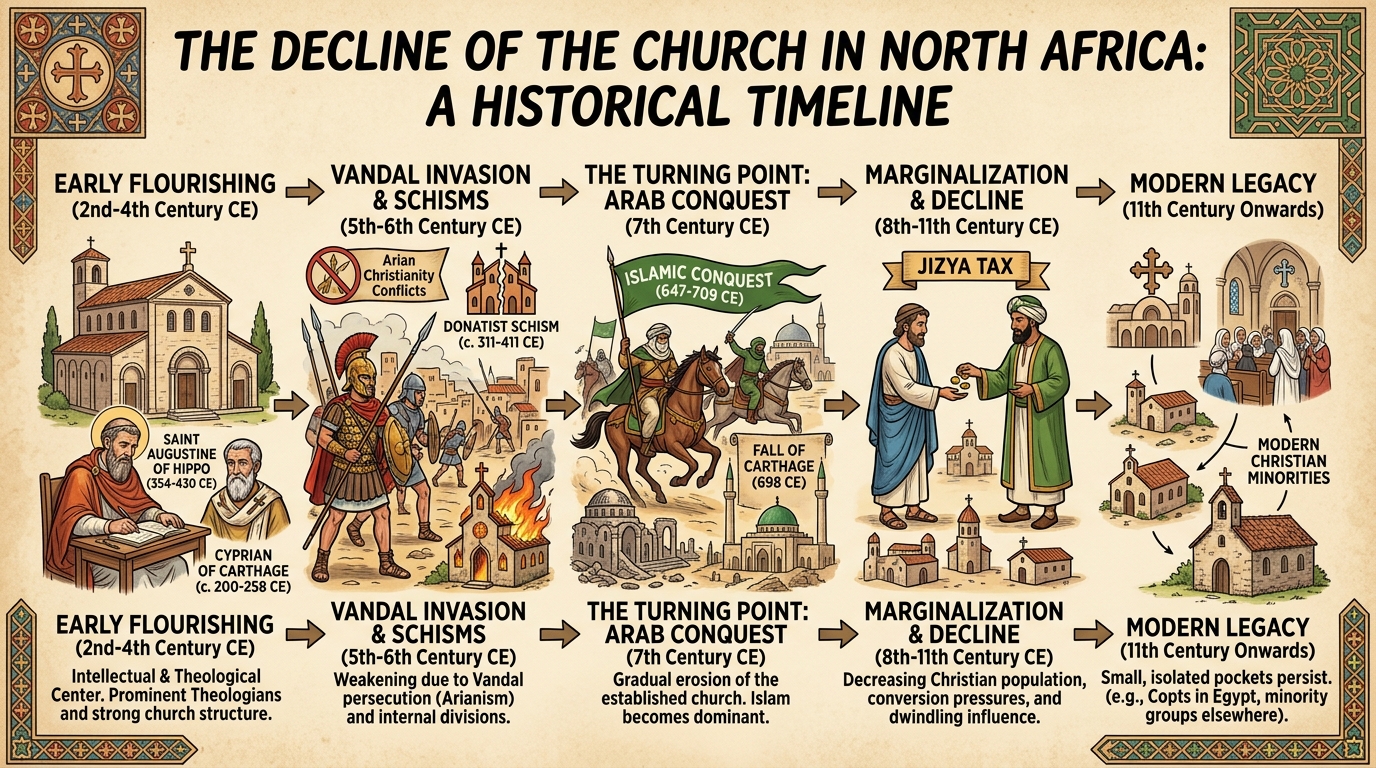
In the year 400 AD, North Africa was the most intellectually powerful Christian region on earth.
Not Europe. Not the Middle East. Africa.
The greatest Christian thinkers of that era were African. The most influential theological debates of that century were happening on African soil. The church that was shaping global Christianity — defining its doctrines, producing its scholars, defending its faith against emperors and heretics — was an African church.
And by the year 1000 AD, it was essentially gone.
Not weakened. Not struggling. Gone.
A church that was once the strongest in the world collapsed so completely that today most Nigerian Christians do not even know it existed. And that collapse — how it happened, why it happened, and what made it possible — is one of the most important lessons that Nigerian Christianity in 2026 needs to sit down and study seriously.
Because the factors that destroyed North African Christianity are not as far from Nigeria’s situation as we would like to believe.
What North Africa Actually Was
Before we talk about the collapse we need to properly appreciate what was there. Because most people have no idea.
Tertullian was born in Carthage — present day Tunisia — around 155 AD. He became one of the first major Christian writers in Latin and gave the church vocabulary it still uses today. The word Trinity. The concept of three Persons in one God. The word Sacrament. These terms that Nigerian Christians use every Sunday came from an African man writing in North Africa in the second century.
Cyprian of Carthage became bishop of his city in the third century during a period of brutal Roman persecution of Christians. He wrote foundational texts about the nature of the church and the meaning of Christian unity that shaped church thinking for centuries. He died a martyr — beheaded by Roman authorities in 258 AD for refusing to renounce his faith.
Athanasius of Alexandria in Egypt is one of the most remarkable figures in all of Christian history. He spent his entire life defending the full divinity of Jesus Christ against the Arian heresy — which argued that Jesus was a created being, not fully God.
Roman emperors supported the Arian position and exiled Athanasius five times for opposing them. He refused to compromise every single time. The phrase that describes him is Athanasius contra mundum — Athanasius against the world. And ultimately he was vindicated. The orthodox position he defended became the foundation of Christian doctrine on the nature of Christ.
And then there is Augustine of Hippo. Born in present day Algeria in 354 AD. His Confessions — a searingly honest account of his spiritual journey — is still one of the most widely read books in human history. His City of God shaped Western political thought for a thousand years.
His theology influenced Catholic, Protestant, Reformed, and evangelical Christianity more than any single thinker after the Apostle Paul.
These were not minor figures from the edges of the Christian world. They were the center. They were the giants on whose shoulders global Christianity still stands.
And their church collapsed.
The First Crack — Division From Within
The beginning of North African Christianity’s decline traces to a controversy that started in the early fourth century. And I want you to notice something as I tell this story. The first damage came not from outside. It came from inside.
During the Roman persecution of Christians under Emperor Diocletian in 303 AD, some church leaders surrendered their scriptures to Roman authorities rather than face death. These people were called traditores — and that Latin word is where the English word traitor comes from.
When the persecution ended, a faction of North African Christians led by a man named Donatus refused to accept that these lapsed leaders could be restored to ministry. Their position was that the church must be pure. That sacraments performed by unworthy priests were invalid. That communion with Rome — which had accepted the lapsed leaders back — was itself corrupt.
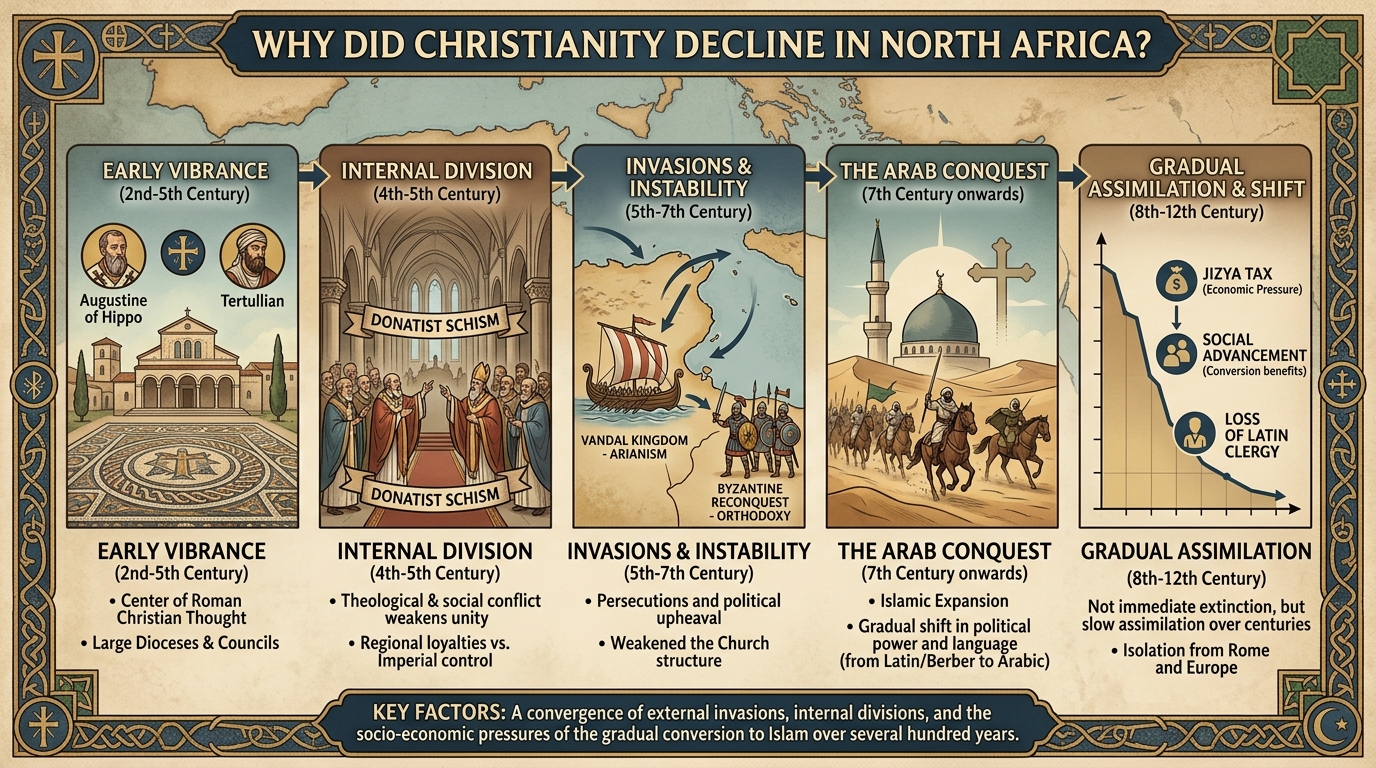
The Donatist church split from the main church and became for a time numerically larger in North Africa than the catholic universal church. The split was never fully healed. It created a permanently divided Christianity in the region — weakening both sides and preventing the unified witness that might have better survived what was coming.
Augustine spent years of his ministry trying to reconcile the Donatists. He largely failed. The division outlasted him.
Nigerian Christianity has thousands of denominations that cannot agree, cannot cooperate, and sometimes actively undermine each other. I am not saying this to be harsh. I am saying it because the Donatist story shows where that road leads.
The Political Disasters
Political catastrophe came in two waves.
The Vandals were a Germanic people who crossed from Spain and conquered North Africa between 429 and 439 AD. They were Christian — but of the Arian variety that Athanasius had spent his life opposing. The Vandals persecuted Nicene Christians aggressively. Bishops were exiled. Churches were seized. The institutional life of the church was severely disrupted over decades.
The Byzantine Empire reconquered North Africa in 533 AD and Christianity experienced a partial recovery. But the damage was already significant. Decades of disruption had weakened the church’s capacity to train leaders and maintain its organizational memory.
Then came Islam.
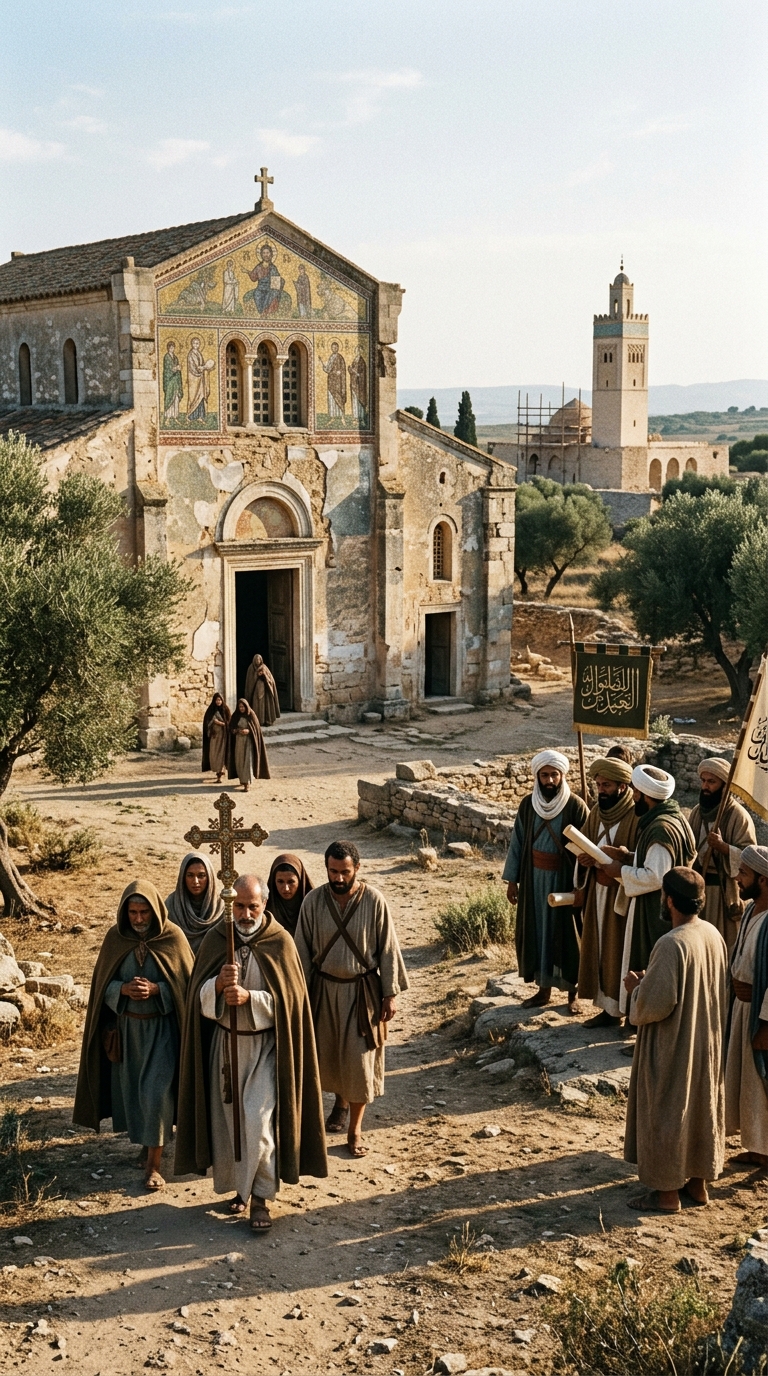
Arab armies swept across North Africa beginning in the 640s AD. Within a relatively short period the political order that had protected and patronized Christianity disappeared.
The new Islamic rulers did not immediately destroy Christianity but they taxed it, restricted it, and provided no social or economic incentive to convert to it.
Over generations as the advantages of being Christian disappeared and the advantages of being Muslim increased, conversion happened steadily and quietly.
Within a few centuries what had been the greatest Christian church in the world was reduced to a scattered remnant.
The Internal Weaknesses That Made Collapse Possible
But here is what I want you to understand most carefully.
External pressure alone does not explain the collapse. Christianity survived worse pressure elsewhere. The Coptic Church in Egypt survived the Arab conquest and is still there today — ancient, continuous, and alive.
Ethiopian Christianity survived centuries of Islamic pressure and not only survived but thrived. It has one of the oldest continuous Christian traditions on earth.
North African Christianity collapsed partly because of internal weaknesses that the external pressure simply exposed.
It was concentrated in cities and among elites. Christianity in North Africa was strongest in urban centers — Carthage, Alexandria, Hippo. The rural Berber populations who made up the majority of North Africa had been far less thoroughly evangelized. When the cities fell or converted the rural base was too thin to sustain the faith.
It was conducted in Latin and Greek rather than in the languages of ordinary people. The educated elite understood Latin and Greek. Ordinary Berber people did not. This meant there were no scriptures in the people’s own language, no liturgy they could fully understand, no theological tradition they could access directly. When the elite disappeared or converted, ordinary people had nothing to hold on to.
Compare this to Egypt. The Coptic Church survived partly because it had translated everything into Coptic — the language of ordinary Egyptians.
The Ethiopian church survived partly because it had its own ancient Ge’ez liturgical tradition rooted in local culture and accessible to local people.
Roots matter. Deep roots in the language and culture of ordinary people matter more than the brilliance of a few great theologians.
The Lessons Nigeria Cannot Afford to Ignore
I want to be direct now because this is the part that matters most.
Nigeria has one of the largest Christian populations on earth. The church here is massive, loud, globally influential, and growing. It is easy to look at that size and feel secure.
North African Christianity was the largest, most intellectually sophisticated Christian community in the world. Size did not save it.
Here are the specific lessons that North Africa’s story puts directly in front of Nigerian Christianity.
Internal division is lethal over time. The Donatist schism weakened North African Christianity for over a century before the external pressures finished the work.
Nigerian Christianity’s fragmentation into thousands of competing, feuding, mutually suspicious denominations is not a sign of spiritual vitality. It is a vulnerability that external pressure can exploit.
Christianity must go deep into every community and language. If Nigerian Christianity remains in practice a religion of the urban educated class — if rural communities and minority language groups are reached superficially rather than deeply — the roots are not deep enough to hold under sustained pressure.
The church must produce serious thinkers, not just successful preachers. North African Christianity survived as long as it did partly because of the intellectual depth of people like Augustine and Athanasius. A church without serious theological thinking is a church that cannot defend itself against serious challenges. Nigeria needs more of both.
Dependence on political protection is dangerous. North African Christianity became comfortable with imperial support. When that support disappeared the church did not know how to survive without it. Nigerian Christianity’s close relationship with political power is something to watch carefully.
 FAQs
FAQs
Q: Is there any Christian community in North Africa today? A: Yes but very small. The Coptic Church maintains a presence in Egypt. There are small Christian communities in Tunisia, Algeria, Morocco, and Libya consisting mostly of sub-Saharan African migrants and a small number of local converts. Indigenous North African Christianity as a mass movement does not exist.
Q: What exactly was the Donatist heresy? A: Donatism was the belief that the validity of sacraments depended on the moral purity of the minister performing them. The mainstream church held that sacraments were valid regardless of the minister’s personal holiness because their power came from Christ, not from the minister. The dispute sounds technical but it tore the North African church apart for over a century.
Q: Could North African Christianity have survived? A: Historians genuinely debate this. Some argue the combination of political upheaval and Islamic expansion made collapse inevitable. Others point to the Coptic and Ethiopian examples as proof that survival was possible — with deeper indigenous roots, translated scriptures, and stronger rural evangelization.
Q: Does Islam’s growth in parts of Nigeria threaten Christianity? A: Nigeria has one of the most active Christian-Muslim frontiers in the world. Historical examples like North Africa suggest that the church’s internal response to this challenge matters far more than the external pressure itself. Division, shallow roots, and dependence on political protection are more dangerous than Islam. A church that is deeply rooted, genuinely united, and intellectually serious can withstand enormous pressure. North Africa shows what happens when those things are missing.
North Africa was once the heart of global Christianity.
Its collapse was not inevitable. It was the product of specific choices, specific weaknesses, and specific failures that accumulated quietly over time until the pressure came and there was nothing left to hold.
Nigeria is not North Africa. The situations are different in important ways. But Nigeria is not immune to the patterns that North Africa illustrates so clearly.
Knowing what happened there — and why — is part of the wisdom that the African church owes itself. Those who do not learn from history, as the saying goes, are condemned to repeat it.
Nigerian Christianity is too important, too alive, and too full of potential to repeat that particular history.
Written for Networknewss.com.ng | History & Heritage