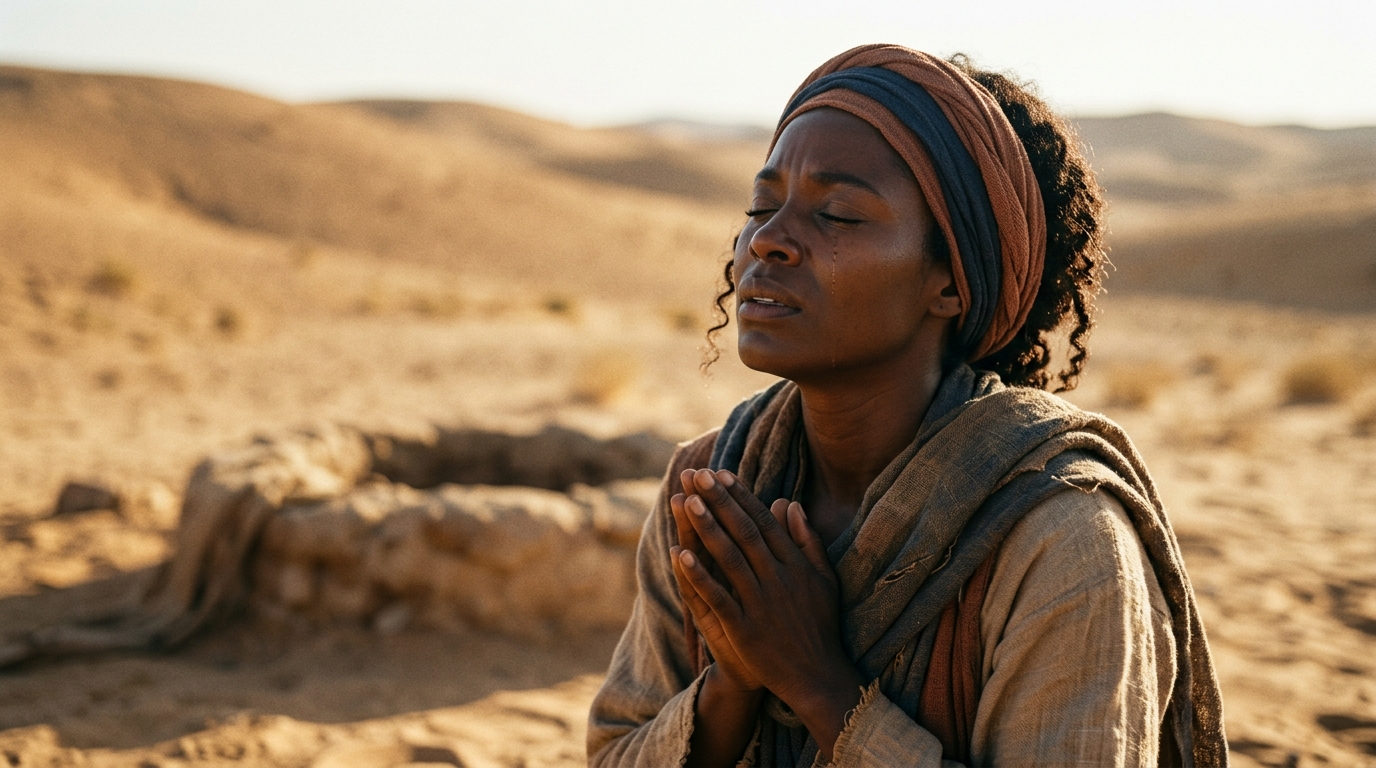
There is a woman in the Bible who did something that very few people in all of scripture ever did.
She gave God a name.
Not a title. Not a description. A personal name, drawn from her own direct encounter with him, in a desert, alone, with no priest present, no temple nearby, no prophet to mediate, no religious system to validate what was happening to her.
She was not Jewish. She was not one of the patriarchs. She was not a king or a general or a celebrated figure in Israel’s story.
She was an Egyptian woman. A slave. A person whom the world of her time considered to have no standing, no voice, and no claim on the attention of any God, least of all the God of Abraham.
And yet.
God found her first.
That is the story of Hagar. And it is one of the most extraordinary, most unsettling, and most quietly powerful stories in the entire Bible. It is also, without any stretch, an African story. And Africa has never fully claimed it.
Until now.
Who Was Hagar and Where Did She Come From
Before we go into what happened to Hagar, we need to establish something that most Sunday school lessons skip entirely.
Hagar was Egyptian.
Genesis 16:1 states it plainly. “Now Sarai, Abram’s wife, had borne him no children. But she had an Egyptian slave named Hagar.”
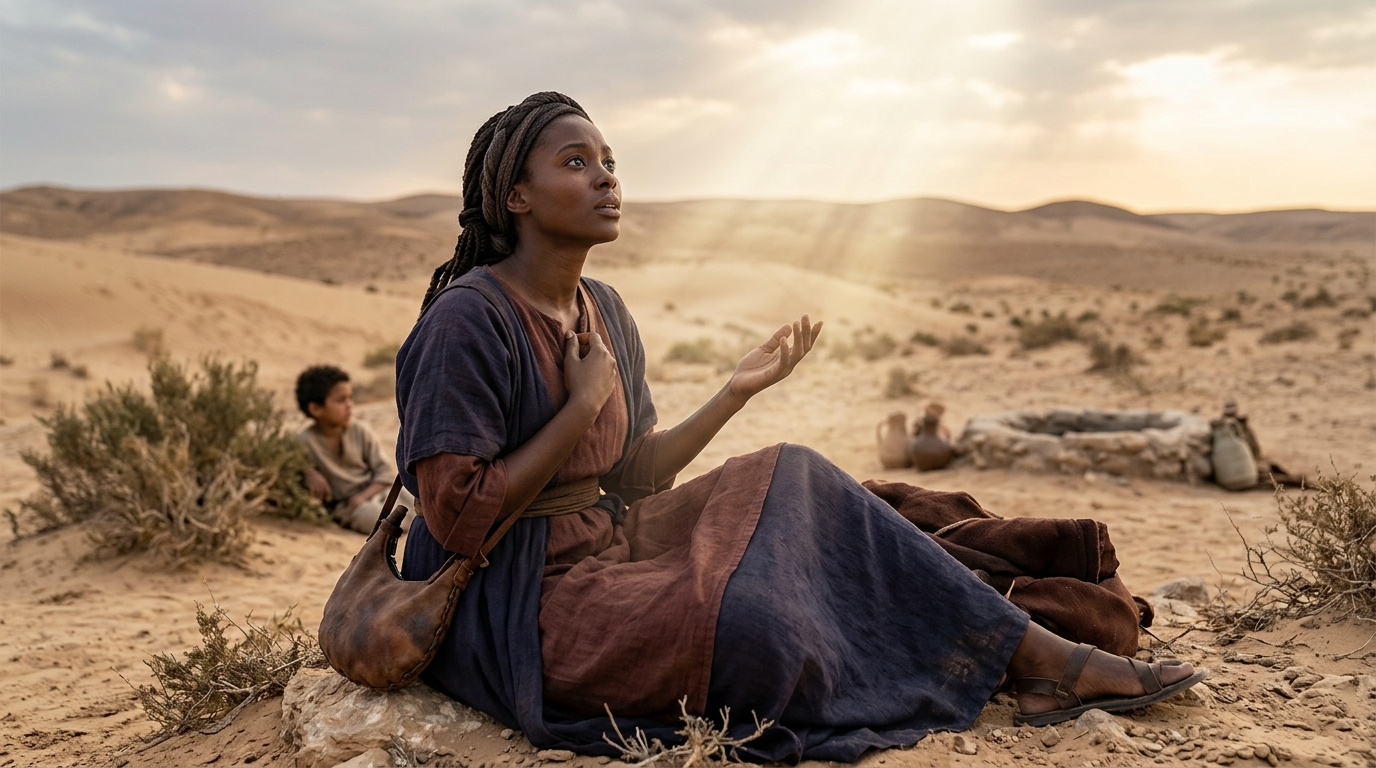 Egypt is in Africa. This is not a controversial geographical claim. The Nile Delta, the pyramids, the ancient civilization that shaped the entire ancient world, all of it sits on the African continent. When the Bible says Hagar was Egyptian, it is saying she was African.
How did an Egyptian woman end up as a slave in Abraham’s household? The Bible does not say explicitly, but the context of Genesis gives us a strong clue.
In Genesis 12, Abraham and Sarah traveled to Egypt during a famine. Pharaoh, impressed by Sarah’s beauty, took her into his household and gave Abraham gifts in exchange, including male and female slaves.
Most biblical scholars believe Hagar was among the Egyptian slaves Abraham received during that Egyptian visit.
Think about what that means for a moment.
Hagar did not choose to be in Abraham’s household. She was taken. She was property, acquired during a transaction between powerful men who never asked what she wanted.
She was brought out of her homeland, away from her people, her culture, her language, her gods, into a foreign household where she had no power and no voice.
She was displaced before her story even began. And yet the most remarkable chapter of that story was still ahead of her.
The Plan That Went Wrong
Sarah had been waiting for a child for years. Decades. The promise God had made to Abraham about descendants as numerous as the stars had not yet materialized in the form of a son. Sarah was old. Time, by any human calculation, had run out.
So Sarah did something that made complete sense within the customs of her time and culture, even if it feels deeply uncomfortable to modern readers.
She gave Hagar to Abraham as a secondary wife, a surrogate, so that Hagar could bear a child on Sarah’s behalf.
This practice, known in ancient Near Eastern law codes, was not unusual.
A barren wife could give her slave to her husband, and the child born from that union would legally belong to the wife.
Hagar had no say in this arrangement. She was given. She was used. She was, as Genesis 16:4 notes almost clinically, taken by Abraham as a wife.
And then everything became complicated in ways that nobody anticipated.
Hagar conceived. And the moment she knew she was pregnant, something shifted inside her. Genesis 16:4 says that when she knew she had conceived, “she began to despise her mistress.”
That word despise is worth sitting with. The Hebrew word is qalal, and it means to treat as light or contemptible, to no longer regard with proper weight or respect. Hagar, who had been powerless her entire life in this household, suddenly had something Sarah did not have. She was carrying Abraham’s child. And apparently she let Sarah know it.
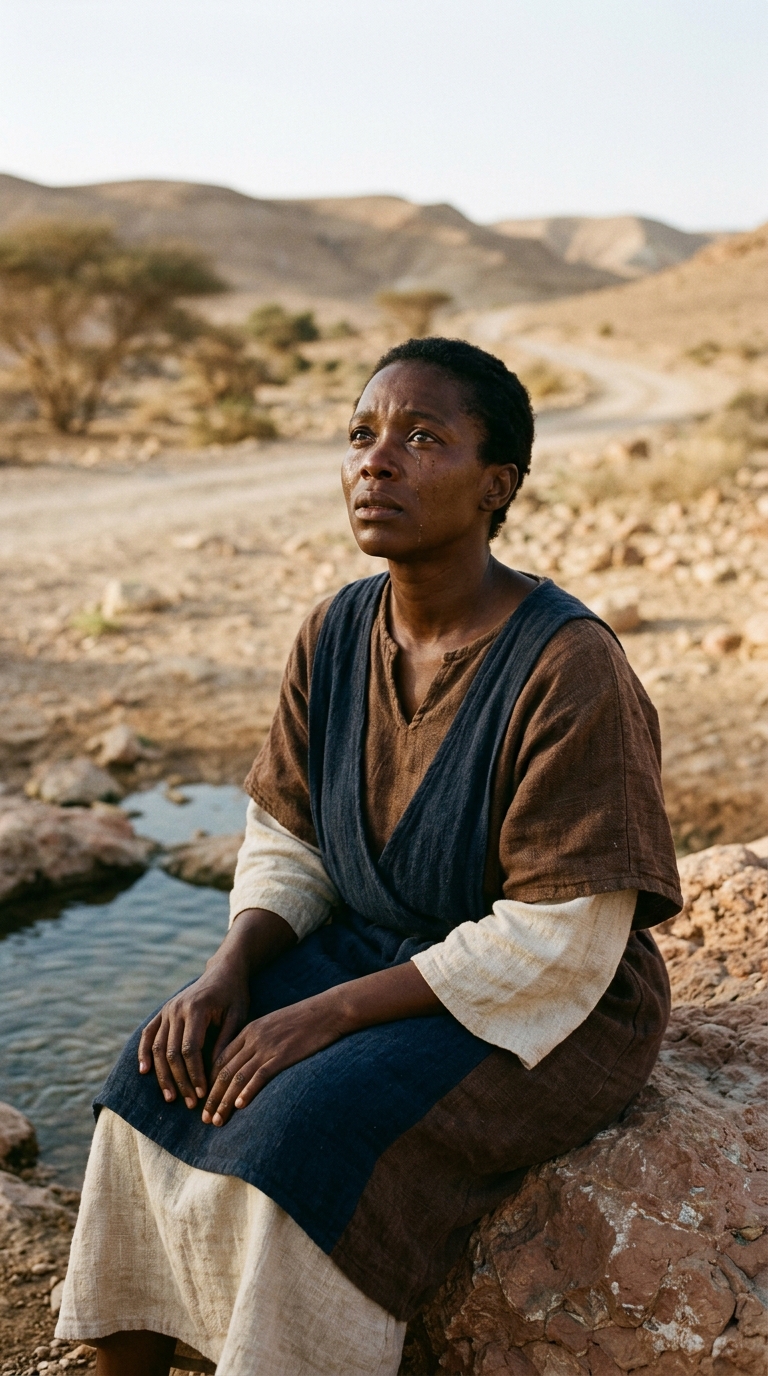 What happened next was brutal. Sarah complained to Abraham. Abraham, in one of the less impressive moments of his life, essentially handed Hagar back to Sarah’s authority and said do whatever you want with her. And Sarah treated Hagar harshly enough that Hagar ran away.
Into the desert. Alone. Pregnant. With nowhere to go and no one to help her.
And that is where God showed up.
The Desert Encounter That Changed Everything
Genesis 16:7 contains one of the most understated and yet electrifying sentences in the entire Bible.
“The angel of the Lord found her near a spring in the desert.”
Found her.
Not found Abraham. Not found Sarah. Not found the people who had made promises and received covenants and been called and chosen.
The Egyptian slave woman, alone in the wilderness of Shur, sitting by a spring with nowhere to go and a child growing inside her that nobody seemed to want except as a legal instrument.
The angel of the Lord, which many biblical scholars understand as a manifestation of God himself rather than a created angel, spoke to Hagar directly. He called her by name. He knew exactly who she was and exactly what had happened to her.
He asked her two questions. Where have you come from? And where are you going?
The first question she answered honestly. She said she was running from Sarah.
The second question she could not answer.
She did not know where she was going. She had no destination. She was just running away from pain.
And then God told her something that must have been almost impossible to hear.
Go back.
Go back to Sarah. Submit to her. Return to the household you fled. This is not the end of your story.
But alongside that instruction came a promise so specific and so personal that it could not be mistaken for a general theological principle.
God told Hagar that she would have a son.
That she should name him Ishmael, which means God hears, because God had heard her misery.
That this son would be a wild man whose hand would be against everyone, and that he would live in hostility toward all his brothers, but that he would live, and that his descendants would be too numerous to count.
God saw Hagar.
God heard Hagar.
God knew her name, her pain, her past, and her future. God gave her a specific promise about her specific child in her specific situation.
And then Hagar did something that nobody else in the Bible does.
The Name Nobody Talks About
Genesis 16:13 is one of the most remarkable verses in the entire Old Testament.
“She gave this name to the Lord who spoke to her: ‘You are the God who sees me,’ for she said, ‘I have now seen the One who sees me.'”
In Hebrew, the name she gave God was El Roi. The God who sees.
Hagar named God.
Let that land for a moment. Throughout the Bible, God reveals his own names. Yahweh. El Shaddai. Elohim. Adonai.
These are names God gives himself or names established through divine self-revelation.
Human beings do not typically name God. They receive his name. They call on his name. They proclaim his name.
But Hagar named him. From what she had personally witnessed in the desert. The God who sees me.
She was the first person in scripture to give God a name from personal encounter.
And she was an African woman, a slave, a person the religious and social systems of her world had assigned zero spiritual standing.
God apparently disagreed with that assignment.
The Second Time God Showed Up For Hagar
If the Genesis 16 encounter were the only time God met Hagar, the story would already be extraordinary. But it is not the only time.
Years later, after Sarah finally bore Isaac as God had promised, the tension between Sarah and Hagar became unbearable.
Sarah demanded that Abraham send Hagar and Ishmael away.
Abraham was distressed, but God told him to listen to Sarah, reassuring him that Ishmael would also become a great nation.
So Abraham gave Hagar some food and a skin of water, and sent her and her teenage son into the desert of Beersheba. Alone. Again.
The water ran out. Ishmael was dying of thirst.
Hagar, unable to watch her son die, placed him under a bush and walked a distance away and sat down and wept. The grief in that image is almost unbearable.
A mother who could not save her child, sitting just far enough away that she would not have to watch him take his last breath.
And then Genesis 21:17 says something that stops you completely.
“God heard the boy crying, and the angel of God called to Hagar from heaven and said to her, ‘What is the matter, Hagar? Do not be afraid; God has heard the boy crying as he lies there.'”
God heard. The same God Hagar had named El Roi, the God who sees, was also the God who heard. And he heard not Hagar’s weeping but the crying of her son.
Then God opened Hagar’s eyes and she saw a well of water. She filled the water skin and gave Ishmael a drink. And Genesis 21:20 ends this chapter of the story with five words that are worth meditating on for a long time.
“God was with the boy.”
 What Happened to Ishmael
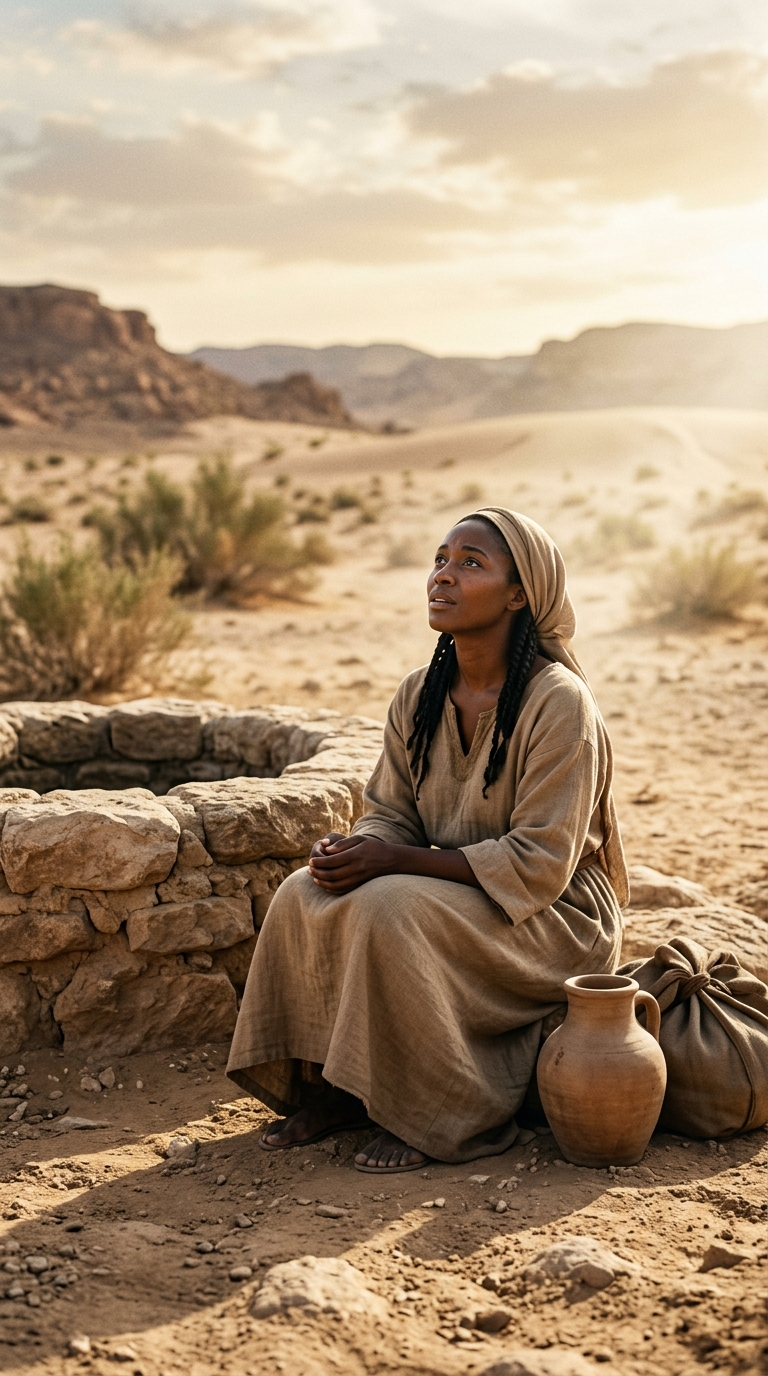
Ishmael grew up in the desert of Paran, which is in the Sinai Peninsula, at the northeastern edge of Africa. He became an archer. His mother found him a wife from Egypt, her own homeland, connecting Ishmael to his African roots through his mother’s deliberate choice.
Genesis 25 tells us that Ishmael had twelve sons who became twelve tribal rulers, a parallel to the twelve sons of Jacob that is surely not accidental. He lived to be 137 years old.
He and Isaac, his half-brother, buried their father Abraham together, a moment of unexpected reconciliation between the two sons of a complicated family.
The descendants of Ishmael are traditionally identified with the Arab peoples.
Islam traces its spiritual lineage through Ishmael and regards him as a prophet.
The connection between Hagar’s son and one of the world’s largest religions is a thread that runs from that desert encounter in Genesis 16 all the way to the present day.
Why Hagar’s Story Belongs to Africa
African Christianity has a complicated relationship with the story of Hagar.
She is sometimes cited in African feminist theology as a figure of solidarity with African women who have experienced displacement, exploitation, and marginalization.
She is sometimes invoked in discussions about slavery and its legacy. She is sometimes used as a symbol of God’s care for those whom human systems have discarded.
All of these readings have genuine merit. But I want to suggest something more fundamental.
Hagar’s story belongs to Africa not just as a symbol but as history. She was an Egyptian woman. Africa.
She encountered God personally and directly in a way that preceded and in some ways paralleled the encounters of the patriarchs themselves.
She gave God a name that is still in the Bible, still in the Hebrew text, still being read in synagogues and churches and theology classrooms around the world, thousands of years after she sat by a desert spring and saw the One who sees.
That name, El Roi, the God who sees, came from an African woman’s mouth.
The next time someone tells you that Africa arrived late to the story of God’s work in the world, tell them about Hagar. Tell them about the Egyptian slave who named God in the desert of Shur before Moses was born, before Israel existed as a nation, before the law was given, before the temple was built.
God saw her first. And she saw him back. And she gave him a name that Africa can be proud of forever.
Written for Networknewss.com.ng | History & Heritage